
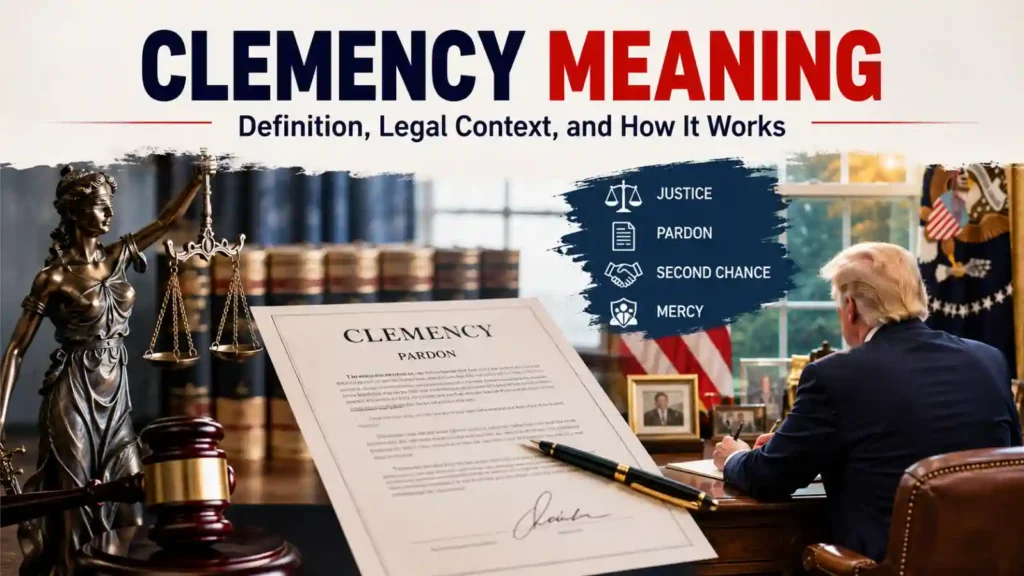
When someone breaks the law, they expect a punishment. But sometimes, a higher authority steps in and offers mercy. That act of leniency is called clemency. The clemency meaning in simple terms is kind or merciful treatment of someone who could be given a harsh punishment.
Clemency isn’t about pretending a crime didn’t happen. It’s an act of grace, a way to show forgiveness and reduce the severity of a penalty. Think of it as a safety valve in the justice system, allowing for compassion when a strict punishment would be unfair or unnecessary. It acknowledges that the law is not always black and white.
This article breaks down the clemency meaning in a clear, straightforward way. We’ll cover its legal definition, how it works in different situations, and what it means for the people who receive it.
What Does Clemency Mean?
Clemency is a powerful concept that shows up in both legal and everyday settings.
The Simple Definition
At its most basic, clemency means leniency or mercy. A judge, governor, or president can decide to be more forgiving than the strict letter of the law requires.
Here are some key points to understand the simple clemency meaning:
- It is a privilege, not a right. No one is automatically entitled to it.
- It is a discretionary act. The person in power can choose to grant it or not.
- It is an act of grace, a gift of forgiveness, not an acknowledgment of innocence.
The Legal Definition
In a legal context, the definition of clemency becomes more specific. It is a power given to a public official, such as a governor or the president, to moderate the harshness of a punishment imposed upon a prisoner.
Legally, the definition is usually divided into several specific types of actions.
Types of Clemency
Clemency isn’t just one thing. The term is an umbrella that covers several different legal actions, each with its own effect.
Pardon
A pardon is perhaps the most well-known type of clemency. It is an official act of forgiveness that releases a person from the legal consequences of a crime.
- Effect: A pardon can restore certain rights that were lost due to a conviction, such as the right to vote or own a firearm.
- Not an exoneration: It’s important to know that a pardon does not mean the person is innocent. It means they are forgiven. The crime is not “forgotten” as it would be with amnesty, but the person is treated more leniently.
Commutation
A commutation is a reduction of a person’s sentence. The person remains guilty of the crime, but their punishment is lessened.
- Example: A person serving a life sentence could have their sentence commuted to a specific number of years, making them eligible for parole.
- Effect: A commutation alters the punishment (the sentence) but does not change the conviction itself.
Reprieve
A reprieve is a temporary postponement of a punishment. It’s a way to delay an execution, for example, to allow time for a review of the case or for the inmate to pursue other legal options.
Amnesty
While often grouped with clemency, amnesty is different. It is a blanket pardon for a group of people for a political offense. It typically looks forward, not backward, and “forgets” the crime altogether. Amnesty is more common for political situations, while clemency is usually considered on a case-by-case basis.
How Clemency Works
The process for granting clemency is complex and depends on the jurisdiction. However, there is a standard framework.
Who Has the Power?
The power to grant clemency is held by the highest executive officials.
- President: The President of the United States has the power to grant clemency for federal offenses.
- Governor: Governors have the power to grant clemency for state offenses.
The Process
Clemency is not a simple or quick process. There is no automatic right to have a request reviewed. The process involves a petition.
- Application: The prisoner, or someone on their behalf, files a formal application for clemency.
- Review: In many cases, a board or authority reviews the application and makes a recommendation. For example, some states require the parole authority to conduct a review before submitting a report to the governor.
- Decision: The final decision rests with the executive official (President or Governor). This is a discretionary act, meaning the official is not bound by the board’s recommendation.
Clemency vs. Pardon
People often use the words “clemency” and “pardon” interchangeably, but they are not exactly the same. Here is a simple breakdown:
- Clemency is the broad category or concept. It’s the general term for mercy or leniency.
- Pardon is a specific type of clemency. It’s one way that mercy is shown.
Think of it this way: Clemency is the umbrella, and a pardon is one type of rain protection under it.
This table clarifies the key differences:
| Feature | Clemency | Pardon |
| Meaning | The general act of showing mercy or leniency. | An official act of forgiveness for a crime. |
| Effect | Can refer to any act of leniency, including reducing a sentence (commutation) or delaying a punishment (reprieve). | Restores rights and removes the legal stain of a conviction. |
| Outcome | The punishment is lessened, but the conviction often remains. | The conviction is forgiven, often restoring civil rights. |
| Categorization | Clemency is the “category.” | Pardon is an “item” under the clemency category. |
What Clemency Is Not
To fully grasp the clemency meaning, it helps to know what it is not.
- Not a Get-Out-of-Jail-Free Card: Clemency is not automatic. It is a rare and extraordinary act that is carefully considered.
- Not Exoneration: Clemency does not mean the person is innocent. It means the system is choosing to be forgiving. The conviction remains a matter of public record unless a separate legal action, like a pardon, expunges it.
- Not a Right: It is a privilege, and a person who receives it is being shown a favor, not receiving what they are owed.
- Not a Minimization of the Crime: Granting clemency doesn’t mean the crime wasn’t serious. It often means other factors (like good behavior, remorse, or unfairness in the original sentence) are being taken into account.
Why Clemency Matters
Clemency serves as a critical check on the justice system. It provides a way to correct injustices that the legal system might not be able to address on its own.
1. Correcting Errors and Injustices
Sometimes, a person is convicted based on flawed evidence, or a sentence is disproportionately harsh. Clemency can be a last resort to correct these issues. In 2003, for example, Illinois Governor George Ryan granted clemency to all 160 death row inmates, citing a deeply flawed and corrupted legal process.
2. Allowing for Human Factors
The law is rigid, but people and their circumstances are not. Clemency allows officials to consider factors that the legal system might not, such as an offender’s age, health, or remorse. This is a key part of the clemency meaning it reintroduces humanity into the legal process.
3. Promoting Second Chances
Clemency can offer a second chance to people who have truly rehabilitated themselves. It provides an incentive for good behavior and helps to reintegrate people into society as productive citizens.
Examples of Clemency in Action
Real-world examples help to clarify the clemency meaning and its impact.
- Federal Clemency: In January 2025, President Trump granted commutations to nine defendants connected to the events of January 6, 2021. This is a clear example of commutation, where their sentences were reduced.
- State Clemency: The Ohio Adult Parole Authority is required to conduct a clemency review 45 days before a scheduled execution. This procedure highlights how clemency plays a role in capital punishment cases.
- Clemency for Non-Violent Offenses: Many grants of clemency are for non-violent, drug-related offenses. For instance, prisoners like Patrick Mensah or Obi Edwin Chukwu had their lengthy sentences reduced due to factors like remorse and the acquisition of vocational skills.
- Granting Pardons: President Bola Ahmed Tinubu approved a list of individuals granted clemency and presidential pardons in Nigeria in October 2025. This included both pardons and commutations of death sentences to life imprisonment.
Common Questions About Clemency
Q: What is the simple clemency meaning?
A: The simple meaning is kindness or mercy shown to someone who could have received a harsh punishment. It is an act of leniency.
Q: What is the difference between a pardon and a commutation?
A: A pardon forgives the crime and restores rights. A commutation reduces the sentence (the punishment), but the person is still considered guilty of the crime.
Q: Does clemency mean the person is innocent?
A: No. Clemency is an act of forgiveness, not a declaration of innocence. It means the punishment has been lessened or forgiven, but the conviction generally stands.
Q: Who can grant clemency?
A: The President can grant it for federal crimes. Governors can grant it for state crimes.
Q: Can a person ask for clemency?
A: Yes, a person can petition for clemency. However, it is a privilege, not a right, and the decision to grant it is entirely at the discretion of the executive official.
Q: Does “clemency” have another meaning?
A: Yes, it can also refer to the mildness of weather, though this usage is less common today. You are more likely to hear “inclement weather” (harsh weather) than “clemency of the weather.”
Similar Words to Clemency
Several words are closely related to clemency. Understanding the nuance can help you use them correctly.
| Word | Meaning | Difference |
| Mercy | Compassion or forbearance shown to an offender. | More general term. Often used in a personal or moral context. Clemency has a more formal, legal tone. |
| Leniency | A lessening of the severity of a punishment. | Very similar to clemency. Leniency often implies a lightening of a specific penalty, while clemency can refer to the broader act of mercy. |
| Pardon | Official forgiveness for a crime. | A specific type of clemency. It does more than reduce a sentence; it forgives the offense. |
| Compassion | Sympathetic pity and concern for the sufferings of others. | The emotion that might lead to clemency. Clemency is the action taken. |
Opposite Words to Clemency
The direct opposite of clemency is severity. Other antonyms include:
- Harshness
- Cruelty
- Ruthlessness
- Inclemency (especially for weather)
Key Takeaways
- Clemency is an act of mercy that reduces or forgives a punishment, often granted by a president or governor.
- It includes pardon (forgiveness of the crime), commutation (reduction of sentence), and reprieve (temporary delay).
- Clemency is a privilege, not a right, and it does not mean the person is innocent. It is an act of grace.
- The word has two main meanings: one legal (mercy), and one related to weather (mildness), though the legal meaning is far more common today.
Conclusion
Clemency represents a critical and humane element within a justice system that is inherently rigid. The clemency meaning goes beyond a simple definition; it is the principle that the law, while necessary, is not absolute. It is the safety valve that allows for mercy, compassion, and a second chance when the strict application of the rules would lead to an unjust outcome.
If it is a pardon, a commutation, or a reprieve, the act of clemency is a powerful tool that reflects a society’s capacity for empathy and forgiveness. It acknowledges that people can change and that the context of a crime can be as important as the act itself. Understanding clemency helps us understand the justice system not just as a machine for punishment, but as a human institution capable of grace.

I am Stephen King an American author known for compelling storytelling. At writemora.com, we value clear, accurate, and reader-focused content inspired by excellence in writing.