
Artists, writers, and musicians have talked about their “muse” for centuries, crediting some person, place, or feeling with sparking their best work. The muse meaning covers two related ideas: a muse is a source of creative inspiration, and “to muse” means to think deeply or reflectively about something, often quietly and without a clear destination in mind.
This guide covers both senses of the word, where “muse” comes from in Greek mythology, how people use it today, and answers to the questions people ask most often. By the end, you’ll know exactly how to use “muse” as a noun and as a verb, and where the word’s rich history comes from.
What “Muse” Means
The simple version: As a noun, a muse is a person, idea, or force that inspires creative work, especially in art, music, or writing. As a verb, “to muse” means to think carefully or reflectively about something, often in a slow, unstructured way.
The fuller picture: The noun form of “muse” describes whatever sparks an artist’s imagination and drives them to create. A muse can be a real person, someone whose presence, personality, or beauty inspires a painter, poet, or musician or something less tangible, like a place, a memory, a mood, or an abstract idea. Historically, the word traces back to specific goddesses believed to inspire different forms of art and knowledge, which gives “muse” a slightly elevated, almost mythic quality even in modern use.
The verb form works differently. “To muse” (often followed by “on” or “about”) means to ponder or reflect thoughtfully, usually in a calm, unhurried way closer to daydreaming with purpose than to focused, deliberate problem-solving.
Origin and History
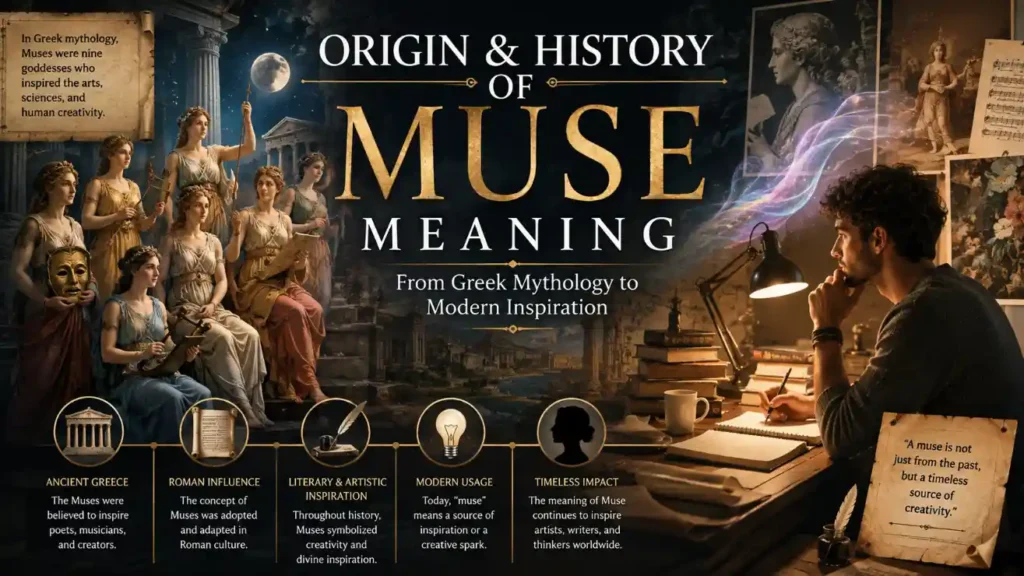
“Muse” comes from Greek mythology, specifically the Muses, a group of goddesses, traditionally numbering nine, believed to inspire and preside over different areas of art, literature, and knowledge, including music, poetry, history, dance, and astronomy. Ancient poets and writers often called on the Muses at the start of a work, asking for inspiration and guidance, a tradition that shaped how later Western writers and artists talked about creative inspiration for centuries afterward.
The word passed into English through Latin and French, retaining its core association with divine or elevated creative inspiration. Over time, “muse” broadened from referring specifically to mythological goddesses into a general term for anyone or anything that inspires creative work, a shift that let the word survive long after most people stopped invoking actual deities before writing a poem.
The verb form, “to muse,” developed alongside this noun sense, drawing on the idea of the quiet, reflective, almost trance-like state associated with genuine creative inspiration thinking deeply, without rushing toward a conclusion.
Different Meanings and Contexts
Muse as a source of inspiration (noun, most common). In art, literature, fashion, and music, a “muse” refers to a person or force that inspires an artist’s work, a famous example being a designer’s muse, whose style or presence shapes an entire collection.
Muse as reflective thinking (verb). “To muse” means to think slowly and reflectively about something, often shown through phrases like “musing on the past” or “she mused about what might have been.”
Mythological reference. In its original context, “the Muses” refers specifically to the Greek goddesses associated with different creative and intellectual pursuits, still referenced today in literature, art history, and classical studies.
Modern branding and naming. Because of its elevated, artistic association, “muse” frequently appears as a brand name, product name, or title for creative projects, magazines, and platforms wanting to evoke inspiration and artistry.
Examples of “Muse” in a Sentence
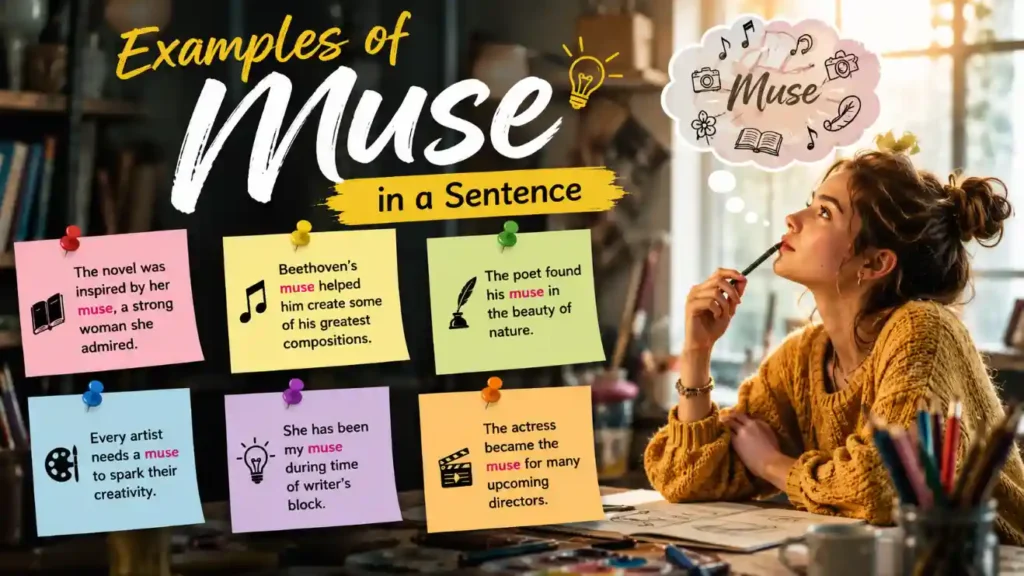
- “The painter credited his wife as the muse behind his most famous portraits.”
- “She often muses about what her life might look like in ten years.”
- “The city itself became a muse for the entire album.”
- “He sat by the window, musing quietly over his morning coffee.”
- “The designer’s longtime muse walked the runway for the final look.”
- “The ancient poet opened his epic by calling on the Muses for inspiration.”
- “I found myself musing on old memories the whole train ride home.”
- “Nature has always been her greatest muse.”
- “The photographer’s muse for the project was an older people fisherman he met on vacation.”
- “He mused aloud about if the plan would actually work.”
How to Use “Muse” Correctly
“Muse” functions as both a noun (a source of inspiration) and a verb (to think reflectively), and context usually makes clear which one applies.
A few usage notes:
- As a noun, pair it with “for” or “behind.” Phrases like “a muse for the collection” or “the muse behind the novel” are natural and common.
- As a verb, pair it with “on,” “about,” or “over.” “She mused on the question,” “he mused about the future,” and “they mused over old photographs” all work naturally.
- Capitalize “Muse” when referring to Greek mythology. Lowercase “muse” fits general, modern usage; capital “Muse” (or “the Muses”) signals the specific Greek goddesses.
- Keep the tone reflective, not rushed. “Musing” implies a slow, unhurried kind of thinking using the verb for quick, decisive thoughts that can feel slightly off.
Common Mistakes to Avoid
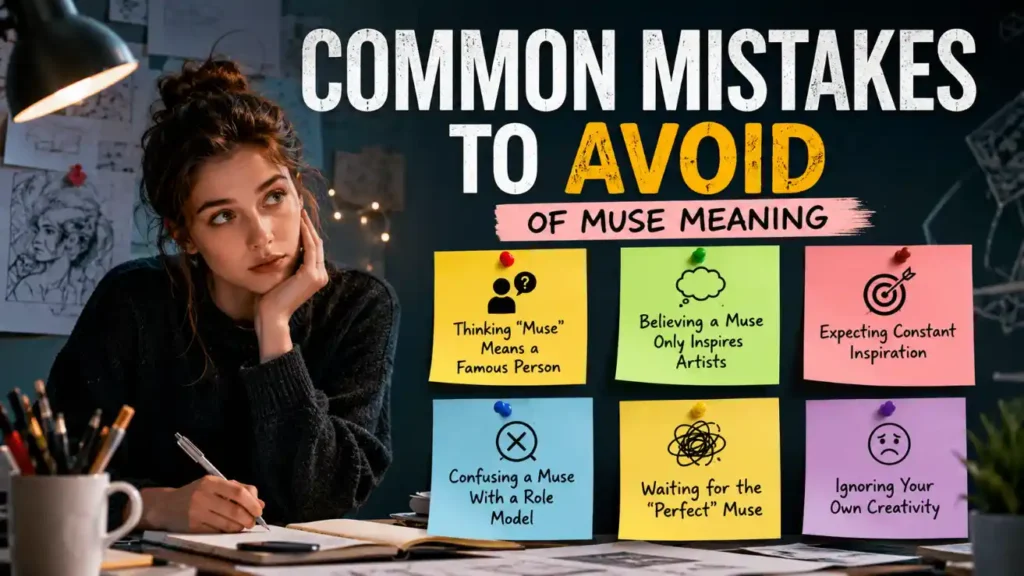
- Confusing “muse” with “amuse.” “Amuse” means to entertain or make someone laugh, an entirely different word despite the visual similarity.
- Using “muse” only as a noun. Many people forget the verb form exists, missing a precise, evocative word for reflective, unhurried thinking.
- Assuming a muse must be a person. While a human muse is common in art history, ideas, places, objects, and abstract concepts can all serve as a muse just as easily.
- Overusing the word in casual writing. Because “muse” carries an elevated, artistic tone, using it too often outside creative or reflective contexts can feel overwrought.
Similar Words and Phrases
| Word | Meaning | How It Differs |
| Inspiration | Something that stimulates creativity or motivation | Broader and more general than “muse,” which often implies a specific source |
| Ponder | To think carefully about something | Close synonym for the verb “muse,” though slightly more deliberate in tone |
| Reflect | To think deeply or carefully | Similar to “muse,” though it can imply more structured or purposeful thought |
| Contemplate | To think about something seriously and at length | Slightly more formal and focused than the dreamier tone of “muse” |
| Daydream | To let the mind wander pleasantly, often away from the present task | Less purposeful than “muse,” which usually centers on a specific topic or question |
Opposite Words and Phrases
| Word | Meaning | Why It’s an Opposite |
| Ignore | To pay no attention to something | Opposite of the deep, reflective attention implied by “muse” |
| Distraction | Something that pulls focus away from a topic | Contrasts with the focused reflection of “musing” |
| Uninspired | Lacking creative motivation or ideas | The direct opposite state to having or drawing on a muse |
| Act impulsively | To act quickly without careful thought | Opposite of the slow, thoughtful quality of “musing” |
Pronunciation
“Muse” is pronounced MYOOZ, rhyming with “views” and “news.” It’s a single syllable.
Quick Facts
| Fact | Detail |
| Meaning (noun) | A source of creative inspiration |
| Meaning (verb) | To think reflectively or ponder |
| Origin | Greek mythology the nine Muses, goddesses of art and knowledge |
| Part of speech | Noun and verb |
| Related word | Amusing (unrelated in modern meaning, despite similar spelling) |
| Common pairing | “Muse for,” “muse behind,” “muse on,” “muse about” |
Frequently Asked Questions
What does “muse” mean?
As a noun, it means a source of creative inspiration. As a verb, it means to think reflectively or ponder something.
Where does the word “muse” come from?
It comes from Greek mythology, referring to the Muses goddesses believed to inspire poetry, music, and other creative and intellectual pursuits.
Can a muse be a person?
Yes, a muse is often a specific person, but it can also be a place, idea, object, or feeling that inspires creative work.
What’s the difference between “muse” and “amuse”?
They’re unrelated words despite looking similar. “Muse” relates to inspiration or reflective thought, while “amuse” means to entertain or make someone laugh.
How do you use “muse” as a verb?
Pair it with “on,” “about,” or “over” for example, “she mused on the question” or “he mused about the future.”
Is “the Muses” always capitalized?
When referring specifically to the Greek mythological goddesses, yes. Lowercase “muse” fits general, modern usage.
What’s a synonym for “musing”?
“Pondering,” “reflecting,” and “contemplating” all work as close synonyms, though each carries a slightly different tone.
How do you pronounce “muse”?
“MYOOZ,” rhyming with “views” and “news.”
Key Takeaways
- As a noun, “muse” means a source of creative inspiration; as a verb, it means to think reflectively.
- The word comes from Greek mythology, specifically the Muses, goddesses associated with art and knowledge.
- A muse doesn’t have to be a person, places, ideas, and feelings can serve the same role.
- “Muse” and “amuse” look similar but mean completely different things.
- Close synonyms include “ponder,” “reflect,” and “contemplate,” each with a slightly different shade of meaning.
Conclusion
“Muse” carries thousands of years of history in a single small word, stretching from ancient goddesses invoked before an epic poem to a modern artist casually naming whatever sparked their latest project. That mythic weight is exactly what gives the word its lasting charm even used casually, it still hints at something a little larger than ordinary inspiration.
The verb form deserves just as much attention as the noun. “Musing” captures a very specific, valuable kind of thinking that is slow, unhurried, and open-ended that’s easy to overlook in a world that mostly rewards quick answers and fast decisions.
Next time something sparks your creativity, or you catch your mind wandering thoughtfully over an old memory, you’ll have exactly the right word for it, one that connects a quiet moment of reflection all the way back to the goddesses ancient poets once called on for inspiration.

I am Olivia Brooks an American editor and content researcher dedicated to creating clear, accurate content. At writemora.com, I help readers to understand words, phrases, and modern language with confidence.