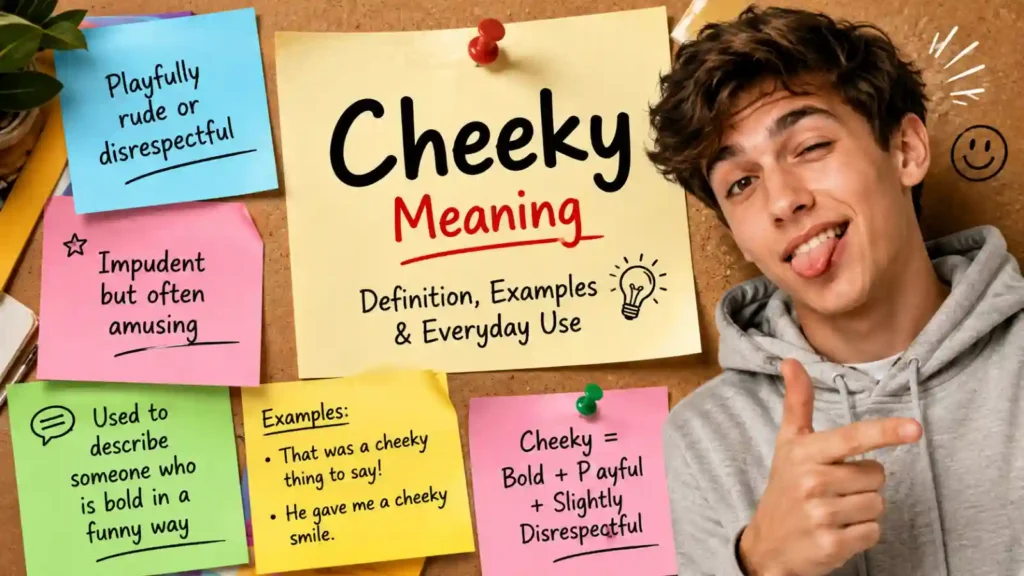
If someone calls you “cheeky,” should you be offended? Probably not. The cheeky meaning sits somewhere between playful and a little bit rude. It’s a word people use when someone is being bold, sassy, or mischievous in a way that’s more charming than actually offensive.
You’ll hear it a lot in British and Australian English, and increasingly in American slang too, thanks to social media. It shows up describing a kid who talks back with a grin, a witty comeback, or even a spontaneous snack you weren’t planning to eat (“a cheeky nap,” “a cheeky pint”).
This guide breaks down exactly what cheeky means, where the word came from, the different ways people use it today, and how to use it yourself without sounding off.
What “Cheeky” Means (Simple Version)
At its core, cheeky describes behavior, speech, or a look that’s a bit disrespectful or bold but in a way that’s playful, funny, or endearing rather than genuinely offensive.
Think of a kid who sticks their tongue out at a teacher and gets a laugh instead of a scolding. That’s cheeky. It’s the difference between rudeness that upsets people and rudeness that makes them smile.
What “Cheeky” Means (Detailed Version)
Cheeky is an adjective used to describe:
- A person’s attitude or personality is someone who’s confident, a little sassy, and not afraid to push boundaries in conversation.
- A specific action or comment, a joke, comeback, or gesture that’s bold or borderline disrespectful but delivered with charm.
- An impulsive or indulgent choice doing something slightly self-indulgent or unplanned, often used self-deprecatingly (“a cheeky takeaway on a Monday night”).
The common thread across all these uses is tone. Cheeky behavior breaks a small social rule: talking back, being overly familiar, indulging when you “shouldn’t” but it does so with humor and warmth, not malice. That’s what separates cheeky from words like rude, insolent, or disrespectful, which carry a harsher, more negative charge.
Origin & History
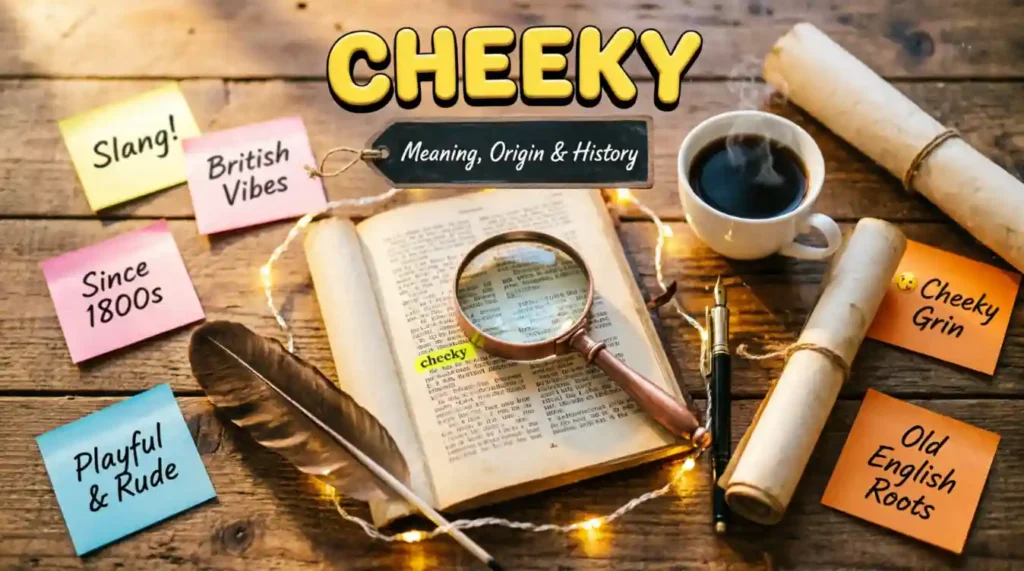
The word cheeky comes from cheek, an old slang term for impudence or nerve. Referring to someone’s “cheek” as a stand-in for boldness or nerve dates back centuries in English, tied to the literal cheek (face) as the part of the body associated with expressions of defiance or sass.
The adjective form, cheeky, became common in British English by the 1800s to describe someone being impertinent or forward, but usually in a way that was more amusing than genuinely threatening. Over time, especially through British sitcoms, tabloids, and everyday speech, the word softened even further; today it leans more toward “playfully bold” than “disrespectful.”
Exact dates and first recorded uses vary depending on the source, but the general trajectory from “cheek” meaning nerve, to “cheeky” meaning playfully impudent is well established in British English history.
Different Contexts and Meanings
Cheeky shows up in a few distinct flavors depending on where and how it’s used.
British and Australian Everyday Slang
This is the world’s home turf. In the UK and Australia, cheeky is used constantly and casually:
- “He gave a cheeky grin before running off.”
- “That was a cheeky question to ask in an interview.”
- “Fancy a cheeky coffee before work?”
Here, cheeky almost always carries affection; it’s rarely a real insult.
Internet and Social Media Slang
Cheeky has picked up momentum online, especially in meme culture and TikTok/Instagram captions, often used ironically or for comedic self-deprecation:
- “Just had a cheeky Nando’s.”
- “Sent a cheeky text I probably shouldn’t have.”
In this context, it signals “I know this is a bit much, but I’m doing it anyway” a wink to the audience.
Describing Children or Pets
Parents and pet owners often use cheeky affectionately to describe playful misbehavior:
- “My daughter gave the cheekiest response to her teacher.”
- “The dog gave me a cheeky look before stealing the sock.”
Flirtatious or Suggestive Tone
Cheeky can also describe flirty, slightly risqué humor or comments, without being explicitly sexual:
- “He sent her a cheeky wink across the room.”
- “It was a cheeky joke, but everyone laughed.”
Examples of “Cheeky” in a Sentence
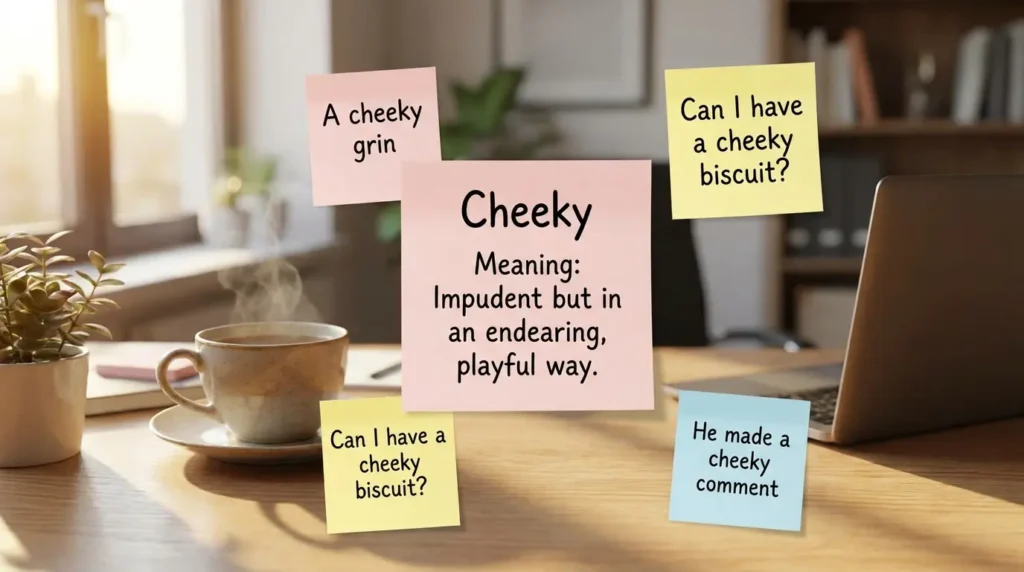
- “She gave a cheeky smile and changed the subject.”
- “That’s a cheeky price for a cup of coffee.”
- “He made a cheeky remark about the boss’s tie.”
- “We’re going for a cheeky drink after work.”
- “The toddler shot her mom a cheeky grin before hiding the remote.”
- “It was a cheeky move, skipping the line like that.”
- “Don’t be cheeky with me, young man.”
- “That ad has a cheeky sense of humor.”
- “She asked a cheeky follow-up question the presenter wasn’t ready for.”
- “He’s got a cheeky streak, always joking around with the staff.”
How to Use “Cheeky” (Grammar & Context)
Cheeky is an adjective, so it modifies nouns directly or follows a linking verb.
- Before a noun: a cheeky comment, a cheeky grin, a cheeky text
- After “to be”: He was being cheeky.
- As an adverb form: cheekily “She cheekily winked at the camera.”
- Comparative/superlative: cheekier, cheekiest “That’s the cheekiest thing you’ve ever said.”
It works best describing tone or attitude, not describing something that’s genuinely cruel or hostile. Using it for something truly offensive tends to sound like you’re minimizing bad behavior.
Common Mistakes
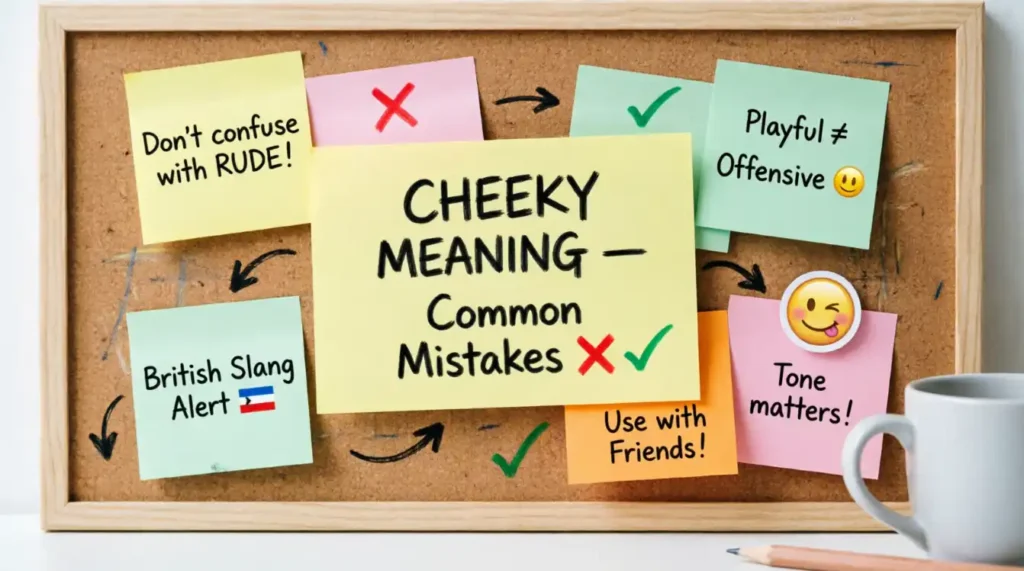
- Using it for genuine rudeness. Cheeky implies charm. If the behavior is actually hurtful or disrespectful with no playful edge, “rude” or “disrespectful” fits better.
- Assuming it’s always British. While it originated in and is most associated with British English, it’s now widely understood and used in American and Australian English too.
- Treating it as a strong insult. Calling someone cheeky is rarely meant as a real criticism context almost always signals it’s lighthearted.
- Overusing it in formal writing. Cheeky is casual and conversational; it doesn’t belong in formal or professional documents.
Similar Words
| Word | Meaning | Difference from “Cheeky” |
| Sassy | Bold, spirited, often with attitude | More about confident attitude; less about testing boundaries |
| Cheeky (chirpy) | Lively, upbeat | Focuses on energy/mood, not boldness |
| Impudent | Disrespectful, lacking manners | Carries a more negative, formal tone |
| Playful | Fun-loving, lighthearted | Broader term, doesn’t imply pushing limits |
| Sassy-mouthed | Talking back with attitude | More specifically about speech, often used for kids |
Opposite Words
| Word | Meaning |
| Respectful | Showing proper regard for others |
| Meek | Quiet, submissive, unassertive |
| Polite | Courteous and well-mannered |
| Reserved | Restrained, not bold or forward |
Pronunciation
Cheeky is pronounced CHEE-kee (/ˈtʃiːki/) two syllables, stress on the first.
Quick Facts
| Fact | Detail |
| Part of speech | Adjective |
| Root word | “Cheek” (slang for nerve/impudence) |
| Region of origin | British English |
| Tone | Playful, mischievous, mildly bold |
| Adverb form | Cheekily |
| Common contexts | Casual conversation, humor, describing kids/pets, social media captions |
Frequently Asked Questions
Is “cheeky” a compliment or an insult?
It’s usually a lighthearted compliment or neutral observation, not a real insult. It suggests someone is being playfully bold rather than genuinely disrespectful.
Is “cheeky” British slang?
Yes, it originated in British English and is still most closely associated with the UK, but it’s now widely used and understood in Australian and American English as well.
What does “a cheeky one” mean?
“A cheeky one” usually refers to an indulgent, unplanned treat or drink like “a cheeky pint” or “a cheeky snack” , something small you’re enjoying a bit guiltily.
Can “cheeky” be used for adults, not just kids?
Yes. While it’s often used to describe children’s playful misbehavior, it applies just as often to adults being witty, flirty, or bold in conversation.
What’s the difference between “cheeky” and “sassy”?
Cheeky leans toward playful boundary-pushing, often with a grin. Sassy is more about confident, spirited attitude, and doesn’t always involve pushing limits.
Is “cheeky” appropriate to use at work?
In casual workplace conversation, it’s generally fine and often reads as friendly. In formal writing or serious professional contexts, it’s better to avoid it.
Does “cheeky” have a negative meaning in any context?
Occasionally, especially in older or more formal usage, “cheeky” can lean closer to “impudent” or “disrespectful.” Tone and context usually make the difference clear.
What does “cheeky” mean in British slang specifically for food or drinks?
It signals a small, self-indulgent treat you weren’t necessarily planning on like “a cheeky Nando’s” or “a cheeky dessert.”
Key Takeaways
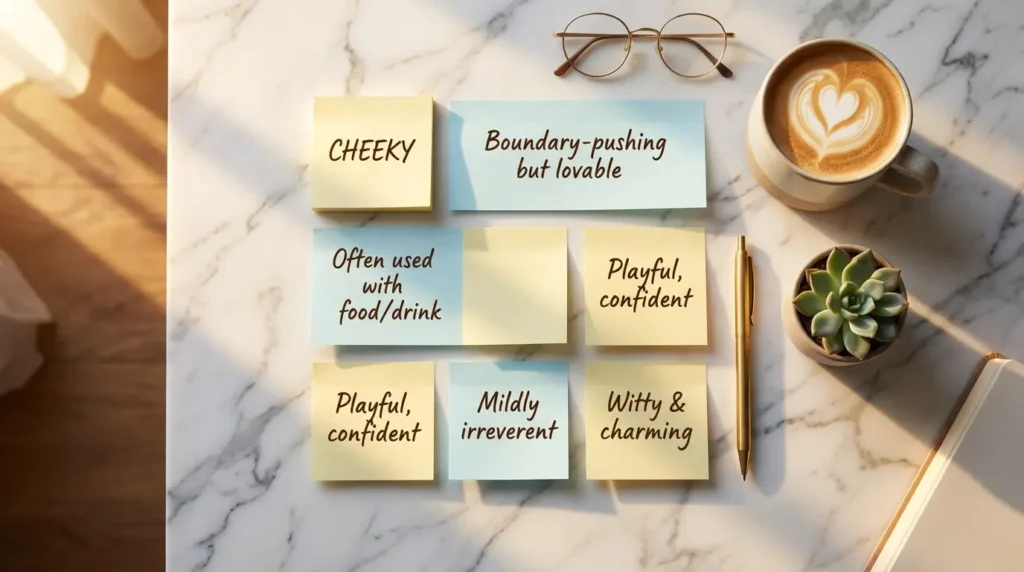
- Cheeky means playfully bold, sassy, or mischievous not genuinely rude or offensive.
- It comes from the word “cheek,” historically used to mean nerve or impudence.
- It’s most associated with British English but is now common in Australian and American slang too.
- Context matters: cheeky implies charm, so it’s the wrong word for behavior that’s actually hurtful.
- Common uses include describing people, comments, jokes, and small indulgent choices (“a cheeky drink”).
- The adverb form is cheekily, and the comparative/superlative forms are cheekier and cheekiest.
Conclusion
So, what does cheeky mean? At its heart, it’s a word for boldness with a wink behavior that pushes a small boundary but does it with enough charm to get away with it. Whether you’re describing a witty comment, a mischievous kid, or your own guilty-pleasure snack run, cheeky captures that specific mix of playful and a little bit naughty.
What makes the word so useful is its flexibility. It can soften a comment about someone’s boldness (“cheeky” instead of “rude”), add warmth to a description of a child’s antics, or turn a small indulgence into a shared joke (“a cheeky dessert”). Few words manage to carry both mild disapproval and genuine affection at the same time and that balance is exactly why cheeky has spread so far beyond its British roots.
The best way to get comfortable with it is to notice how native speakers use it in context, sitcoms, social captions, everyday conversation and pay attention to tone rather than trying to memorize a strict definition. Once the tone clicks, the word becomes easy to reach for. Next time you hear it, you’ll know exactly what the speaker is going for and you can use it just as confidently yourself.

I am Stephen King an American author known for compelling storytelling. At writemora.com, we value clear, accurate, and reader-focused content inspired by excellence in writing.