

Conclave most often refers to the private meeting where Catholic cardinals gather to elect a new pope. The word also carries a broader, everyday meaning: any private, closed-door meeting of a small group deciding something important.
Most people encounter the term during news coverage of a papal election, but conclave carries a longer history than any single election. Understanding the conclave meaning explains both the formal Church process and the more casual way writers borrow the word elsewhere.
This guide covers what conclave means, where the word comes from, how the papal process actually works, and how people use the term outside religious contexts.
What It Means
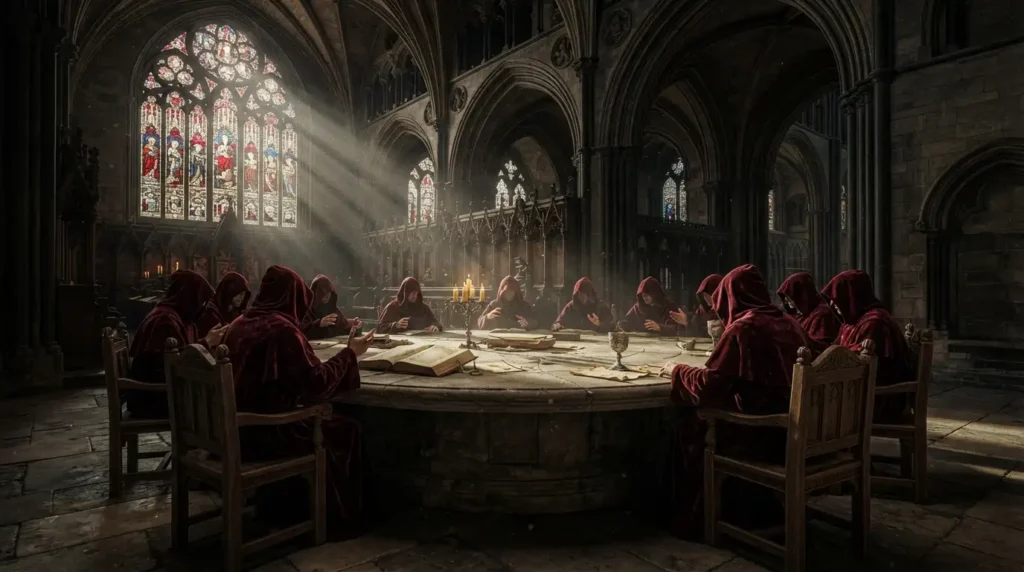
In its most specific and widely recognized sense, a conclave names the formal process the College of Cardinals uses to elect a new pope, held in strict secrecy inside the Sistine Chapel. Cardinals under the age of 80 gather, cast votes, and remain isolated from outside contact until they choose a new pope by the required majority.
In a broader sense, “conclave” describes any private, closed meeting of a select group making an important decision, often implying secrecy or exclusivity. Writers sometimes use it loosely to describe corporate boardroom meetings, political gatherings, or any small group deliberating behind closed doors.
Both senses share the same core idea: a small, enclosed group meeting privately to reach a decision that affects far more people than those in the room.
Origin & History
The word conclave comes from the Latin “conclave,” built from “con” (with) and “clavis” (key) literally, “a room that can be locked with a key.” The term originally described any locked room, but it became permanently attached to papal elections after a specific historical event.
In 1268, Pope Clement IV died, and cardinals took so long to agree on a successor that local officials in Viterbo, Italy, eventually locked the cardinals inside the building where they were meeting, cut back their food, and even tore off part of the roof to pressure them toward a decision. That election, which finally concluded in 1271, became the longest papal election in history and directly shaped the rules that followed.
The Catholic Church later turned that enforced isolation into official procedure, establishing strict rules that require cardinals to sequester themselves and literally lock themselves away until they choose a new pope. The word conclave, tied to that locked room, stuck permanently to the process itself.
Different Contexts and Meanings
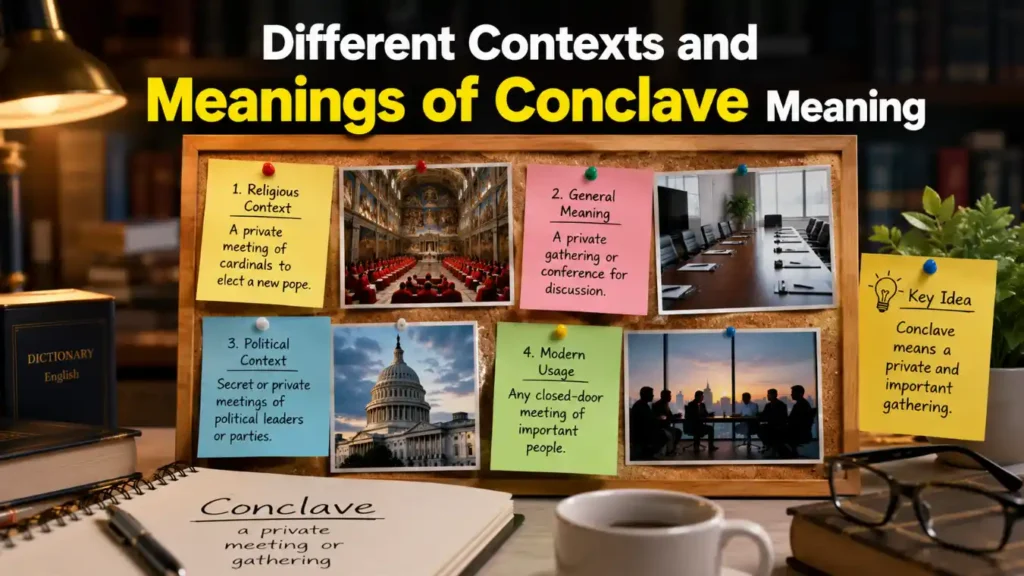
In the Catholic Church. This is the term’s primary and most formal use: the secretive gathering of cardinals inside the Sistine Chapel to elect a pope, which follows centuries-old rules and rituals.
In news and media coverage. Journalists reach for “conclave” constantly during papal transitions, often alongside details like the burning of ballots and the resulting white or black smoke that signals if a new pope has emerged.
As a general term for secretive meetings. Outside religious contexts, people use conclave to describe any small, closed-door gathering: a business conclave, a political conclave, or an academic conclave where a limited group makes decisions privately.
In fiction and pop culture. Writers and filmmakers sometimes borrow the term for secretive councils or gatherings in stories, games, and films, leaning on the word’s association with mystery and exclusivity even outside any religious setting.
As a symbol of secrecy and tradition. Because the papal conclave follows such strict, ritualized secrecy, the word itself carries connotations of tradition, exclusivity, and hidden decision-making, even when people use it loosely.
Examples
- “The cardinals entered the conclave shortly after officials announced the pope’s death.”
- “White smoke rose from the chapel chimney, signaling that the conclave had chosen a new pope.”
- “The board held a private conclave to decide on the merger.”
- “Reporters gathered outside, waiting for news from the conclave.”
- “It felt like a corporate conclave, with executives locked in a room for hours.”
- “The senators held a late-night conclave to hash out the final vote.”
- “Every detail of the conclave, from the oath to the sealed doors, follows centuries-old tradition.”
- “The novel describes its secret council as a conclave of elders.”
- “Cardinals under eighty qualify to vote in the conclave.”
- “The committee’s conclave lasted well into the night before reaching a decision.”
How to Use It (Grammar and Context)
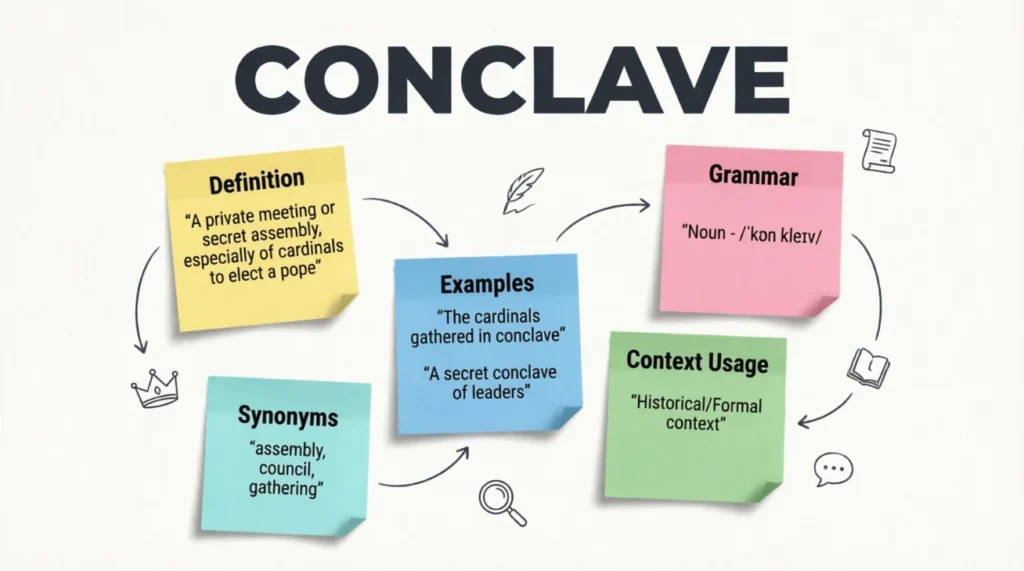
Conclave functions as a noun, and writers commonly pair it with the phrase “in conclave” or “hold a conclave” in formal and journalistic writing. People typically lowercase it in general use, though it sometimes appears capitalized when referring to a specific, named papal election.
The word can also take a plural form “conclaves” when referring to multiple historical elections or multiple metaphorical closed-door meetings.
Common Mistakes
Assuming conclave only means “meeting.” While the broader usage exists, the word specifically implies secrecy, isolation, or exclusivity people wouldn’t typically call a large public meeting a conclave.
Confusing conclave with consistory. A consistory names a separate, more general assembly of cardinals that the pope calls for various Church business. A conclave specifically refers to the election process after a pope has died or resigned.
Assuming the term only applies to the Catholic Church. While the papal election gives the word its most famous use, writers have long used “conclave” more broadly for any secretive, decision-making gathering.
Getting the etymology wrong. Some assume the word relates to secrecy alone, but its Latin roots point specifically to a locked room; secrecy follows from that original meaning rather than forming the root meaning itself.
Similar Words
| Word | Meaning | Difference from Conclave |
| Assembly | A general gathering of people, often for discussion or decision-making | Assembly carries no built-in implication of secrecy or a small, closed group |
| Council | A group formally organized to give advice or make decisions | A council can meet publicly and on an ongoing basis; a conclave typically stays closed and often ties to a specific decision or event |
| Summit | A high-level meeting, often between leaders or officials | Summits frequently happen in public or get publicized; conclaves emphasize seclusion |
| Caucus | A meeting of members of a political party or group to decide policy or candidates | Caucuses can stay relatively open; conclaves emphasize strict privacy and isolation |
Opposite Words
| Word | Meaning | Why It’s an Opposite |
| Public forum | An open meeting or discussion accessible to anyone | The opposite of a conclave’s strict privacy and limited attendance |
| Open hearing | A formal meeting held publicly, often with an audience or press present | Directly contrasts with a conclave’s secrecy |
| Town hall | A large, open gathering where anyone can attend and speak | Emphasizes openness and broad participation, unlike a conclave’s exclusivity |
Pronunciation
People pronounce conclave as KON-klayv, stressing the first syllable.
Quick Facts
| Fact | Detail |
| Word origin | Latin “conclave,” from “con” (with) and “clavis” (key) literally “a room locked with a key” |
| Primary meaning | The secretive process by which cardinals elect a new pope |
| Location | The Sistine Chapel, Vatican City |
| Historical event that shaped it | The 1268–1271 papal election in Viterbo, the longest in history |
| Eligible voters | Cardinals under age 80 |
| Broader usage | Any small, private, closed-door meeting or gathering |
FAQs
What does conclave mean simply?
Conclave most often refers to the private meeting where Catholic cardinals gather to elect a new pope, though the word can also describe any small, closed-door meeting more generally.
Where does the word conclave come from?
It comes from the Latin words for “with” and “key,” originally meaning a room that could be locked, and it traces back to a 13th-century election where officials literally locked cardinals in until they chose a pope.
Who takes part in a papal conclave?
Cardinals of the Catholic Church who are under the age of 80 at the time of the election.
Why is a papal conclave so secretive?
The secrecy traces back to historical attempts to speed up drawn-out elections, and the Church has since turned it into a formal, ritualized part of tradition meant to protect the integrity of the process.
What does the smoke from a conclave mean?
Officials burn the ballots after each vote; black smoke signals that cardinals haven’t chosen a pope yet, while white smoke signals they’ve elected a new one.
Can the word conclave be used outside religion?
Yes. People commonly use it to describe any private, closed-door meeting of a select group, such as a corporate or political gathering.
How long does a papal conclave usually last?
Modern conclaves typically last only a few days, though historically some elections, like the one in the 13th century that gave the word its name, dragged on for years.
What’s the difference between a conclave and a consistory?
A consistory names a broader assembly of cardinals that the pope calls for general Church business, while a conclave specifically refers to the closed process of electing a new pope.
Key Takeaways
- Conclave most commonly refers to the secretive process cardinals use to elect a new pope.
- The word comes from Latin roots meaning “a room locked with a key.”
- A 13th-century papal election in Viterbo directly shaped the tradition of locking cardinals away until they decide.
- People also use the word more broadly for any small, private, closed-door meeting.
- The term carries strong connotations of secrecy, tradition, and exclusivity in both its formal and casual uses.
Conclusion
The conclave meaning ties together a specific religious tradition and a much older idea: a locked room where a small group makes a decision that the outside world simply has to wait on. That image of sealed doors, no outside contact, and smoke as the only signal explains why the word carries so much weight even outside the Vatican.
It also explains why journalists and writers reach for “conclave” whenever they want to describe secrecy and high stakes in the same breath, if they’re covering an actual papal election or describing a boardroom locked in negotiations. The word does a lot of work in a single term: it signals not just privacy, but a decision important enough to justify that privacy in the first place.
So if you encounter it during news coverage of an actual papal election or in a headline about corporate executives locked in talks, the core meaning stays the same: a small group, a closed door, and a decision the rest of the world has to wait to hear.

I am Stephen King an American author known for compelling storytelling. At writemora.com, we value clear, accurate, and reader-focused content inspired by excellence in writing.