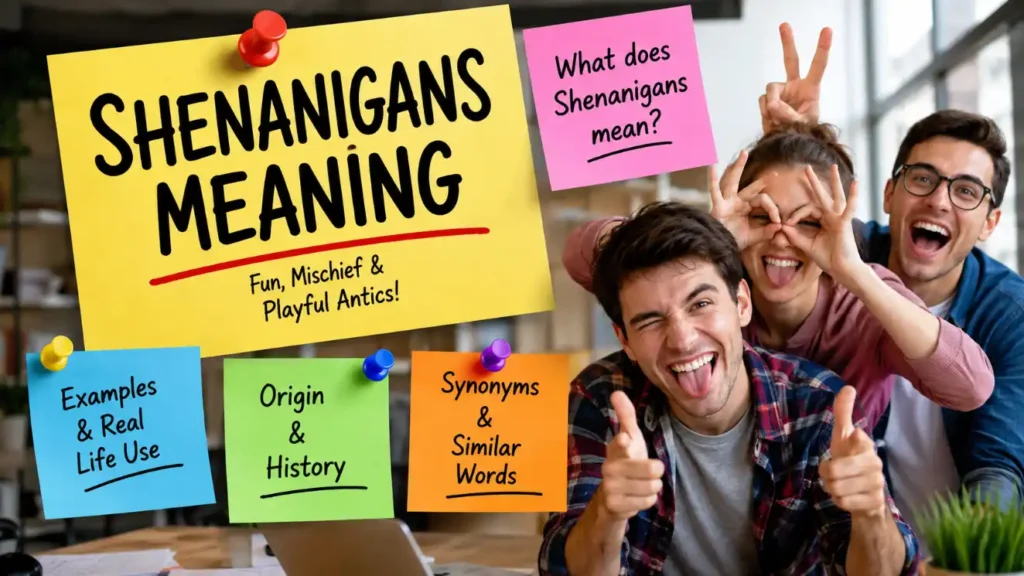
Shenanigans describe playful mischief, tricks, or dishonest behavior usually lighthearted rather than seriously harmful. People use it for everything from harmless pranks between friends to more pointed accusations of shady dealings.
The word carries a fun, almost cartoonish energy that few other English words match, and it appears constantly in casual speech, headlines, and warnings against misbehavior. Understanding the shenanigans meaning means understanding both its playful side and its sharper, more accusatory side.
This guide covers what shenanigans means, where the word likely came from, the different ways people use it, and the mistakes people sometimes make with it.
What It Means
In simple terms, shenanigans (almost always used in the plural) describes mischievous, playful, or tricky behavior actions that bend rules or cause minor trouble, usually without serious harm involved.
In a fuller sense, the word spans a range of tones. On the lighter end, shenanigans can mean harmless silliness or playful pranks, like kids sneaking extra dessert or coworkers setting up an office prank. On the sharper end, it can describe dishonest or underhanded behavior, particularly in business, politics, or finance, where “shenanigans” implies something shady is happening, even if no one has proven wrongdoing outright.
Context and tone determine which end of that spectrum applies. A parent saying “no shenanigans tonight” to kids at a sleepover means something very different from a headline about “corporate accounting shenanigans.”
Origin & History
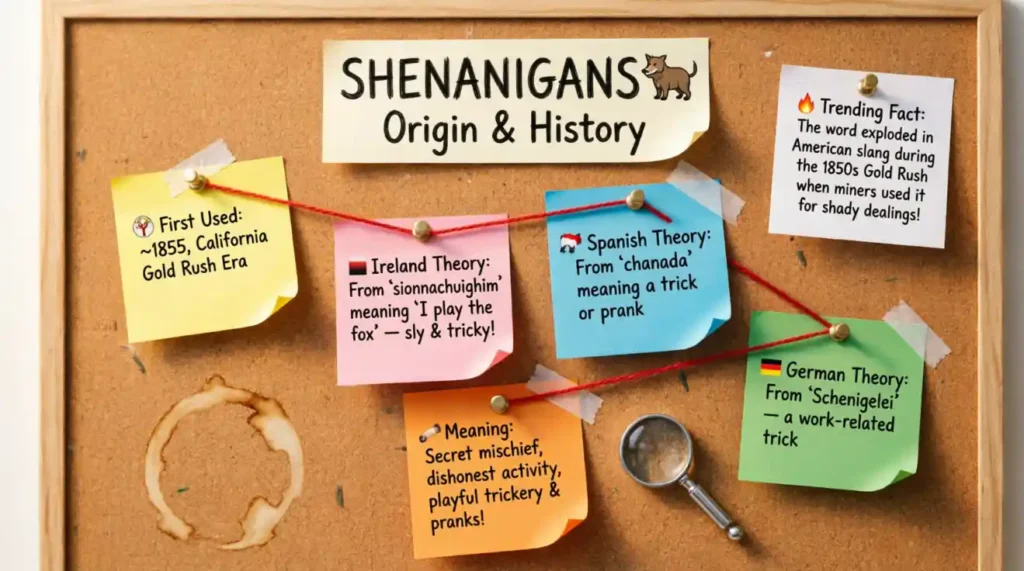
The exact origin of “shenanigans” remains genuinely uncertain, and etymologists disagree on its precise roots. The word first appeared in American English in the mid-19th century, specifically documented in California during the Gold Rush era around the 1850s.
Several theories attempt to explain where it came from. Some trace it to the Irish word “sionnach,” meaning “fox,” suggesting a connection to cunning or trickery. Others suggest a link to the Spanish word “chanada,” a shortened form of “charranada,” meaning “trick” or “deceit.” Neither theory has been conclusively proven, and dictionaries and word historians generally describe the origin as uncertain or disputed rather than settled.
Regardless of its exact roots, the word spread quickly through American English after its 19th-century appearance, eventually becoming a common, versatile term for mischief and trickery across the English-speaking world.
Different Contexts and Meanings
As harmless fun or mischief. This is the word’s lightest and most common everyday use of playful pranks, silly antics, or minor rule-bending among friends or family, carrying no real malice.
As a warning against misbehavior. People often use “no shenanigans” as a lighthearted but clear instruction to behave, especially aimed at children, teenagers, or party guests.
As an accusation of dishonest dealing. In business, politics, and finance, “shenanigans” takes on a sharper edge, implying manipulation, fraud, or underhanded tactics as in “accounting shenanigans” or “political shenanigans.”
In headlines and journalism. Writers frequently use “shenanigans” as a punchy, attention-grabbing word for scandals or questionable behavior, especially when the full details remain unclear or under investigation.
As a lighthearted exaggeration. People sometimes use the word ironically or humorously to describe very mundane behavior, exaggerating minor incidents into “shenanigans” for comic effect.
Examples
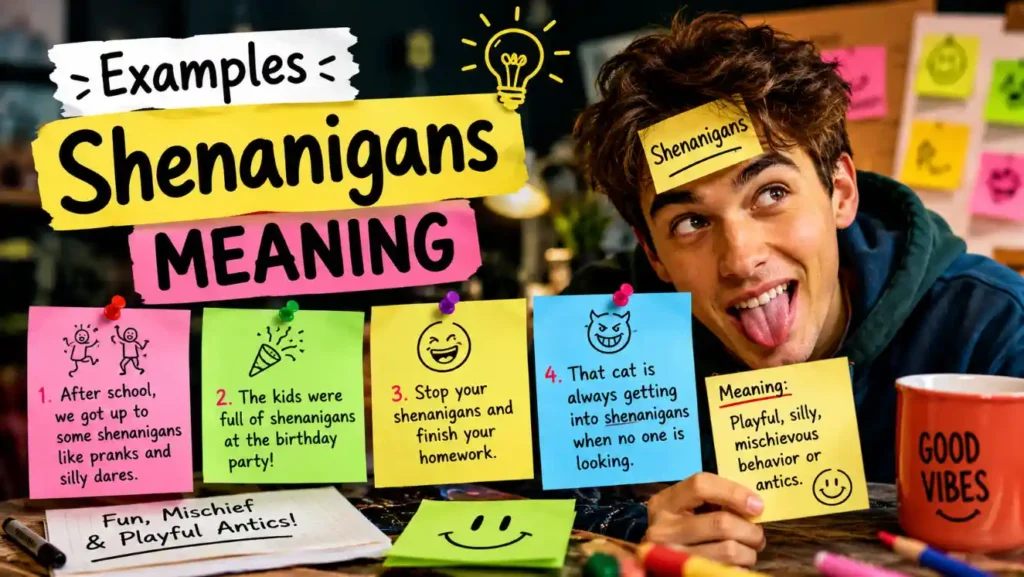
- “The kids got up to some shenanigans while the babysitter wasn’t looking.”
- “No shenanigans tonight, everyone needs to be home by ten.”
- “Reports of accounting shenanigans led to an internal investigation.”
- “Their office prank war has turned into full-blown shenanigans.”
- “The article accused the campaign of political shenanigans during the vote count.”
- “We caught the dog in the middle of some backyard shenanigans.”
- “That whole scheme sounds like classic corporate shenanigans.”
- “The weekend was full of harmless shenanigans with old college friends.”
- “Someone’s been up to shenanigans with the office supply closet.”
- “The company denied any shenanigans related to the missing funds.”
How to Use It (Grammar and Context)
Shenanigans almost always appear in plural form, even when referring to a single ongoing situation you’d say “these shenanigans,” not “this shenanigan.” It functions as a noun, typically paired with verbs like “get up to,” “pull,” or “cause”: “get up to shenanigans,” “pull some shenanigans.”
The word works equally well in casual speech and in more formal journalism or business writing, though its tone shifts depending on context, playful in casual use, more pointed and skeptical in reports of financial or political wrongdoing.
Common Mistakes
Assuming it always means something harmless. While often lighthearted, “shenanigans” can also imply genuine dishonesty or fraud, especially in business or political contexts reading it as always innocent can miss a more serious accusation.
Using it in singular form. Saying “a shenanigan” sounds unnatural in standard English; the word virtually always appears as “shenanigans,” even for a single incident.
Overusing it to downplay serious wrongdoing. Calling genuinely serious fraud or misconduct mere “shenanigans” can trivialize something that deserves more serious language.
Assuming the word’s origin is settled. Some sources confidently state a single origin story, but etymologists still debate the word’s roots, and no theory has been definitively proven.
Similar Words
| Word | Meaning | Difference from Shenanigans |
| Mischief | Playful troublemaking, often minor and harmless | Very close in meaning, though “shenanigans” often implies more elaborate or organized trickery |
| Antics | Playful, often silly or attention-grabbing behavior | Antics leans purely playful; shenanigans can carry a sharper, more accusatory edge in serious contexts |
| Chicanery | Deceptive or dishonest manipulation, especially in politics or business | Chicanery leans more seriously negative; shenanigans can range from playful to seriously dishonest |
| Hijinks | Boisterous or high-spirited pranks and fun | Hijinks and shenanigans are near-synonyms in casual use, both implying lighthearted mischief |
Opposite Words
| Word | Meaning | Why It’s an Opposite |
| Propriety | Correct, appropriate, or proper behavior | Directly opposes the rule-bending, mischievous nature of shenanigans |
| Diligence | Careful, honest, and conscientious effort | Contrasts with the underhanded or trickster connotation of shenanigans |
| Transparency | Openness and honesty, especially in business or dealings | Opposes the secretive, deceptive edge that “shenanigans” can imply in serious contexts |
Pronunciation
Shenanigans is pronounced shuh-NAN-ih-gunz, with the stress on the second syllable.
Quick Facts
| Fact | Detail |
| Typical form | Almost always plural |
| First documented | Mid-19th century, American English, California Gold Rush era |
| Possible origins | Irish “sionnach” (fox) or Spanish “chanada” (trick); origin remains disputed |
| Tone range | Playful mischief to serious dishonesty, depending on context |
| Common phrase | “No shenanigans” |
| Common serious use | “Accounting shenanigans,” “political shenanigans” |
FAQs
What does shenanigans mean simply?
Shenanigans describe playful mischief, trickery, or sometimes dishonest behavior, ranging from harmless fun to more serious underhanded dealings depending on context.
Is shenanigans always used in plural form?
Yes, almost always. Even a single incident of mischief typically gets described as “shenanigans,” not “a shenanigan.”
Where does the word shenanigans come from?
Its exact origin remains uncertain. It first appeared in American English in the mid-19th century, with theories tracing it to an Irish word for “fox” or a Spanish word for “trick,” though neither is confirmed.
Can shenanigans mean something serious?
Yes. In business, finance, or politics, “shenanigans” can imply genuine dishonesty or manipulation, not just harmless fun.
What’s the difference between shenanigans and mischief?
The words overlap closely, but shenanigans often implies more elaborate, organized, or clever trickery, while mischief can describe simpler, more spontaneous troublemaking.
Is “no shenanigans” a common phrase?
Yes, people frequently use “no shenanigans” as a playful but clear warning against misbehavior, especially with kids, teenagers, or party guests.
Do shenanigans always imply wrongdoing?
Not necessarily. Its meaning depends heavily on context; it can describe innocent fun just as easily as it can describe suspicious or dishonest behavior.
Why do headlines use the word shenanigans?
Journalists often use it as a punchy, attention-grabbing term for scandals or questionable behavior, especially when full details remain unclear.
Key Takeaways
- Shenanigans describe playful mischief or, in sharper contexts, dishonest behavior.
- The word almost always appears in plural form, even for a single incident.
- Its exact origin remains uncertain, first documented in mid-19th century American English.
- Tone and context determine If “shenanigans” means harmless fun or something more serious.
- The word appears frequently in casual speech, warnings, and journalism covering scandals.
Conclusion
The shenanigans’ meaning stretches across a surprisingly wide range, from a kid sneaking an extra cookie to a company accused of manipulating its financial reports. That flexibility is part of what makes the word so useful it lets a speaker signal “something’s not quite right here” without committing to exactly how serious the situation actually is.
The word’s murky, unresolved origin only adds to its charm. Few common English words carry this much genuine mystery behind them, and that unsettled history feels oddly fitting for a term that itself describes behavior nobody’s entirely sure they should take seriously.
If you’re warning kids against sneaking around after bedtime or reading a headline about corporate wrongdoing, shenanigans does the same basic job either way: it flags behavior worth a second look, wrapped in a word playful enough that it rarely feels heavy-handed, even when the situation underneath it actually is.

I am Stephen King an American author known for compelling storytelling. At writemora.com, we value clear, accurate, and reader-focused content inspired by excellence in writing.