
“Deny, defend, depose” is a three-word phrase that became globally recognized in December 2024 after it was reportedly written on ammunition used in the killing of UnitedHealthcare CEO Brian Thompson in New York City . The words echo a long-standing criticism of the insurance industry, but they also carry distinct legal and political meanings on their own.
This article breaks down what each word means, where the phrase came from, how it differs from the similar “delay, deny, defend,” and why it resonated with so many people. You’ll also find examples, usage guidance, and common misconceptions.
What Does “Deny, Defend, Depose” Mean?
At its core, the phrase describes a sequence of tactics that critics accuse insurance companies of using to avoid paying claims:
- Deny Reject a claim outright.
- Defend Fight back legally when a claimant pushes back.
- Depose Remove from power, or in legal terms, question under oath.
Together, the three words read as a critique of how insurers allegedly operate. But they also function as a kind of slogan, an indictment of a system that profits by withholding care.
The phrase is not a formal legal maxim or an official industry term. It is a rhetorical framing, and one that gained enormous cultural weight after the December 2024 shooting .
Where the Phrase Comes From
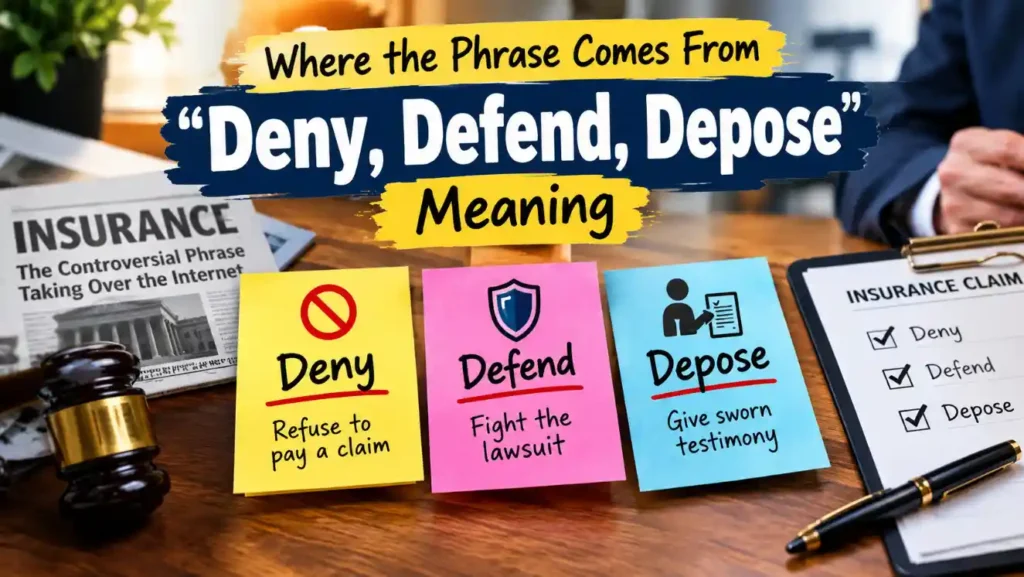
The phrase “deny, defend, depose” is a variation of an older, better-known phrase: “delay, deny, defend.”
That older phrase was popularized by a 2010 book titled Delay, Deny, Defend: Why Insurance Companies Don’t Pay Claims and What You Can Do About It by Jay Feinman, a professor emeritus at Rutgers University and an expert in insurance law . Feinman’s book argued that denying valid claims was a systematic business strategy for maximizing profits at major insurers .
The three D’s in Feinman’s title refer to:
- Delay paying claims as long as possible.
- Deny claims that should be paid.
- Defend those denials in court if challenged.
The version found on the shell casings swapped delay for deposing a word with a sharper edge, as we’ll see below .
What Each Word Means on Its Own
Understanding the phrase requires understanding its parts. Each word carries weight in legal, political, and everyday contexts.
Deny
To deny means to state that something is not true, or to refuse to grant something requested. In an insurance context, a denied claim means the company refuses to pay for a service or treatment.
In everyday life, you might deny an accusation or deny access to information. The word suggests rejection, refusal, or contradiction.
Defend
To defend means to protect from attack or harm. In law, a defense is the argument made on behalf of someone accused. In insurance, “defend” refers to the company protecting its decision to deny a claim typically through legal means.
The word implies resistance and self-protection.
Depose
“Depose” has two distinct meanings that both apply here:
- Legal meaning: To depose someone means to take their testimony under oath, typically outside of court during the discovery phase of a lawsuit. A deposition is a formal questioning session.
- Political meaning: To depose someone means to remove them from a position of power like deposing a king or a ruler .
The political meaning is the one that gives the phrase its bite. In the context of insurance criticism, “depose” suggests removing the system or the people who run it from power.
It’s worth noting that the word itself is neutral. Deposing a CEO is a routine action taken by boards of directors. Deposing a witness is a standard legal procedure. The word does not inherently imply violence .
“Deny, Defend, Depose” vs. “Delay, Deny, Defend”
These two phrases are related but not identical. Here’s how they compare:
| Phrase | Origin | Key Difference |
| Delay, Deny, Defend | 2010 book by Jay Feinman | Describes insurance tactics: slow-walk claims, reject them, then fight legal challenges |
| Deny, Defend, Depose | Found on shell casings, Dec. 2024 | Replaces “delay” with “depose,” shifting from process criticism to removal from power |
The switch from “delay” to “depose” is significant. “Delay” describes a tactic. “Depose” describes an outcome: the removal of those who wield power. That shift made the phrase feel more confrontational and more like a demand for systemic change .
Why the Phrase Went Viral
The phrase exploded online after the December 4, 2024, shooting of Brian Thompson outside a Manhattan hotel. Reports that the words were written on ammunition turned the phrase into a symbol almost overnight .
But the phrase resonated for reasons beyond the shooting itself. Public frustration with the U.S. health insurance system had been building for years.
A KFF poll conducted in February 2024 found that about two-thirds of Americans believed health insurance companies deserve “a lot of blame” for high health care costs . A separate 2023 KFF survey found that a majority of insured adults had experienced problems using their insurance in the previous year including denied claims and prior authorization issues .
The phrase gave people a compact way to express that frustration. It appeared on T-shirts, stickers, and social media posts. Artists incorporated it into works. It became, in effect, a rallying cry .
How to Use the Phrase
If you want to use “deny, defend, depose” in writing or conversation, here are a few guidelines:
Do:
- Use it when discussing insurance industry criticism or health care reform.
- Recognize its dual nature: it’s both a critique and a slogan.
- Understand that “depose” carries political weight, not just legal meaning.
Don’t:
- Assume it’s a formal term used by the insurance industry. It is a phrase about the industry, not from it.
- Treat it as a direct call to violence. The words themselves describe tactics and outcomes, not specific acts.
- Use it without context. New readers may not know the origin or the “delay, deny, defend” connection.
Common Mistakes and Misconceptions
Mistake #1: Thinking it’s the original phrase.
The original is “delay, deny, defend.” “Deny, defend, depose” is a variation .
Mistake #2: Assuming “depose” means “kill.”
It does not. To depose is to remove from office or to question under oath. It’s a word about power and testimony, not violence .
Mistake #3: Believing it’s an official insurance industry term.
It is not. It is a phrase used by critics of the industry .
Mistake #4: Ignoring the legal meaning of “depose.”
In a litigation context, a deposition is a routine part of a lawsuit. The phrase’s legal meaning is less dramatic than its political meaning, but it’s still relevant .
Similar Phrases and Words
| Phrase/Word | Meaning | How It Differs |
| Delay, Deny, Defend | Insurance tactic critique | Original phrase; focuses on process |
| Deny, Delay, Defend | Same idea, reordered | Some sources use this variant |
| Deny, Defend, Depose | Removal from power version | Sharper, more political |
| Deposition | Legal testimony under oath | Noun form of “depose” |
| Dethrone | Remove from power | Closer to political meaning of “depose” |
Pronunciation
Deny /dɪˈnaɪ/ (dih-NYE)
Defend /dɪˈfɛnd/ (dih-FEND)
Depose /dɪˈpoʊz/ (dih-POHZ)
The phrase is usually spoken with even stress on each word, like a chant or slogan: de-NY, de-FEND, de-POSE.
Quick Facts
| Fact | Detail |
| Phrase type | Critique of insurance industry tactics |
| Origin of “delay, deny, defend” | 2010 book by Jay Feinman |
| “Deny, defend, depose” emergence | December 2024, after UnitedHealthcare CEO shooting |
| Legal meaning of “depose” | To take testimony under oath |
| Political meaning of “depose” | To remove from power |
| Key difference from original | “Depose” replaces “delay,” adding a demand for removal |
Key Takeaways
- “Deny, defend, depose” is a variation of the older phrase “delay, deny, defend,” which came from a 2010 book critical of insurance industry claims practices.
- Each word has distinct meanings: deny (reject), defend (protect/argue), depose (remove from power or question under oath).
- It is a critique and a slogan, not an official industry term.
- The word “depose” carries both legal and political weight, which gives the phrase its edge.
FAQs
What is the most sued insurance company?
There is no single official ranking for the “most sued” insurance company; lawsuits vary by country, insurance type, and year.
What not to tell your insurance company?
Avoid guessing, admitting fault, exaggerating injuries, or giving unnecessary details before you understand what happened and your policy obligations.
What is the 80/20 rule in insurance?
The 80/20 rule commonly means the insurer pays 80% of covered costs while you pay 20%, usually after meeting the deductible.
Why deny defend depose?
“Deny, defend, depose” became associated with criticism of health-insurance practices and gained attention after the Luigi Mangione case.
What does “delay, deny, defend” mean?
It is a phrase critics use to describe alleged insurance tactics of delaying claims, denying coverage, and defending those decisions when challenged.
What does the term “depose” mean in the context of insurance?
To depose someone means to question them under oath during a legal proceeding, usually as part of gathering evidence in a dispute.
Can a person refuse to be deposed?
Usually, a person cannot simply refuse a properly ordered deposition, although they may have legal grounds to object or seek a protective order.
Which word is opposite to deposition?
The opposite depends on the meaning: for removing someone from office, “appointment” or “installation” can be an opposite; for testimony, there is no exact single opposite.
What is another word for “depose”?
In a legal context, “question under oath” or “examine under oath” can be used. If removing someone from office, “dismiss” or “remove” may fit.
Conclusion
“Deny, defend, depose” is a compact, three-word critique of how insurance companies are accused of operating. It’s not a formal term, but it packs a punch because each word carries weight legal, political, and emotional.
The phrase’s journey from a 2010 book title to a viral slogan reflects something deeper: a widespread sense that the system isn’t working for the people it’s supposed to serve. Understanding where the words come from and what they mean helps you make sense of why they struck such a chord.

I am Olivia Brooks an American editor and content researcher dedicated to creating clear, accurate content. At writemora.com, I help readers to understand words, phrases, and modern language with confidence.