
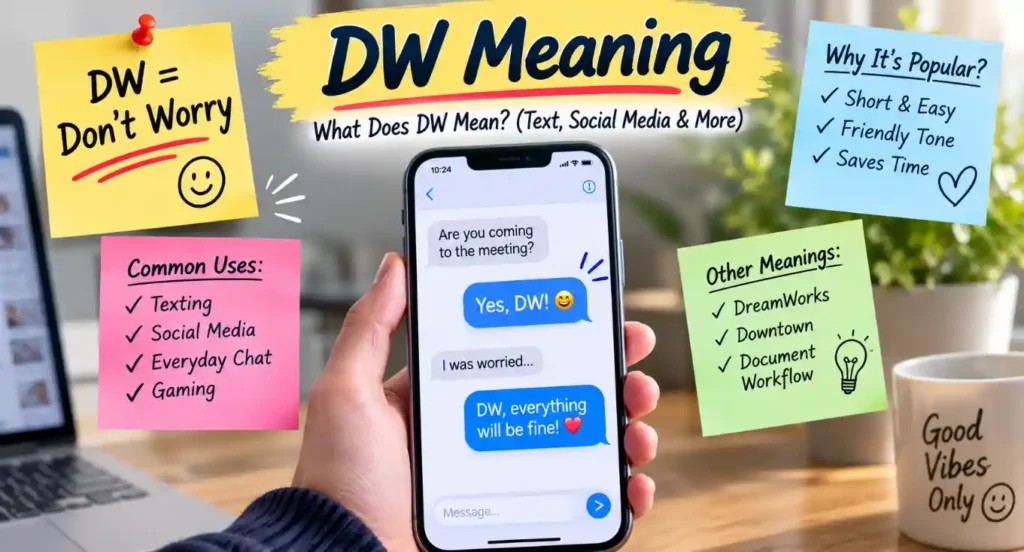
If a friend texts you “dw, I got it,” you don’t need to worry that’s literally what the abbreviation says. The DW meaning you’ll run into most often is “don’t worry,” a shorthand people use in texts, group chats, and social media comments to brush off an apology, calm someone down, or say a problem isn’t a big deal.
This guide breaks down the main meaning of “dw,” the handful of other things it can stand for depending on the context, real examples of it in use, and answers to the questions people search most. By the end, you’ll know exactly when to use “dw” and when a different abbreviation fits better.
What “DW” Means
The simple version: In texting and casual online chat, “dw” almost always means “don’t worry.” People type it to reassure someone, wave off a small mistake, or respond to an apology without making a big deal of it.
The fuller picture: “Dw” belongs to a large family of texting abbreviations that strip vowels or shorten common phrases to save keystrokes similar to “np” (no problem), “idc” (I don’t care), or “nvm” (never mind). It works as a quick, low-effort way to close out a small exchange, often paired with a comma, an emoji, or a follow-up sentence that explains why there’s nothing to worry about.
Outside of texting slang, the same two letters show up in a few unrelated fields, where they stand for completely different things:
- Data Warehouse a common abbreviation in tech and business analytics
- Deutsche Welle Germany’s international public broadcaster, which commonly uses “DW” as its brand name
- Dry Weight used in fitness, nutrition, and medical contexts (for example, dialysis patients)
- Distant Worlds a term some gamers use as shorthand in certain strategy games
Context makes the meaning obvious almost every time. In a text message or comment section, “dw” means “don’t worry.” In the business meeting or tech article, it almost certainly as “data warehouse.” at international news, “DW” usually refers to the German broadcaster.
Origin and History

Like most texting abbreviations, “dw” grew out of the broader shift toward shorthand communication that came with SMS text messaging and, later, instant messaging apps and social media. Character limits, small keyboards, and the pace of casual conversation online all pushed people toward dropping vowels and shortening common phrases. “Dw” fits neatly into that pattern, sitting alongside older, well-established abbreviations like “brb” (be right back) and “ttyl” (talk to you later).
Nobody can point to one specific person or platform that invented “dw” for “don’t worry” internet slang like this usually spreads organically across group chats, forums, and comment sections rather than starting from a single traceable source. What’s clear is that it became common enough, especially among younger texters, to now sit as a widely recognized piece of everyday internet shorthand.
The unrelated meanings Data Warehouse, Deutsche Welle, Dry Weight developed independently in their own fields, long before texting slang existed, and simply happen to share the same two letters.
Different Meanings and Contexts
Texting and social media (most common). “Dw” means “don’t worry.” People use it in texts, DMs, comments, and captions to reassure someone or downplay a problem.
Business and technology. “DW” stands for “Data Warehouse,” a system organizations use to store and analyze large amounts of data from different sources. You’ll see this usage in job titles, technical documentation, and IT conversations.
International media. “DW” refers to Deutsche Welle, Germany’s public international broadcaster, which uses the initials as its everyday brand name across its website, TV channels, and social accounts.
Health and fitness. “DW” can stand for “dry weight,” a term used in some medical and fitness settings to describe a person’s weight without excess fluid, most notably in discussions of dialysis treatment.
Gaming communities. In some gaming contexts, players use “dw” as shorthand for in-game terms specific to that community, though this usage is far less universal than the texting meaning and depends heavily on the game and community.
Examples of “DW” in a Sentence

- “Sorry I’m running late!” “dw, take your time.”
- “Dw about the bill, I’ve got this one.”
- “I forgot to reply yesterday, sorry!” “dw lol, life happens.”
- “Dw, I already told the group chat what happened.”
- “You don’t need to explain yourself, dw about it.”
- “Dw, I’ll grab your coffee order too.”
- “I might be a few minutes late to the call.” “dw, we’ll wait for you.”
- “Dw, it’s not a big deal, we can reschedule.”
- “She said dw and moved on before I could apologize again.”
- “Dw about texting back late, I was asleep.”
How to Use “DW” Correctly
“Dw” works as a standalone response or as the opening of a sentence, almost always followed by a comma when it starts a sentence (“Dw, I’ve got it”).
A few usage notes:
- Lowercase is standard. Most people write “dw” in lowercase in casual texting, even at the start of a sentence, since texting abbreviations generally skip formal capitalization rules.
- Pair it with context. “Dw” on its own can feel a little abrupt, so people often follow it with a short explanation (“dw, I already fixed it”) to keep the tone friendly rather than dismissive.
- Match the setting. “Dw” fits casual texting, DMs, and social comments. In a work email or formal message, spell out “don’t worry” or “no worries” instead.
- Watch for the acronym clash. In professional or technical writing, capitalized “DW” almost never means “don’t worry” readers will assume you mean data warehouse or another field-specific term, so spell things out if there’s any chance of confusion.
Common Mistakes to Avoid
- Using it in formal writing. “Dw” reads as very casual. Emails to a boss, cover letters, and professional messages call for the full phrase instead.
- Assuming it always means “don’t worry.” In a business, tech, or news context, capitalized “DW” usually means something else entirely, check the surrounding text before assuming.
- Sending it without warmth. A bare “dw” with no punctuation or follow-up can come across as curt in a serious conversation, even if that’s not the intent.
- Confusing it with similar-looking abbreviations. “Dw” is easy to mix up with “idk” (I don’t know) or “idc” (I don’t care) when skimming quickly double-checks before replying to avoid an awkward mismatch.
Similar Words and Phrases
| Phrase | Meaning | How It Differs |
| np | No problem | Responds specifically to thanks, rather than reassuring someone before or during a worry |
| nvm | Never mind | Cancels or withdraws a previous statement rather than reassuring the other person |
| ik | I know | Confirms understanding rather than offering reassurance |
| no worries | Don’t worry (spelled out) | Same meaning as “dw,” just written in full for a slightly warmer or more formal tone |
| chill | Relax, don’t stress | Broader tone-setting word, not tied to a specific apology or situation like “dw” often is |
Opposite Words and Phrases
| Phrase | Meaning | Why It’s an Opposite |
| tbh, that’s a problem | Signals genuine concern | Directly contradicts the reassurance “dw” offers |
| smh | Shows frustration or disapproval | Expresses annoyance instead of easing someone’s worry |
| ugh, not again | Expresses irritation at a repeated issue | The opposite emotional register from a casual “dw” |
| I’m worried | States concern directly | The literal opposite sentiment “dw” tells someone not to feel |
Pronunciation
People almost never say “dw” out loud as a word; it’s read as three separate letters: D-W. In speech, most people just say “don’t worry” instead of spelling out the abbreviation.
Quick Facts
| Fact | Detail |
| Most common meaning | “Don’t worry” |
| Origin | Texting and internet shorthand culture |
| Capitalization | Lowercase in casual texting; capitalized “DW” usually means something else (Data Warehouse, Deutsche Welle) |
| Part of speech | Interjection / short phrase |
| Common setting | Texts, DMs, comments, casual chat |
| Formality | Very casual avoid in professional writing |
Frequently Asked Questions
What does “dw” mean in texting?
It means “don’t worry.” People use it to reassure someone or brush off a small mistake or apology.
Is “dw” the same as “np”?
Not quite. “Np” (no problem) responds to thanks, while “dw” (don’t worry) reassures someone before or during a moment of concern, though the two sometimes overlap in casual use.
What does “DW” stand for besides “don’t worry”?
Depending on the context, “DW” can stand for “Data Warehouse” in tech and business, “Deutsche Welle” in international media, or “dry weight” in health and fitness settings.
Is it rude to reply with just “dw”?
It can come across as blunt in a serious conversation. Adding a short explanation or a warmer phrase (“dw, all good!”) usually softens the tone.
Should I capitalize “dw” when texting?
No, lowercase is standard in casual texting. Capitalizing it can make readers think you mean a different, unrelated abbreviation.
Can I use “dw” in a work email?
It’s best to avoid it. Spell out “don’t worry” or use “no worries” for a more professional tone.
Where did “dw” come from?
It grew out of general texting shorthand culture, where people shorten common phrases to type faster no single origin point exists.
Does “dw” mean the same thing in every online community?
Mostly, yes, for the “don’t worry” meaning. But in specific fields like tech, media, or gaming, the same letters can point to a completely different term.
Key Takeaways
- “DW” most commonly means “don’t worry” in texting and casual online chat.
- People use it to reassure someone, downplay a mistake, or brush off an apology.
- Capitalized “DW” often stands for something unrelated, like “Data Warehouse” or “Deutsche Welle” context decides the meaning.
- Keep “dw” lowercase and casual, and save the full phrase for formal writing.
- Pairing “dw” with a short explanation keeps the tone warm instead of curt.
Conclusion
“Dw” is one of those small, everyday abbreviations that does a lot of emotional work in very few characters. It tells someone to relax, apologies are unnecessary, and the conversation can move on. Once you recognize it, you’ll notice it constantly in texts, comments, and DMs, almost always doing the same friendly job of smoothing over a minor hiccup.
The trickiest part isn’t the texting meaning itself, it’s remembering that the same two letters mean something else entirely once you leave casual chat. Seeing “DW” in a tech article, a news headline, or a hospital chart doesn’t mean anyone’s telling you to relax; check the setting first, and the right meaning becomes obvious almost instantly.
Next time someone sends you a quick “dw,” you’ll know exactly what they mean and next time you want to reassure a friend without typing out a full sentence, you’ll know exactly which two letters to reach for.

I am Stephen King an American author known for compelling storytelling. At writemora.com, we value clear, accurate, and reader-focused content inspired by excellence in writing.