
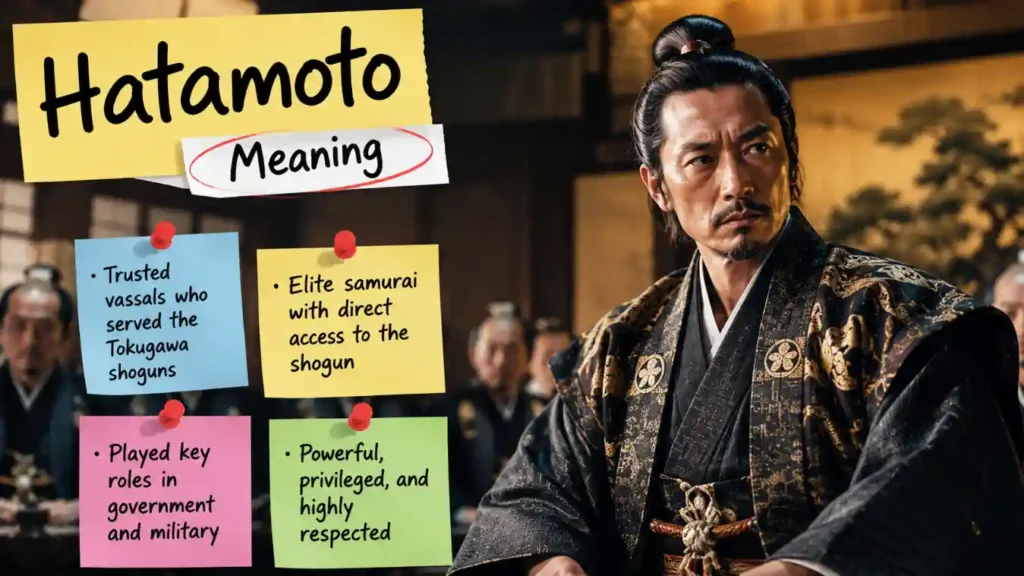
In feudal Japan, not every samurai answered to the same lord in the same way. The hatamoto meaning points to a specific, privileged rank: a samurai who served the shogun directly, rather than serving through a regional lord, and who held the right to a personal audience with the shogun himself.
This guide covers exactly what “hatamoto” means, where the word and the rank came from, how the term shows up in modern usage, and answers to the questions people ask most about it. By the end, you’ll understand where hatamoto fits into Japan’s feudal hierarchy and how the word gets used today.
What “Hatamoto” Means
The simple version:
A hatamoto was a samurai who served as a direct retainer of the shogun during Japan’s Edo period, ranked below a daimyo (regional lord) but above the lower-ranking gokenin retainers.
The fuller picture:
During the Edo period, under the Tokugawa shogunate, Japan’s warrior class fell into a strict hierarchy. Daimyo governed their own domains and answered to the shogun from a position of regional authority. Below the daimyo sat two tiers of direct shogunate retainers: hatamoto and gokenin. The key distinction between them was the right of direct audience with the shogun hatamoto held that privilege, while gokenin generally did not. Hatamoto received their income and status directly from the shogunate rather than from a regional lord, which placed them close to the center of political and military power even though most individual hatamoto held far less land and wealth than a daimyo.
Hatamoto served in a wide range of roles beyond battlefield duty, including administrative positions, guard duties, and other posts within the shogunate’s government structure, making the rank as much a bureaucratic and political identity as a purely military one by the later Edo period.
Origin and History
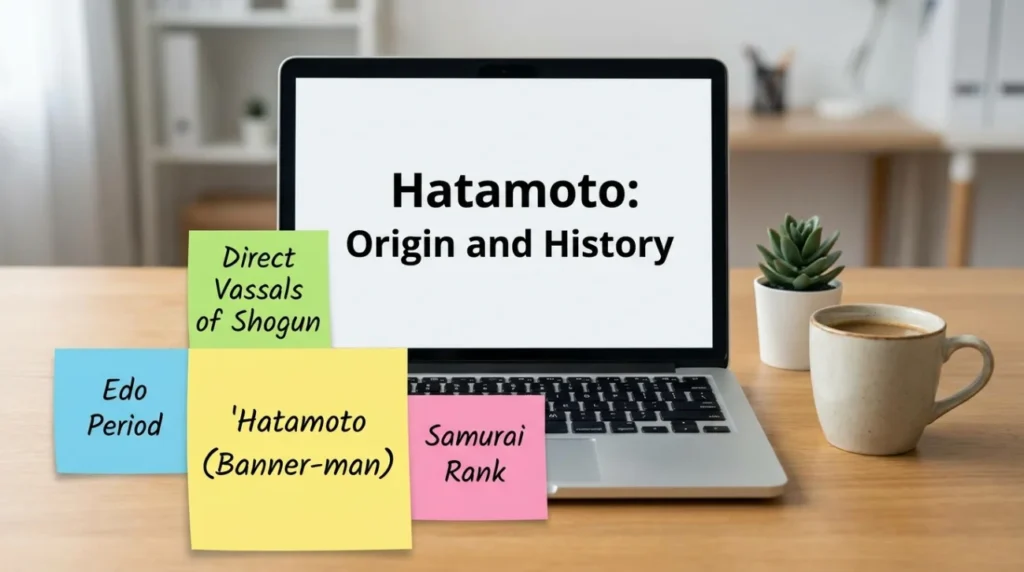
The word “hatamoto” combines two Japanese characters: hata, meaning “flag” or “banner,” and moto, meaning “base” or “origin.” Together, the term literally translates to something like “at the base of the flag,” referring to warriors positioned near their lord’s banner during battle, a place of trust and importance, since troops stationed close to the command banner were typically among the most reliable and directly loyal fighters.
The concept of warriors serving near a lord’s standard predates the Edo period, appearing in earlier eras of Japanese military history. However, “hatamoto” became a formalized, specific rank under the Tokugawa shogunate, which governed Japan from the early 1600s until the mid-1800s. The shogunate organized its direct retainers into clear tiers, with hatamoto sitting just below daimyo status, and this structure remained largely stable throughout the Edo period as part of Japan’s broader feudal system.
The rank effectively ended with the fall of the Tokugawa shogunate and the sweeping social reforms that followed, which dismantled Japan’s traditional samurai class structure along with many of the formal ranks and privileges tied to it.
Different Meanings and Contexts
Historical/feudal rank (primary meaning). In the context of Edo-period Japan, “hatamoto” refers specifically to a direct shogunate retainer with the right of personal audience with the shogun, ranked below daimyo and above gokenin.
General historical reference. Writers and historians use the term when discussing Japan’s feudal hierarchy, samurai culture, and the internal structure of the Tokugawa shogunate’s government and military.
Modern figurative use. In contemporary Japanese, “hatamoto” occasionally appears more loosely to describe someone’s closest, most trusted aides or inner circle echoing the original sense of warriors stationed near the leader’s banner, even outside a strictly historical or military context.
Pop culture and media. The term shows up in period dramas, novels, video games, and other media set in feudal Japan, usually referring directly to the historical samurai rank rather than any figurative meaning.
Examples of “Hatamoto” in a Sentence
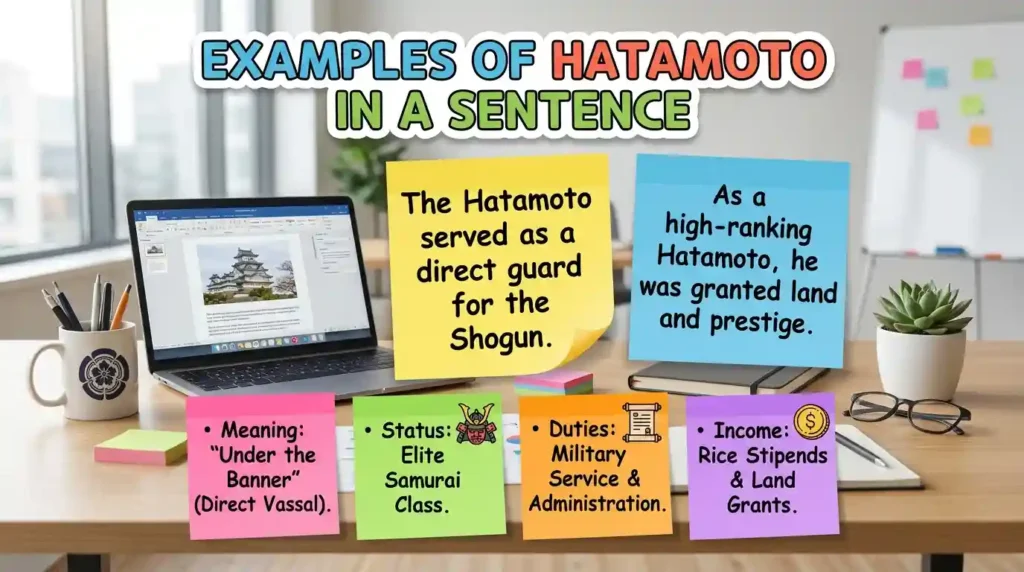
- “As a hatamoto, he answered directly to the shogun rather than to any regional daimyo.”
- “The novel follows a young hatamoto navigating the politics of Edo-period Japan.”
- “Hatamoto held a privileged position within the shogunate’s retainer system.”
- “Unlike a daimyo, most hatamoto governed no land of their own.”
- “The museum exhibit detailed the daily duties of a typical hatamoto household.”
- “He was promoted from gokenin to hatamoto after years of loyal service.”
- “The film depicts a hatamoto torn between duty to the shogun and loyalty to his family.”
- “Historians describe the hatamoto class as a crucial link between the shogunate and its administration.”
- “Some hatamoto served in purely administrative roles rather than military ones.”
- “The game lets players build a career from lowly foot soldier to respected hatamoto.”
How to Use “Hatamoto” Correctly
“Hatamoto” functions as a noun, referring either to an individual retainer or, collectively, to the class of retainers as a whole. In Japanese, the word doesn’t change form between singular and plural, and English writing generally follows that same convention.
A few usage notes:
- Capitalization depends on context. Many English-language history texts capitalize “Hatamoto” when treating it as a formal title or rank, though lowercase is also common and acceptable in general writing.
- Pair it with related terms. Words like daimyo, shogun, gokenin, and samurai often appear alongside “hatamoto” since the rank only makes sense within that broader feudal hierarchy.
- Specify the era when needed. Because the rank was specific to the Edo period, it’s helpful to note the historical period when writing for readers unfamiliar with Japanese history.
- Avoid using it as a generic word for “samurai.” Not every samurai was a hatamoto; the term refers specifically to direct shogunate retainers with audience privileges, a distinct and relatively privileged subset of the broader samurai class.
Common Mistakes to Avoid
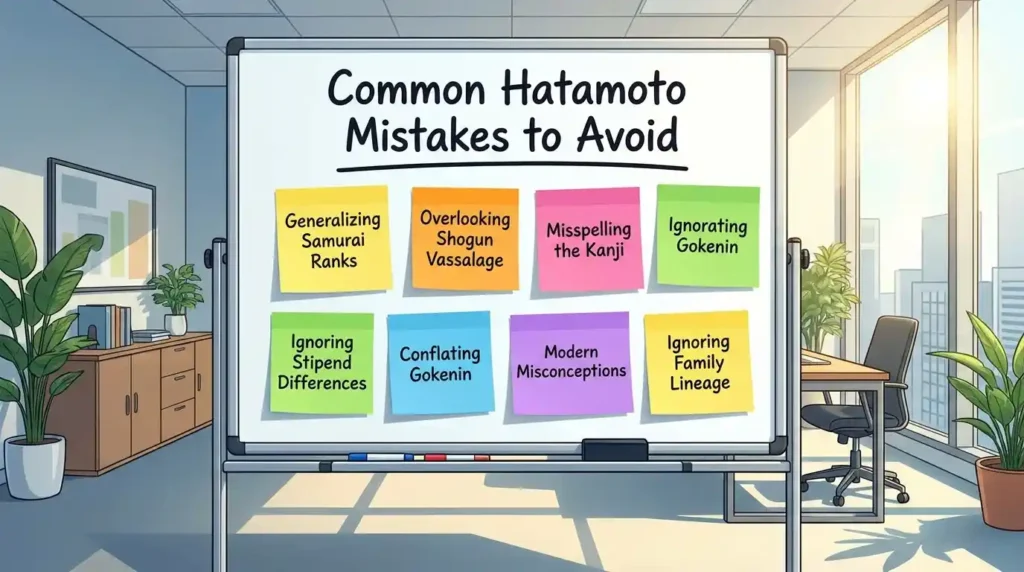
- Treating “hatamoto” and “samurai” as interchangeable. All hatamoto were samurai, but not all samurai were hatamoto. The term refers to a specific rank within the samurai class, not the class itself.
- Confusing hatamoto with daimyo. Daimyo governed their own domains and held significantly more land, wealth, and independent authority than hatamoto, who served as direct shogunate retainers rather than regional rulers.
- Assuming the rank still exists today. The hatamoto system ended along with Japan’s traditional feudal class structure in the 19th century; it’s a historical rank, not a modern title.
- Overlooking the administrative side of the role. Hatamoto weren’t purely battlefield warriors; many held bureaucratic or governmental posts within the shogunate, especially as the Edo period progressed.
Similar Words and Phrases
| Term | Meaning | How It Differs |
| Daimyo | A regional feudal lord who governed his own domain | Held far more land, wealth, and independent authority than a hatamoto |
| Gokenin | A lower-ranking direct shogunate retainer | Lacked the right of personal audience with the shogun that hatamoto held |
| Samurai | The broad warrior class of feudal Japan | A general term; “hatamoto” refers to one specific rank within it |
| Shogun | The military ruler who governed Japan on behalf of the emperor | The figure hatamoto served directly, rather than through an intermediary lord |
| Ronin | A samurai without a lord or master | The opposite of a hatamoto’s stable, direct service to the shogunate |
Opposite Words and Phrases
| Term | Meaning | Why It’s an Opposite |
| Ronin | A masterless samurai | Lacks the direct, formal service to the shogun that defines a hatamoto |
| Daimyo | A regional lord with independent territorial authority | Operates with far more autonomy and status than a hatamoto |
| Commoner (heimin) | A member of the non-samurai class in feudal Japan | Held none of the samurai status, privileges, or duties tied to the hatamoto rank |
Pronunciation
“Hatamoto” is pronounced hah-tah-MOH-toh, with all syllables given roughly equal weight, as is typical in Japanese pronunciation.
Quick Facts
| Fact | Detail |
| Meaning | A direct retainer of the shogun with the right of personal audience |
| Literal translation | “At the base of the flag” (hata = flag, moto = base) |
| Historical period | Formalized during Japan’s Edo period, under the Tokugawa shogunate |
| Rank position | Below daimyo, above gokenin |
| Part of speech | Noun |
| Related terms | Daimyo, gokenin, samurai, shogun |
Frequently Asked Questions
What does “hatamoto” mean?
It refers to a samurai who served as a direct retainer of the shogun during Japan’s Edo period, with the privilege of a personal audience with the shogun.
Where does the word “hatamoto” come from?
It combines the Japanese words for “flag” (hata) and “base” (moto), literally meaning “at the base of the flag” a reference to warriors stationed near their lord’s battle standard.
What’s the difference between a hatamoto and a daimyo?
A daimyo governed an independent regional domain with significant land and wealth, while a hatamoto served as a direct shogunate retainer, usually with far less land and no independent domain of his own.
What’s the difference between a hatamoto and a gokenin?
Both served the shogunate directly, but hatamoto held the right of personal audience with the shogun, while gokenin generally did not.
Does the hatamoto rank still exist today?
No, it was a historical rank tied to Japan’s feudal samurai system, which ended in the 19th century along with the broader class structure of the Edo period.
Were all hatamoto warriors?
Not exclusively. While rooted in military tradition, many hatamoto held administrative or bureaucratic roles within the shogunate’s government, especially later in the Edo period.
How do you pronounce “hatamoto”?
“Hah-tah-MOH-toh,” with roughly even stress across the syllables.
Is “hatamoto” used in modern Japanese?
It’s mainly a historical term today, though it occasionally appears in a looser, figurative sense to describe someone’s closest, most trusted aides.
Key Takeaways
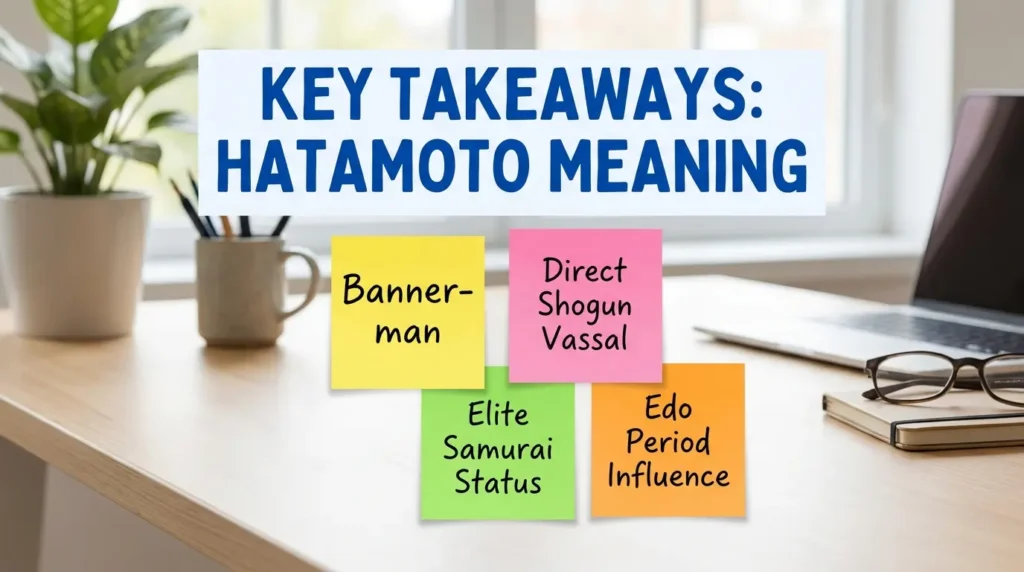
- A hatamoto was a samurai who served as a direct retainer of the shogun during Japan’s Edo period.
- The term literally means “at the base of the flag,” referencing warriors positioned near their lord’s battle standard.
- Hatamoto ranked below daimyo but above gokenin, distinguished by their right to a personal audience with the shogun.
- Not all hatamoto were purely military figures; many held administrative posts within the shogunate.
- The rank ended along with Japan’s feudal class system in the 19th century and now survives mainly as a historical term.
Conclusion
“Hatamoto” opens a window into how carefully structured Japan’s feudal hierarchy really was, a system where even within the elite warrior class, precise distinctions like the right to a personal audience with the shogun carried real political weight. Understanding the term helps make sense of period dramas, historical fiction, and nonfiction accounts of Edo-period Japan, where these distinctions shaped careers, loyalties, and entire family lines.
The rank disappeared with the fall of the shogunate, but the word hasn’t disappeared from the language or the culture built around that history. It still shows up in historical writing, film, and literature whenever a story needs a character positioned close to real power, trusted, privileged, and standing, quite literally, near the flag.
Next time you come across “hatamoto” in a novel, documentary, or history book, you’ll know exactly where that character sits in the feudal hierarchy, someone close enough to the shogun to matter, but still a rank below the true regional lords of the era.

I am Olivia Brooks an American editor and content researcher dedicated to creating clear, accurate content. At writemora.com, I help readers to understand words, phrases, and modern language with confidence.