
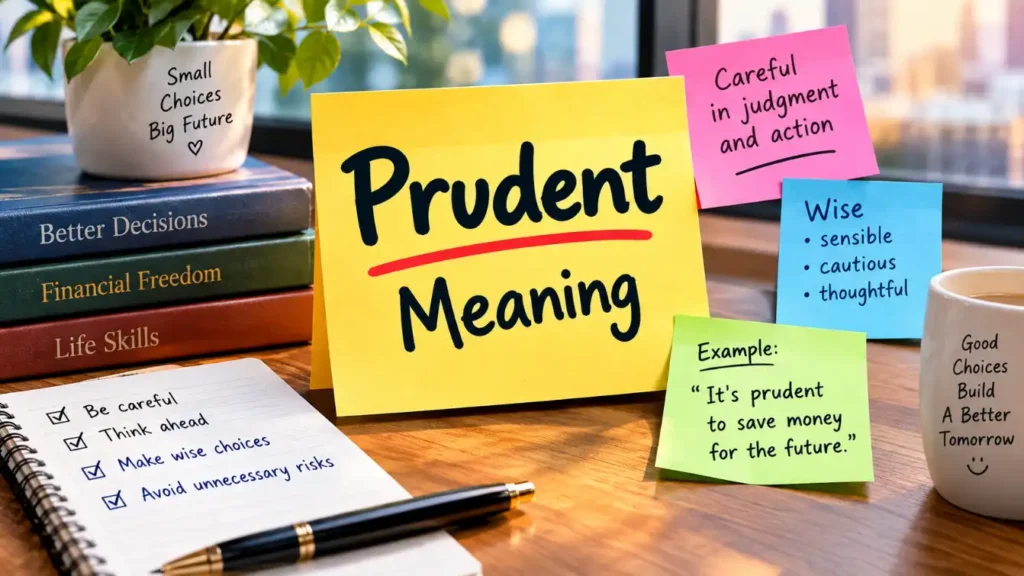
Prudent describes someone who exercises good judgment, careful thought, and caution especially when making financial, legal, or personal decisions. When you act prudently, you weigh consequences, avoid unnecessary risks, and consider long-term outcomes rather than chasing quick gains or impulsive choices.
You encounter prudent thinking everywhere: an investor who diversifies her portfolio instead of betting everything on one stock acts prudently. A manager who documents decisions and keeps meticulous records practices prudent business habits. A parent who maintains an emergency fund demonstrates prudent financial planning. Prudence combines wisdom, foresight, and restraint and it’s one of the oldest virtues across human cultures.
Understanding what prudent means matters because the word shapes how we evaluate decisions in business, finance, law, and personal life. Employers value prudent employees. Investors reward prudent leaders. Courts hold individuals and organizations to “prudent person” legal standards. This guide walks you through the definition, explores how prudence works across contexts, and shows you how to recognize and apply prudent thinking in your own decisions.
What Prudent Means: Simple Definition
Prudent means showing good judgment and careful thought, especially to avoid harm or unnecessary risk. A prudent person thinks ahead, weighs options, and makes decisions based on experience and reason rather than emotion or impulse.
Prudence isn’t fearfulness or excessive caution; a prudent investor still takes calculated risks. Instead, prudence represents balanced decision-making: you gather information, consider consequences, and act deliberately. Prudent thinking reduces the chances of regret because you’ve already weighed the tradeoffs.
The core idea: prudent means you think before you act, and your thinking protects your interests.
Origin and History of Prudent

The word “prudent” traces to Latin prudens, meaning “foreseeing” or “providing for.” Roman philosophers and statesmen valued prudential practical wisdom that guided action in law, governance, and daily life. Cicero, the Roman orator, emphasized prudentia as essential to political leadership and sound judgment.
Medieval and Renaissance scholars adopted the concept as one of the cardinal virtues foundational to ethical character. Thomas Aquinas wrote extensively about prudence as the ability to deliberate well and choose actions that align with reason and virtue. The word entered Middle English through Old French prudent, maintaining its meaning across centuries.
By the 17th and 18th centuries, “prudent” became central to economic and legal thinking. Scottish philosophers like David Hume wrote about the “prudent” person as someone who balances self-interest with responsibility to others. English common law developed the “prudent person” standard, a legal benchmark for how a reasonable, careful individual should act in specific circumstances.
Today, prudentness appears throughout finance, law, medicine, and ethics, always signaling that someone exercised good judgment and careful thought.
Different Meanings and Contexts for Prudent
Financial Prudence
In finance, prudence means managing money carefully, avoiding excessive debt, and thinking long-term. A prudent investor diversifies her portfolio, maintains an emergency fund, and resists the urge to chase speculative gains. Prudent lending means banks verify borrowers’ ability to repay before extending credit. Prudent budgeting requires tracking spending, prioritizing essential expenses, and saving for future needs.
Legal and Regulatory Prudence
Courts and regulators use “prudent person” or “prudent standard” to define how individuals and organizations should behave. Fiduciaries people who manage others’ money or assets must act as a “prudent person” would, putting clients’ interests first and avoiding conflicts of interest. Corporate directors face legal obligations to make prudent business decisions. Medical professionals must exercise prudent clinical judgment when treating patients.
Business and Organizational Prudence
Prudent business leadership means setting realistic goals, documenting decisions, maintaining adequate insurance, and planning for contingencies. A prudent manager doesn’t gamble the company’s future on a single product launch. Prudent hiring practices include thorough background checks and clear onboarding. Prudent crisis management means having backup plans and communication protocols ready before emergencies strike.
Personal and Health Prudence
Prudence in personal life means taking reasonable precautions: wearing a seatbelt, getting preventive medical care, backing up important documents, and choosing friends and partners carefully. Prudent health choices include regular exercise, managing stress, and listening to professional medical advice rather than self-diagnosing. Prudent travel means researching destinations, telling someone where you’re going, and carrying identification.
Risk Management and Insurance
Prudent risk management acknowledges that bad things happen and prepares accordingly. Homeowners carry homeowner’s insurance. Drivers maintain auto insurance. Businesses purchase liability coverage. A prudent organization identifies potential risks (cyberattacks, supply chain disruptions, key employee departure) and develops response plans before crises occur.
Relationships and Social Prudence
Prudent people think carefully before sharing secrets, making commitments, or burning bridges professionally or personally. A prudent employee maintains professional boundaries at work. A prudent friend doesn’t encourage someone to make impulsive decisions during emotional moments. Prudent social media use means thinking before posting and considering how words might be misunderstood.
How to Use “Prudent” Correctly
Use “prudent” to describe careful, thoughtful decision-making or people who exercise good judgment. It works as an adjective describing people, choices, actions, or practices.
Correct use:
- “She made the prudent choice to invest gradually rather than dumping all her savings into the stock market.”
- “The company’s prudent financial policies kept them solvent during the recession.”
- “He’s a prudent man who always reads contracts before signing.”
- “Prudent planning helped us avoid the worst effects of the supply chain crisis.”
- “It would be prudent to get a second opinion before accepting the diagnosis.”
Adverb form (prudently):
- “She prudently diversified her investments across multiple sectors.”
- “The board acted prudently by rejecting the overly aggressive expansion plan.”
Avoid common mistakes:
- Don’t use “prudent” to mean “prude” or sexually conservative that’s a different word entirely.
- Don’t use it for excessively cautious behavior (that’s timid or overcautious). Prudence allows reasonable risk-taking.
- Don’t confuse it with “prude,” which refers to someone easily shocked by matters of sex or taste.
Prudent describes wisdom in action: the person or choice that thinks carefully and avoids preventable mistakes.
Examples of Prudent Thinking in Real Situations
- Investment Strategy: A 30-year-old starts saving for retirement by contributing to a diversified portfolio rather than trying to time the market or chase hot stocks. This prudent approach typically outperforms aggressive trading over decades.
- Home Purchase: A couple with a $100,000 down payment chooses a house they can afford with a 15-year mortgage instead of stretching for a luxury home that would strain their budget. Prudent thinking protects them from foreclosure risk if income drops.
- Job Change: Before quitting her current job, a woman secures a written offer letter, verifies the company’s financial stability, and confirms the benefits package. She acts prudently rather than resigning based on enthusiasm alone.
- Health Decision: A man experiences chest pain and visits his doctor immediately instead of waiting to see if it resolves. Prudent action catches the problem early, possibly preventing serious complications.
- Contract Review: A freelancer has a lawyer review a major client contract before signing, rather than accepting the client’s terms without scrutiny. This prudent step prevents future disputes and protects his interests.
- Business Expansion: A restaurant owner opens her second location only after the first restaurant generates consistent profit and she secures adequate financing. She resists pressure to expand too quickly, acting prudently.
- Emergency Fund: A family maintains three to six months of expenses in savings, accessible for job loss, medical emergencies, or major repairs. This prudent preparation prevents them from going into debt during crises.
- Data Security: A company backs up critical data daily, uses strong passwords, and trains employees on phishing risks. Prudent cybersecurity practices prevent data breaches and ransomware attacks.
- Relationship Boundary: Before introducing a new partner to family and friends, someone waits until the relationship is established and stable. This prudent approach protects everyone from awkward situations if the relationship ends soon.
- Professional Reputation: A consultant declines lucrative work from a client she knows has ethical issues, recognizing the potential reputation damage. Prudent judgment protects her long-term career prospects.
Common Mistakes People Make with “Prudent”
Confusing prudent with fearful. Prudent people still take calculated risks with potential rewards. Someone who refuses all risk, avoiding investments or new opportunities from pure fear, isn’t prudent; she’s risk-averse. Prudence accepts reasonable risk after careful evaluation.
Assuming prudence means slow decision-making. Prudent thinking doesn’t require endless deliberation. A prudent manager can make quick decisions when circumstances demand speed, as long as the thinking is sound. Prudence describes the quality of judgment, not the speed of action.
Using “prudent” when you mean “prudish.” These are completely different words. Prudish means easily shocked or puritanical about sexuality. Prudent means careful and wise. Confusing them changes meaning entirely and sounds awkward.
Treating prudence as outdated or boring. Some dismiss prudent behavior as overly cautious or unambitious. In reality, prudent thinking drives long-term success in investing, business, and personal life. Many of the wealthiest, most successful people exemplify prudence.
Equating prudence with perfectionism. A prudent person accepts “good enough” decisions when perfection is impossible or the cost of pursuing it exceeds the benefit. Prudence means smart risk management, not eliminating all risk or delay.
Similar Words to “Prudent”: Comparison Table
| Term | Meaning | Key Difference |
| Wise | Having deep knowledge and good judgment | Wider concept; prudent is specific to careful caution |
| Cautious | Careful to avoid danger or mistakes | Cautious can be excessive; prudent is balanced |
| Sensible | Showing good practical sense and judgment | Sensible is broader; prudent emphasizes foresight |
| Judicious | Showing good judgment and wisdom in decisions | Nearly synonymous; judicious is slightly more formal |
| Discreet | Careful not to cause offense or draw attention | Discrete means separate; discreet means tactful |
| Deliberate | Done consciously and intentionally; carefully considered | Deliberate focuses on intentionality, prudent on care |
| Circumspect | Careful to consider all circumstances and consequences | Very formal; nearly identical to prudent in meaning |
| Vigilant | Keeping careful watch; alert to danger | Vigilant emphasizes active monitoring; prudent is planning |
| Conservative | Preferring traditional or moderate approaches | Conservative can mean rigid; prudent is flexible |
| Reckless | Showing lack of care for consequences (opposite) | Complete opposite of prudent |
Opposite of Prudent: Imprudent Behavior
Words describing imprudent behavior (the opposite of prudent):
- Reckless acting without regard for consequences
- Impulsive acting without deliberation or planning
- Hasty rushing decisions without sufficient thought
- Negligent failing to exercise proper care
- Foolhardy foolishly bold or daring
- Careless not paying sufficient attention to consequences
Pronunciation
Prudent is pronounced: PROO-dent
Two syllables: PROO (rhymes with “food”) + dent (rhymes with “bent”). Stress falls on the first syllable. The word flows naturally in speech without unusual sounds. The related adverb “prudently” adds a syllable: PROO-dent-lee.
Quick Facts About Prudence
| Aspect | Details |
| Part of Speech | Adjective (prudent), adverb (prudently), noun (prudence) |
| Opposite | Reckless, impulsive, negligent, hasty |
| Legal Use | Courts apply “prudent person” standards to evaluate conduct and liability |
| Finance | Fiduciaries must act as “prudent investors” managing others’ money |
| Historical Virtue | Counted as one of the four cardinal virtues in Western ethics |
| Cultural Value | Emphasized across cultures as essential to good character |
| Modern Relevance | Central to risk management, compliance, insurance, and professional standards |
| Common Phrases | “Prudent planning,” “prudent investor,” “prudent person,” “prudent choice” |
Key Takeaways
- Prudent means exercising good judgment and careful thought, especially to avoid harm or unnecessary risk; it’s not the same as fearfulness.
- Prudence appears across finance, law, business, personal life, and health anywhere important decisions carry consequences.
- A prudent person gathers information, weighs options, considers consequences, and acts deliberately rather than impulsively.
- The “prudent person” standard is a legal benchmark for evaluating if conduct was reasonable and responsible.
- Prudence balances risk-taking with careful planning. Prudent people take calculated risks, not avoid all risks.
- Opposite behaviors include recklessness, impulsiveness, negligence, and hasty decision-making.
FAQs:
What is the synonym for prudent?
Common synonyms for prudent include wise, sensible, careful, cautious, and judicious.
What does the Bible mean by prudent?
In the Bible, prudent generally means wise, thoughtful, and careful when making decisions or responding to situations.
What does “prudent person” mean?
A prudent person thinks carefully before acting and makes sensible decisions to avoid unnecessary risks or problems.
What is prudent behavior?
Prudent behavior means acting wisely, carefully, and responsibly, especially when making important decisions.
Which word is closest in meaning to prudent?
The word closest in meaning to prudent is wise, especially when describing careful and sensible judgment.
What are 5 strong synonyms?
Five strong synonyms for prudent are wise, sensible, cautious, judicious, and discerning.
Who is a prudent woman in the Bible?
The Bible describes a prudent woman as wise, responsible, and thoughtful, particularly in Proverbs 19:14 and Proverbs 31.
What does “prudent” mean in one word?
Prudent means wise.
Conclusion
Prudence operates across centuries and cultures as one of the foundational virtues: the ability to see ahead, weigh consequences, and act with wisdom rather than impulse. When you act prudently, you protect not just your immediate interests but your long-term future. That’s why courts anchor legal standards in prudent behavior, why fiduciaries must act as prudent investors, and why successful leaders across business and finance exemplify prudent thinking.
The practical power of prudence lies in this: it reduces regret. When you think before you act, gather information before deciding, and consider what could go wrong, you eliminate many preventable mistakes. Over years and decades, avoiding mistakes compounds into substantial advantages: more money preserved, stronger relationships maintained, better professional reputation built, fewer crises faced.
Prudence doesn’t mean fear or excessive caution. Prudent investors still invest in growth. Prudent innovators still take risks. The difference is that they’ve thought through consequences, built safeguards, and positioned themselves to weather downturns. They haven’t eliminated risk; they’ve managed it intelligently.

I am Olivia Brooks an American editor and content researcher dedicated to creating clear, accurate content. At writemora.com, I help readers to understand words, phrases, and modern language with confidence.