
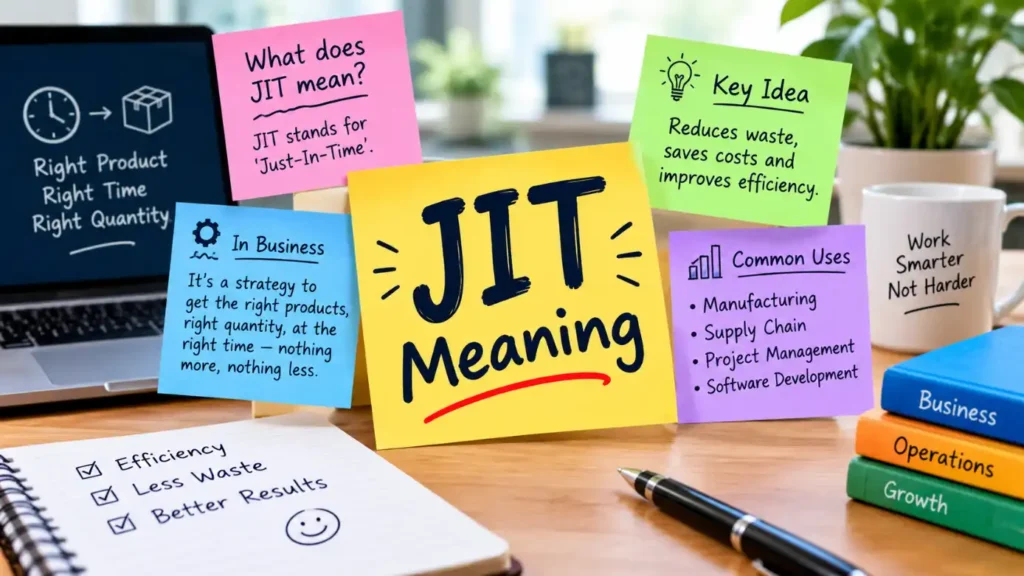
JIT stands for “Just-In-Time,” a strategy that delivers materials, products, or services at precisely the moment someone needs them not before, not after. Manufacturers pioneered JIT to slash inventory costs and reduce waste. Tech companies apply JIT principles to software deployment. Supply chain managers use JIT logistics to time shipments perfectly. Software engineers compile code with JIT compilers to optimize performance.
The core principle: eliminate waste by aligning supply with demand exactly. Instead of stockpiling inventory that ties up money and warehouse space, JIT systems produce or deliver only what’s needed when it’s needed. Toyota made JIT famous by building it into manufacturing operations starting in the 1970s. Today, JIT principles drive efficiency across manufacturing, retail, logistics, technology, and healthcare.
Understanding what JIT means matters because the strategy shapes how modern businesses operate and compete. If you work in supply chain, operations, or technology, you’ll encounter JIT concepts constantly. If you’re a business owner, JIT thinking can transform how you manage costs and cash flow. This guide walks you through what JIT actually means, explores how it works across industries, and shows you the real advantages and challenges of just-in-time strategies.
What JIT Means: Simple Definition
JIT (Just-In-Time) means delivering resources, materials, products, information, or services at the exact moment they’re needed, rather than in advance or after delay. A JIT system eliminates waiting time on both ends: suppliers don’t produce excess inventory, and customers don’t wait for items.
Think of it practically: Instead of a restaurant stocking 100 chickens in a freezer, a JIT restaurant orders chickens to arrive the morning they’ll be cooked, minimizing waste and ensuring freshness. Instead of a software company building features months ahead and holding them in staging, a JIT deployment releases features as soon as they’re ready and tested.
The magic of JIT: it reduces inventory costs, frees up cash, and minimizes waste but only when systems run smoothly.
Origin and History of JIT
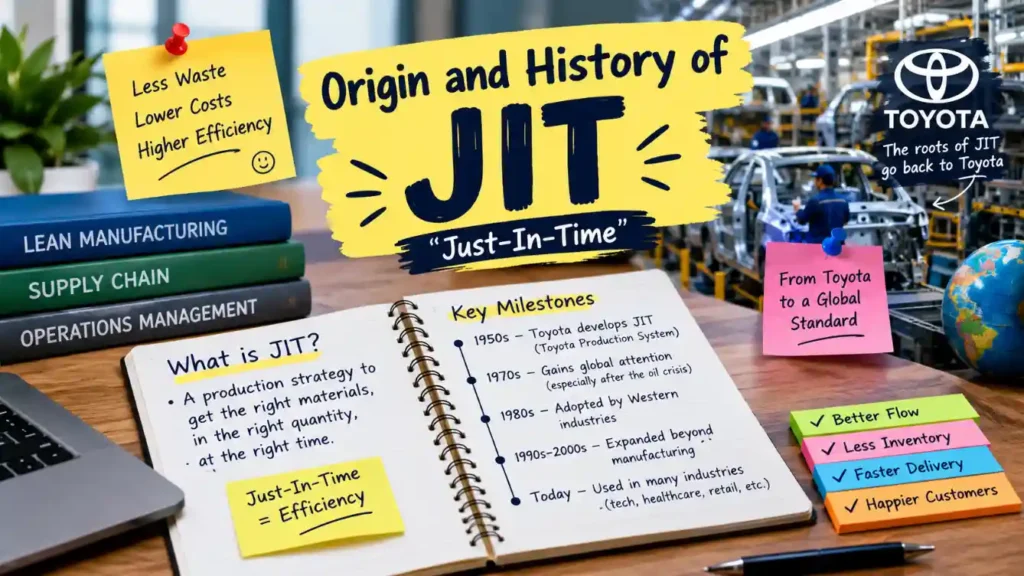
JIT manufacturing emerged in Japan during the post-World War II era as a response to resource scarcity. Japanese manufacturers couldn’t afford to stockpile materials like Western factories did, so they developed systems to order exactly what they needed when they needed it. Taiichi Ohno, an engineer at Toyota, refined JIT principles into a comprehensive manufacturing philosophy called the “Toyota Production System” starting in the 1950s.
The Toyota Production System combined JIT with other lean principles: continuous improvement (kaizen), waste elimination, and quality focus. By the 1970s and 1980s, Toyota’s efficiency and quality made it a global competitor. American and European manufacturers noticed and began adopting JIT strategies. The concept spread beyond manufacturing into retail (Walmart’s supply chain), food service, healthcare, and eventually software and technology.
The term “Just-In-Time” itself became popularized in the 1980s as Western companies studied Toyota’s methods and translated Japanese manufacturing principles into their own languages and cultures. Today, JIT represents a fundamental shift in how industries think about inventory, supply chains, and resource management.
Different Meanings and Contexts for JIT
JIT in Manufacturing and Production
Manufacturing companies use JIT to synchronize production with demand. Instead of making products for inventory and hoping they sell, JIT manufacturers make products only after receiving customer orders. An automotive parts supplier manufactures brake pads only when a car manufacturer places an order, then ships them to arrive exactly when assembly lines need them. This eliminates warehouse storage, reduces capital tied up in unsold inventory, and minimizes waste from obsolete products.
JIT in Inventory Management
Retailers and distributors apply JIT to inventory ordering goods to arrive just before they sell. A grocery store doesn’t stock six months of milk; it receives daily deliveries timed to match customer demand. A clothing retailer receives seasonal inventory just before the season starts, not months ahead. JIT inventory management frees up cash, requires less warehouse space, and reduces markdowns from unsold seasonal goods.
JIT in Supply Chain and Logistics
Supply chain managers use JIT delivery to coordinate shipments precisely. Parts and materials arrive at factories timed to production schedules. Delivery vehicles coordinate routes and timing to distribute products efficiently. JIT logistics requires sophisticated tracking systems, reliable suppliers, and backup plans because delays cascade quickly through the system.
JIT in Software and Programming
Software engineers use JIT (Just-In-Time) compilation to improve program performance. Instead of compiling code all at once before running it, JIT compilers compile code sections during execution, optimizing based on how the program actually runs. JavaScript engines like V8 (used in Chrome) use JIT compilation to accelerate code execution. JIT lets programmers write flexible code without sacrificing performance.
JIT in Business Operations and Finance
Companies apply JIT principles to cash management and capital allocation. Businesses time payments to suppliers strategically, use working capital efficiently, and time facility expansion to match actual growth rather than anticipated growth. A retail chain opens new stores JIT only when market demand and profitability justify the investment rather than opening speculatively.
JIT in Healthcare
Hospitals apply JIT principles to medications, medical supplies, and scheduling. Pharmacies receive medications JIT to avoid overstocking expensive drugs that might expire. Operating rooms receive sterile instruments and supplies timed to surgical schedules. Hospitals schedule staff JIT to match patient census, reducing labor costs while maintaining care quality.
JIT in Service Delivery
Service companies consulting, transportation, field service use JIT to deploy resources when clients need them. An IT consulting firm assigns developers to projects JIT as engagements start, rather than keeping staff on bench time. A delivery service dispatches couriers JIT to match delivery requests. This maximizes resource utilization and reduces idle time.
How to Use “JIT” Correctly
Use “JIT” when referring to strategies that time delivery, production, or resource allocation precisely to match need. It works as a noun (the JIT system), adjective (JIT manufacturing), or abbreviation (JIT logistics).
Correct use:
- “Our company switched to JIT inventory, which reduced warehouse costs by 40 percent.”
- “JIT manufacturing requires reliable suppliers and strong forecasting.”
- “The software uses JIT compilation to optimize performance.”
- “We implemented JIT delivery to our stores to minimize markdowns.”
- “JIT principles help us free up cash that was tied up in excess inventory.”
Adjectival form:
- “The JIT system reduced our carrying costs significantly.”
- “JIT supply chains are vulnerable to disruptions.”
- “JIT manufacturing demands precision and coordination.”
Avoid common mistakes:
- Don’t confuse JIT with other operational concepts like lean manufacturing (related but broader) or agile development (related but distinct).
- Don’t assume JIT works in all situations; it requires stable demand, reliable suppliers, and strong systems.
- Don’t use “JIT” as slang or informal shorthand for other meanings without context.
JIT describes a specific strategy of aligning supply timing with demand timing to eliminate waste and reduce costs.
Examples of JIT in Real Situations
- Automotive Supply Chain: A car manufacturer receives door panels from a supplier three days before they’re needed on the assembly line. JIT delivery minimizes the manufacturer’s parts storage and frees warehouse space.
- Grocery Store Inventory: A supermarket receives bread deliveries six days per week instead of one large weekly delivery. JIT allows the store to stock fresh bread while reducing shelf space devoted to old bread that would spoil.
- Tech Company Deployment: A software engineering team releases new features immediately after testing, rather than batching releases monthly. JIT deployment gets value to users faster and reduces the backlog of unreleased work.
- Restaurant Food Ordering: A restaurant orders fresh fish daily from a supplier rather than freezing bulk quantities. JIT sourcing ensures menu freshness and reduces waste from spoilage.
- Manufacturing Equipment: A factory receives replacement parts JIT to production schedules. When a machine needs maintenance, parts arrive just-in-time, minimizing downtime.
- Healthcare Pharmacy: A hospital pharmacy orders expensive cancer medications JIT only when patients are scheduled for treatment. This prevents overstocking costly drugs that might expire before use.
- Retail Store Staffing: A retail chain schedules employees JIT to match predicted customer traffic by hour. Staffing levels rise during lunch rushes and weekends, fall during slow periods, optimizing labor costs.
- JavaScript Execution: A web browser’s JavaScript engine uses JIT compilation to compile frequently-executed code sections during runtime, speeding up user interactions and animations.
- Consulting Project Staffing: A consulting firm assigns team members to client engagements JIT, only as projects start and require specific skills. This keeps consultants billable and reduces unpaid bench time.
- E-Commerce Fulfillment: An online retailer positions inventory in regional warehouses JIT based on shipping demand patterns, reducing distance to customers and delivery times.
Common Mistakes People Make with JIT
Assuming JIT works everywhere. JIT requires stable demand, reliable suppliers, and sophisticated systems. Industries with highly variable demand, long lead times, or unreliable suppliers often struggle with JIT. Implementing JIT in the wrong context creates more problems than it solves.
Underestimating complexity. JIT looks simple in theory but demands precision in execution. Forecasting must be accurate. Suppliers must be dependable. Systems must track inventory and orders in real-time. Companies that underestimate this complexity often abandon JIT after failed implementation.
Overlooking supply chain disruption risk. JIT systems are vulnerable to interruptions: a supplier delay cascades into production halts, a delivery truck breaks down, delays a shipment, a natural disaster disrupts logistics. Building resilience into JIT systems requires backup suppliers, safety stock strategies, and contingency planning.
Confusing JIT with just-in-case. JIT (just-in-time) minimizes inventory. Just-in-case (traditional inventory management) stocks safety buffers to handle uncertainty. These are opposites. Mixing the two strategies wastes the benefits of both.
Ignoring customer impact. JIT prioritizes cost and efficiency. But if JIT systems fail, customers suffer stockouts, delays, or unavailable products. Balancing JIT efficiency with customer satisfaction requires careful system design.
Not accounting for lead times. JIT requires realistic lead times in your forecast. If a supplier needs 30 days to produce and ship, you must order 30 days before you need the materials. Ignoring lead times makes JIT fail.
Similar Terms to JIT: Comparison Table
| Term | Meaning | Key Difference |
| Lean Manufacturing | Eliminating all forms of waste in production processes | Broader philosophy; JIT is one lean tool |
| Agile Development | Flexible software development with short iterations | Different context (software); JIT is supply-focused |
| Kanban | Visual system signaling when to produce or order materials | JIT is timing; kanban is a method to implement JIT |
| Continuous Flow | Steady production or supply without batching | Similar concept; JIT emphasizes timing specifically |
| Pull System | Producing based on actual demand, not forecasts | Very similar; pull systems often use JIT |
| Make-to-Order | Manufacturing products after receiving customer orders | Related; JIT enables efficient make-to-order |
| Safety Stock | Extra inventory to buffer against uncertainty | Opposite of JIT; JIT minimizes safety stock |
| Just-in-Case | Stocking inventory in advance to avoid shortages | Direct opposite of JIT |
| On-Demand | Providing services or products when requested | Similar outcome; broader than JIT’s specific timing |
Opposite of JIT: Push Systems and Batch Approaches
Terms describing non-JIT approaches (the opposite of JIT):
- Just-in-Case stocking inventory in advance to handle uncertainty
- Batch Production making large quantities at once to reduce per-unit costs
- Push System producing based on forecasts and pushing inventory to customers
- Safety Stock maintaining buffer inventory to protect against disruption
- Stockpiling deliberately accumulating excess inventory
- Make-to-Stock producing for inventory before receiving customer orders
Pronunciation
JIT is pronounced: JAY-AY-TEE (spelling out the letters)
Most people pronounce JIT by saying each letter individually rather than as a single word. The abbreviation is treated as an acronym, so you say “jay-ay-tee” not “jit” as a word. In formal writing, JIT appears with or without periods (JIT or J.I.T., though modern style prefers no periods).
Quick Facts About JIT
| Aspect | Details |
| Full Form | Just-In-Time |
| Origin | Toyota Production System, 1950s-1970s Japan |
| Primary Use Cases | Manufacturing, retail, supply chain, software, healthcare, operations |
| Key Benefit | Reduced inventory costs, freed working capital, minimized waste |
| Main Challenge | Vulnerability to supply disruptions and demand variability |
| Requires | Accurate forecasting, reliable suppliers, real-time systems, coordination |
| Related Concepts | Lean manufacturing, kanban, pull systems, continuous improvement |
| Common Industries | Automotive, electronics, retail, food service, healthcare, software |
| Success Factors | Stable demand, dependable suppliers, sophisticated tracking, contingency plans |
Key Takeaways
- JIT (Just-In-Time) means timing supply to match demand exactly, eliminating advance inventory while reducing waste and capital tied up in stock.
- JIT works across manufacturing, retail, supply chain, software, healthcare, and operations anywhere organizations can time delivery precisely.
- JIT reduces inventory costs and frees working capital, but requires accurate forecasting, reliable suppliers, and sophisticated systems.
- Successful JIT demands stable demand, dependable suppliers, real-time tracking, and contingency planning for disruptions.
- JIT is vulnerable to supply chain disruptions; a single delay cascades through the entire system without buffer inventory.
- JIT represents a fundamental shift from push systems (produce for inventory) to pull systems (produce on demand).
FAQs
What’s the main advantage of JIT?
JIT dramatically reduces inventory costs and frees up cash that would otherwise sit in warehouses. For a company with $10 million tied up in inventory, JIT might free up $7 million.
What are the risks of JIT?
JIT systems are vulnerable to disruptions. A supplier delay, natural disaster, transportation problem, or demand spike can cascade into production halts and customer shortages.
Can small businesses use JIT?
Yes, but typically less aggressively than large manufacturers. A small business might use JIT for some inventory categories while maintaining safety stock for critical items. The key is matching JIT intensity to your actual business volatility and supplier reliability.
What does JIT mean in software development?
In software, JIT usually refers to Just-In-Time compilation, where a compiler translates code during program execution rather than beforehand. This allows compilers to optimize based on actual usage patterns, improving performance. Modern JavaScript, Java, and .NET engines all use JIT compilation.
How does JIT affect quality?
JIT can improve quality by catching defects quickly. There’s no large batch of bad parts sitting in inventory. However, JIT can also reduce quality if suppliers cut corners to meet tight schedules. Success requires that quality expectations remain non-negotiable despite time pressures.
What’s the difference between JIT and lean manufacturing?
Lean manufacturing is a broader philosophy eliminating all waste in processes motion, waiting, overproduction, defects, and more. JIT is one tool in the lean toolkit, specifically focused on timing and inventory.
Is JIT still relevant after COVID-19 supply disruptions?
Yes, but companies are reconsidering how much JIT risk to accept. Many businesses now maintain strategic safety stock for critical items and diversify suppliers.
Conclusion
Just-In-Time represents one of the most impactful operational innovations of the past 50 years. By eliminating the waste of excess inventory and timing supply to match actual demand, JIT has transformed how companies operate, compete, and manage cash. What Toyota pioneered in factories now shapes supply chains, software engineering, healthcare delivery, and business operations across industries.
The power of JIT lies in its simplicity: stop creating waste through overproduction. Instead, align what you make and deliver with what customers actually need, right when they need it. This simple principle cascades into major advantages: lower costs, faster cash conversion, fresher products, less storage, less obsolescence. Companies that master JIT gain competitive advantages that persist for years.
But JIT’s simplicity masks complexity. Successfully implementing JIT requires flawless systems, reliable partners, and accurate forecasting. One weak link, a supplier that misses deadlines, a forecast that’s wildly wrong, a transportation disruption collapses the entire advantage. The COVID-19 pandemic exposed this vulnerability as global supply chains buckled and companies struggled with stockouts. The lesson: JIT works brilliantly when systems function smoothly, but amplifies problems when they don’t.

I am Stephen King an American author known for compelling storytelling. At writemora.com, we value clear, accurate, and reader-focused content inspired by excellence in writing.