

NEET stands for “Not in Education, Employment, or Training.” It describes a person, usually a young person, who is not currently studying, working, or participating in job-related training. Online, NEET can also be used as slang for someone who is unemployed and outside the usual school-or-work routine.
Key Takeaways
- NEET means Not in Education, Employment, or Training.
- The term is commonly used when discussing young people outside education and work.
- Being unemployed does not automatically make someone NEET.
- Online, NEET can be used seriously, humorously, or negatively depending on context.
- NEET (UG) can also refer to India’s National Eligibility-cum-Entrance Test, a completely different meaning.
What Does NEET Mean?

The NEET meaning is Not in Education, Employment, or Training. It is an acronym used to describe someone who is not participating in education, paid employment, or training that prepares them for work.
The term is especially common in discussions about young people and the transition from school to employment. The OECD defines NEET youth as people who are neither employed nor participating in formal education or training.
For example, imagine someone who has finished high school, is not attending college, does not have a job, and is not enrolled in a vocational program. Depending on the definition being used, that person could be classified as NEET.
The exact age range can vary by country and statistical program. For example, UK statistics commonly use ages 16–24, while international measures may use different age groups.
What Does NEET Stand For?
NEET stands for:
N — Not
E — Education
E — Employment
T — Training
In the standard phrase, it means “not in education, employment, or training.” Cambridge Dictionary and Oxford Learner’s Dictionaries both use this definition.
The three parts are important because NEET is broader than simply being unemployed.
Education
A person is generally considered outside education when they are not participating in an applicable educational program. This can include situations where someone has completed school but is not currently enrolled in college or another qualifying educational program.
Employment
Employment means having a job or working. Someone who is unemployed may be looking for work, while someone who is economically inactive may not currently be looking for work.
NEET measures can include both groups because the category is not limited to people actively searching for jobs.
Training
The final part is training. A person who is not attending school but is completing qualifying vocational or job-related training may not fall into the NEET category.
This is one reason why simply saying “NEET means unemployed” is incomplete.
What Does NEET Mean in Slang and Text?
In texting, social media, gaming communities, and internet conversations, NEET usually keeps its original meaning but is often used more casually.
Someone might write:
“He’s been a NEET for months.”
Here, the speaker probably means that the person is not working, studying, or receiving job training.
Online, however, NEET can also become a lifestyle label. Some communities use it humorously or self-referentially for someone who spends most of their time at home, playing games, browsing the internet, or avoiding conventional school-and-work routines. Online slang sources document this broader usage.
That casual usage should not be confused with an official statistical definition.
For example:
- Formal: “The report measures the number of young people who are NEET.”
- Casual: “I’ve basically become a NEET this summer.”
- Humorous: “My NEET era has officially begun.”
The meaning depends heavily on context.
Is NEET the Same as Being Unemployed?
No. Unemployment and NEET status are related but not identical.
An unemployed person does not have a job and may be actively looking for work. A NEET person is outside employment and education or training.
For example:
| Situation | NEET? |
| Works full-time but is not in school | No |
| Attends college but does not have a job | No |
| Has no job but attends vocational training | Usually no |
| Has no job and is not studying or training | Potentially yes |
| Has a part-time job and is not in school | No |
This distinction matters because employment statistics and NEET statistics measure different things. The OECD notes that NEET measures can include both unemployed people and people who are economically inactive.
Is Calling Someone a NEET an Insult?
Not necessarily. The word itself is a descriptive acronym, but its tone can change depending on how someone uses it.
In government, academic, and economic discussions, NEET is generally a neutral classification. Dictionaries also define it without making “lazy” or “bad” part of the core meaning.
Online, however, someone may use NEET as a joke, self-description, criticism, or insult. In some internet communities, it can suggest that a person is socially isolated or has withdrawn from conventional education and employment.
For example:
- “I’m currently NEET while figuring out my next career move.” neutral.
- “He’s a NEET who spends all day gaming.” potentially judgmental.
- “Welcome to my NEET arc.” often humorous or self-referential.
Therefore, context and tone matter.
Where Did the Term NEET Come From?
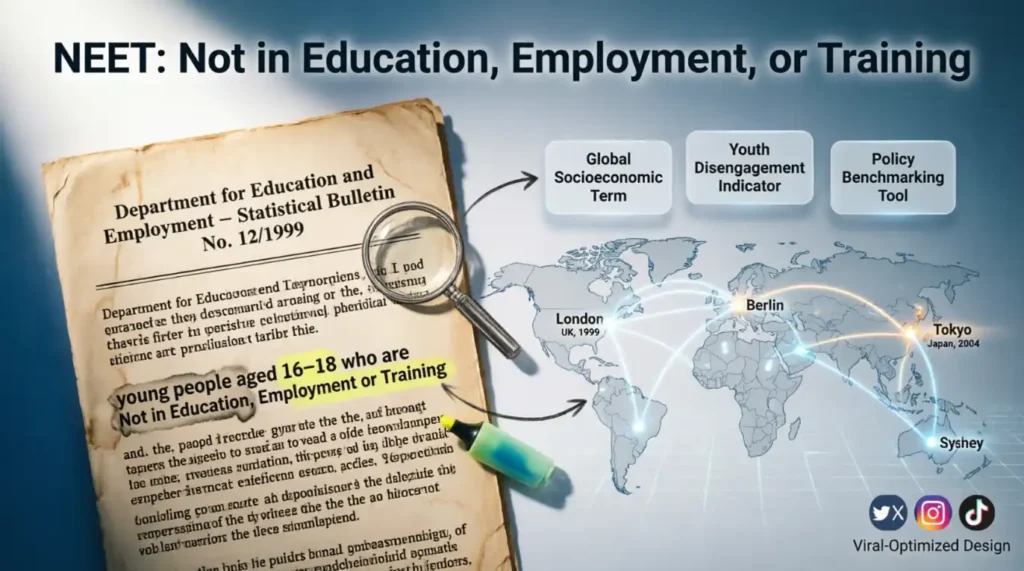
The term developed as a way of identifying young people who were outside education, employment, and training. Research literature traces the term to the United Kingdom in the late 20th century, after which it became increasingly used internationally.
Today, NEET is used by governments, researchers, international organizations, and other groups studying youth education and employment.
The concept is useful because traditional unemployment figures do not capture everyone who is outside both work and education. Someone who has stopped looking for work, for example, may not be counted as unemployed even though they are still outside employment.
What Does NEET Mean in Anime and Internet Culture?
You may also encounter NEET in anime discussions, Japanese internet culture, gaming communities, and memes.
In these contexts, the term can describe a person who is not working or studying and may spend much of their time at home. It is sometimes associated with the broader image of a socially withdrawn or home-based lifestyle.
However, NEET and hikikomori are not exact synonyms. NEET describes a person’s relationship to education, employment, and training, while hikikomori refers to a much more specific pattern of prolonged social withdrawal.
Internet users may use these terms loosely, but they should not automatically be treated as interchangeable.
NEET Meaning vs. Similar Terms
| Term | Basic meaning |
| NEET | Not in education, employment, or training |
| Unemployed | Without a job and generally seeking/available for work under statistical definitions |
| Economically inactive | Not employed and not participating in the labor force |
| Student | Participating in education |
| Trainee | Participating in qualifying work-related training |
The most important distinction is that NEET combines the absence of employment with the absence of education or training.
Examples of NEET in a Sentence
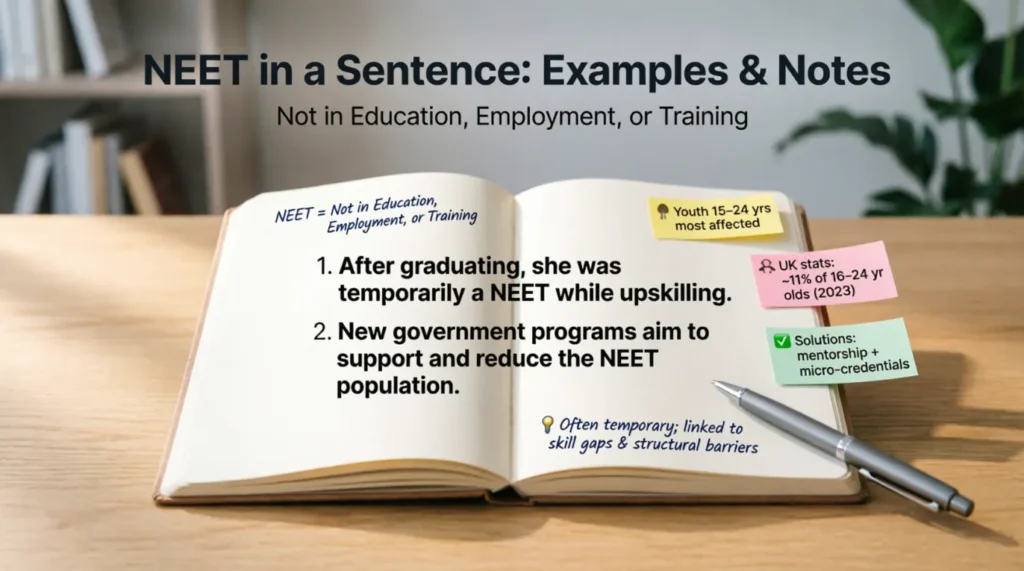
Here are several natural examples:
- “After finishing school, he took the NEET for several months.”
- “The organization helps young NEETs find education and employment opportunities.”
- “She described herself as NEET while deciding what career to pursue.”
- “The article examines why some young people become NEET.”
- “He used the word NEET jokingly to describe his break between jobs.”
These examples show how the word can work in formal reports as well as everyday online conversation.
Does NEET Have Another Meaning?
Yes. NEET can refer to a completely different acronym in the context of Indian education.
NEET (UG) stands for National Eligibility-cum-Entrance Test (Undergraduate). It is India’s national entrance examination used for admission to undergraduate medical education and certain other health-related programs. India’s National Testing Agency currently administers the examination.
So context is important:
- “He is NEET and looking for work.” → Not in Education, Employment, or Training.
- “She is preparing for NEET.” → India’s medical entrance examination.
For a U.S. audience searching for neet meaning as slang or an English term, the first definition is generally the relevant one.
Frequently Asked Questions
NEET stands for Not in Education, Employment, or Training. It describes people who are not currently participating in education, employment, or qualifying work-related training.
In text and online conversations, NEET usually means someone who is not in education, employment, or training. It may be used seriously, casually, humorously, or negatively depending on the context.
NEET is not inherently a bad word. It is a descriptive acronym, but online speakers sometimes use it as a negative label or insult. The tone depends on who uses it and why.
No. A person can be unemployed while attending school or participating in qualifying training. NEET generally refers to people who are outside employment, education, and training at the same time.
In anime and internet culture, NEET usually refers to someone who is not working, studying, or training and may spend much of their time at home. It is often used as a character description or internet-culture label.
Conclusion
Understanding the NEET meaning is about more than knowing what four letters stand for. NEET means “Not in Education, Employment, or Training,” and the term can describe a real situation in education and employment discussions or appear casually in online conversations.
It does not automatically mean someone is lazy or unmotivated. Context matters, especially because NEET can also refer to India’s medical entrance exam. So, whenever you see the word, look at the surrounding conversation to understand which meaning is intended.

I am Olivia Brooks an American editor and content researcher dedicated to creating clear, accurate content. At writemora.com, I help readers to understand words, phrases, and modern language with confidence.