
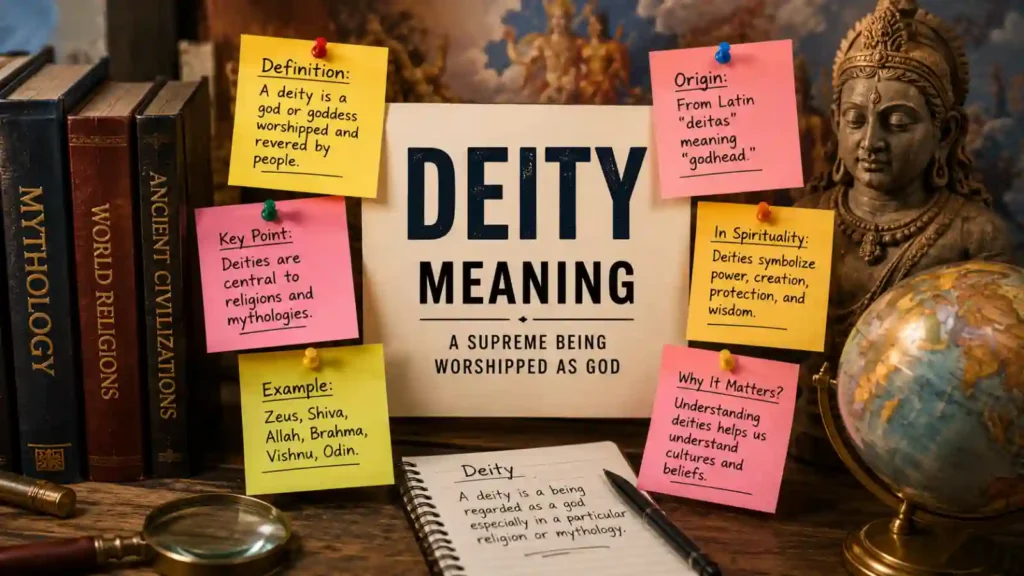
Deity meaning, in simple terms, is a god or goddess : a divine being that people worship and credit with power over some part of the world, nature, or human life. When people talk about “the deity” in a religion, or “deities” in mythology, they mean the divine figures at the center of that belief system.
The word sounds formal, and writers tend to reach for it in academic, religious, or literary contexts rather than everyday conversation. But the concept behind it, a being considered divine, ranks among the oldest and most widespread ideas in human culture. Nearly every religion and mythology, from ancient Egypt to modern faiths, centers on one or more deities.
This guide covers what deity means, where the word comes from, how different religious and cultural contexts use it, and how to use it correctly yourself.
What It Means
The simple version
A deity is a god or goddess. It’s a being that people regard as divine or sacred, one they often credit with supernatural power, immortality, and influence over the natural world or human affairs.
The fuller picture
“Deity” works as a broad, neutral umbrella term. It doesn’t specify:
- How many there are (a religion can center on one deity, as in monotheism, or many, as in polytheism).
- What kind of power the deity holds (some deities create and rule everything; others govern a single domain, like the sea, the harvest, or love).
- Which tradition it belongs to (the word applies equally to the God of Abrahamic religions, the Greek god Zeus, the Hindu goddess Lakshmi, or a local nature spirit a specific community worships).
Because it stays neutral and general, scholars, writers, and comparative religion courses use “deity” to discuss gods and goddesses across different belief systems without favoring one tradition’s terminology over another.
Origin & History
Deity comes from the Latin word deitas, meaning “divine nature” or “godhood,” which itself derives from deus, meaning “god.” Early Christian Latin writers, often credited to the theologian Augustine, coined deitas as a way to discuss the abstract quality of being divine, not just a specific god by name.
The word entered English through Old French (deité) around the 14th century. Over time, deity meaning in english shifted slightly from the abstract quality of “godhood” to the more concrete sense people use today: a god or goddess as an individual being.
The Latin root deus traces back further to the Proto-Indo-European root dyeu-, which also gives us words like “divine,” “Zeus,” and “Jupiter” (from Dyēus phter, roughly “sky father”). That shared root shows how deeply this concept runs across ancient Indo-European languages and cultures.
Deities Meaning
The word deities means gods, goddesses, or divine beings that are worshiped or respected in a particular religion, culture, or belief system. It is the plural form of deity. Different cultures have different deities associated with areas such as wisdom, love, war, nature, fertility, or protection. For example, ancient Greek religion included deities such as Zeus, Athena, and Aphrodite. The term can also be used more generally when discussing supernatural or divine figures. Understanding the meaning of deities can help explain religious traditions, mythology, ancient stories, and cultural beliefs. In simple words, deities are divine beings believed to possess supernatural or sacred powers.
Deity Plural
The plural form of deity is deities. A deity refers to one god, goddess, or divine being, while deities refers to more than one. For example, “Athena is a deity in Greek mythology” describes one divine figure, while “Greek mythology contains many deities” refers to several gods and goddesses. The spelling changes from deity to deities because words ending in “-y” often change the “y” to “-ies” when made plural. The word deities is commonly used in discussions about religion, mythology, history, and cultural traditions. It can describe divine figures from ancient religions as well as supernatural beings recognized in various belief systems.
Deities Definition
The definition of deities is divine beings, gods, or goddesses that are worshiped, honored, or regarded as possessing supernatural powers. Deities can appear in religious traditions, mythology, folklore, and cultural stories. Some are believed to control natural forces, while others represent qualities such as wisdom, strength, beauty, justice, or love. For instance, different ancient civilizations had their own groups of deities with specific roles and characteristics. The meaning can vary depending on the culture or religion being discussed. In everyday language, deities generally refers to more than one divine being. Therefore, the simplest definition is: deities are multiple gods, goddesses, or sacred supernatural beings.
What Does Deities Mean?
Deities means more than one god, goddess, or divine being. The word is used when talking about religious or mythological figures believed to have supernatural, sacred, or divine powers. For example, if someone says, “The ancient Egyptians worshiped many deities,” they mean that ancient Egyptian religion included numerous gods and goddesses. Deities may have different roles depending on the belief system, such as protecting people, controlling nature, representing wisdom, or guiding human affairs. The singular form is deity, meaning one divine being. In simple terms, when you see the word deities, think of multiple gods or goddesses associated with a religion, mythology, or cultural tradition.
Divine Deity Meaning
The phrase divine deity refers to a god, goddess, or supernatural being considered sacred and possessing divine qualities or powers. The word divine describes something connected with a god or a higher spiritual nature, while deity means a god or goddess. Because the meaning of deity already involves divinity, the phrase “divine deity” can sometimes sound repetitive. However, it may be used for emphasis when describing a sacred or supernatural figure. In religious and mythological discussions, divine deities may be associated with creation, protection, nature, wisdom, war, love, or other powerful forces. Simply put, a divine deity is a sacred or supernatural god-like being.
What Does Deities Mean?
When someone asks “What does deities mean?”, they are asking about the plural meaning of the word deity. Deities refers to two or more gods, goddesses, or divine beings. The term is often found in discussions of mythology and religion, especially when a tradition recognizes multiple supernatural figures. For example, ancient Greek, Roman, Egyptian, and Norse traditions include groups of deities with different names, personalities, powers, and responsibilities. A deity may be connected with nature, war, love, wisdom, fertility, or protection. So, in very simple English, deities means multiple divine or supernatural beings that people may worship, honor, or recognize as sacred.
Different Contexts and Meanings

The core meaning, a divine being, stays the same, but “deity” shifts depending on the tradition or field.
Monotheistic religions
In religions like Christianity, Islam, and Judaism, “deity” typically refers to the single, supreme God. Theological or academic writing tends to favor the term, while believers usually say “God” directly in everyday worship language.
Polytheistic religions and mythology
In polytheistic systems, ancient Greek and Roman religion, Hindu traditions, Norse mythology, and many Indigenous belief systems, “deity” refers to any one of multiple gods or goddesses, each often tied to a specific domain: war, wisdom, the harvest, the underworld, and so on.
Comparative religion and academic use
Scholars favor “deity” as a neutral, cross-cultural term when they compare belief systems, since it doesn’t assume a specific religion’s framework the way “God” (capitalized, often specifically Abrahamic) might.
Everyday and figurative use
Informally, people sometimes stretch “deity” to describe someone others treat with god-like reverence or influence, as in “fans treat the singer like a deity,” though this counts as a figurative, non-literal use.
Examples
- Ancient Egyptians worshipped many deities, including Ra, the sun god.
- Local people dedicated the temple to a deity they believed protected the harvest.
- In Hindu tradition, deities like Vishnu and Shiva play central roles.
- The philosopher wrote extensively about the nature of the supreme deity.
- Greek mythology features a large pantheon of deities, each with distinct powers.
- She studied how ancient cultures depicted their deities in art.
- The novel imagines a world where a forgotten deity returns to earth.
- Norse mythology includes well-known deities such as Odin and Thor.
- Some Indigenous traditions honor nature deities tied to rivers, mountains, or forests.
- The museum displayed statues of several ancient Mesopotamian deities.
How to Use It (Grammar and Context)
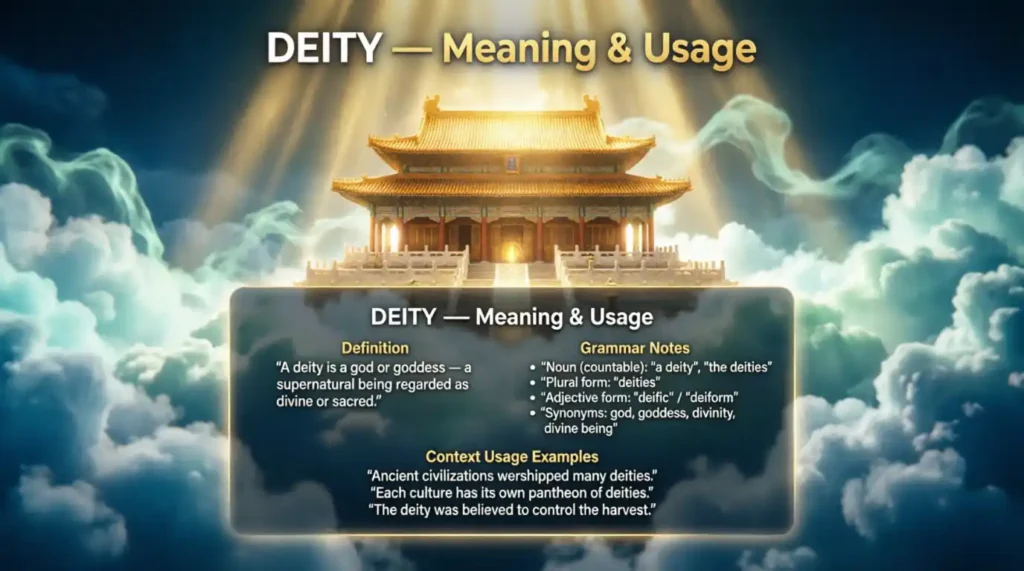
Deity is a countable noun.
- Singular: “a deity,” “the deity”
- Plural: “deities”
Writers typically pair it with a religion, culture, or mythology for context: “an Egyptian deity,” “a Hindu deity,” “a minor deity in Greek mythology.” When referring to the single God of a monotheistic religion, “deity” often follows “the,” as in “belief in a single deity” (a phrase that describes monotheism itself).
Related word forms:
- Deify (verb) : to treat or worship someone or something as a god.
- Deification (noun) : the act of making something a deity, or the state of being deified.
- Deistic / Deism : related but distinct terms that describe a specific philosophical belief about a distant, non-intervening creator; these don’t mean the same thing as “deity” itself.
Common Mistakes
- Confusing “deity” with “diety.” Writers often misspell it as “diety”; the correct spelling is d-e-i-t-y.
- Assuming “deity” only applies to polytheistic religions. It applies equally to the single God of monotheistic faiths.
- Mixing up “deity” and “divinity.” Deity refers to the being itself (a god), while divinity more often refers to the quality of being divine, or to the academic field of religious study.
- Using “deify” and “deity” interchangeably. Deify is the verb (to make something a deity); deity is the noun (the being itself).
Similar Words
| Word | Meaning | Difference from Deity |
| God | A divine being, often capitalized for the supreme being in monotheism | People use it more often in everyday religious speech; “deity” reads as more formal or academic |
| Divinity | The quality of being divine, or the academic study of religion | Refers to a quality or field, not necessarily a specific being |
| Idol | An image or object that represents a deity, which some traditions worship in its own right | Refers to a representation, not the divine being itself |
| Spirit | A supernatural being that doesn’t always rank as a full deity | Often carries lower status or a more localized scope than a deity |
| Divine being | A general descriptive phrase for something godlike | Reads as less formal; not a single fixed term |
Opposite Words
| Word | Meaning |
| Mortal | A being subject to death, not divine |
| Human | An ordinary person, without divine status |
| Atheist (concept) | Describes disbelief in any deity, rather than an opposite being |
| Secular | Relating to non-religious, worldly matters, as opposed to the divine |
Pronunciation
Deity is pronounced DEE-ih-tee (/ˈdiːɪti/), with the stress on the first syllable.
Quick Facts
| Fact | Detail |
| Word type | Noun |
| Origin | Latin deitas (“divine nature”), from deus (“god”) |
| First recorded English use | Around the 14th century |
| Common fields of use | Religion, mythology, comparative religious studies, literature |
| Plural form | Deities |
| Common confusion | People often misspell it as “dirty” |
Key Takeaways
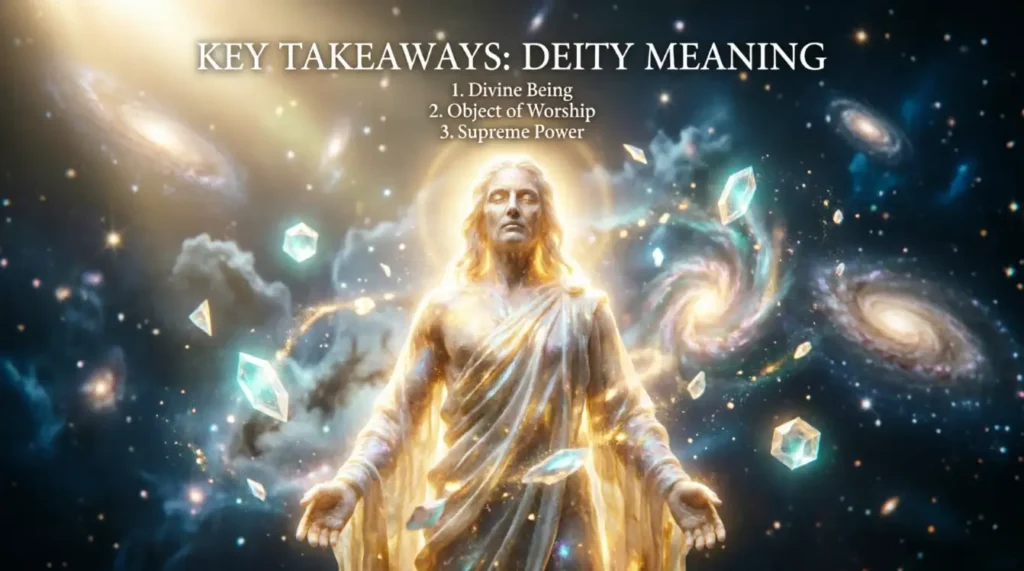
- Deity means a god or goddess, a divine being that people credit with power over some part of existence.
- The word comes from the Latin deitas (“divine nature”), rooted in deus (“god”).
- It applies to both monotheistic religions (one deity) and polytheistic traditions (many deities).
- Deity works as a neutral, cross-cultural term that academic and comparative religion writing often favors.
- People commonly confuse it with “divinity” (a quality) and misspell it as “diety.”
- The plural form is “deities.”
FAQs
What does deity mean in simple terms?
Deity means a god or goddess, a divine being that people often worship and credit with power over some part of the world or human life.
Is deity always capitalized?
No. “Deity” stays lowercase as a general word. Writers capitalize it only as part of a proper name or in specific religious texts that use “Deity” as a direct stand-in for “God,” though this varies by style guide.
What’s the difference between deity and God?
“God” (capitalized) usually refers specifically to the supreme being in monotheistic religions like Christianity, Judaism, and Islam. “Deity” works as a broader, more neutral term that can refer to any god or goddess in any tradition.
Can a deity be female?
Yes. People often call a female deity a goddess, though “deity” itself stays gender-neutral and can refer to any divine being regardless of gender.
What is the difference between deity and divinity?
Deity refers to a specific divine being (a god or goddess). Divinity refers to the quality of being divine, or sometimes to the academic study of religion.
How many deities are there in the world’s religions?
This varies enormously. Monotheistic religions recognize one deity, while polytheistic traditions can include dozens or even hundreds of named deities.
What does it mean to deify someone?
To deify someone means to treat or elevate them to the status of a god, if literally in religious practice or figuratively, as in celebrity culture.
Is “deity” a religious or scientific term?
It’s a religious and cultural term that theology, mythology, and comparative religion use, not a scientific one.
Conclusion
At its core, “deity” simply names a god or goddess, but its neutrality makes it useful. It lets people discuss gods across very different religions and mythologies, from a single supreme God to a whole pantheon of specialized gods and goddesses, using one shared term.
Next time you come across the word in a history book, a religious studies class, or a mythology retelling, you’ll know exactly what it points to: a being that some tradition considers divine, whichever one it comes from.

I am Stephen King an American author known for compelling storytelling. At writemora.com, we value clear, accurate, and reader-focused content inspired by excellence in writing.