
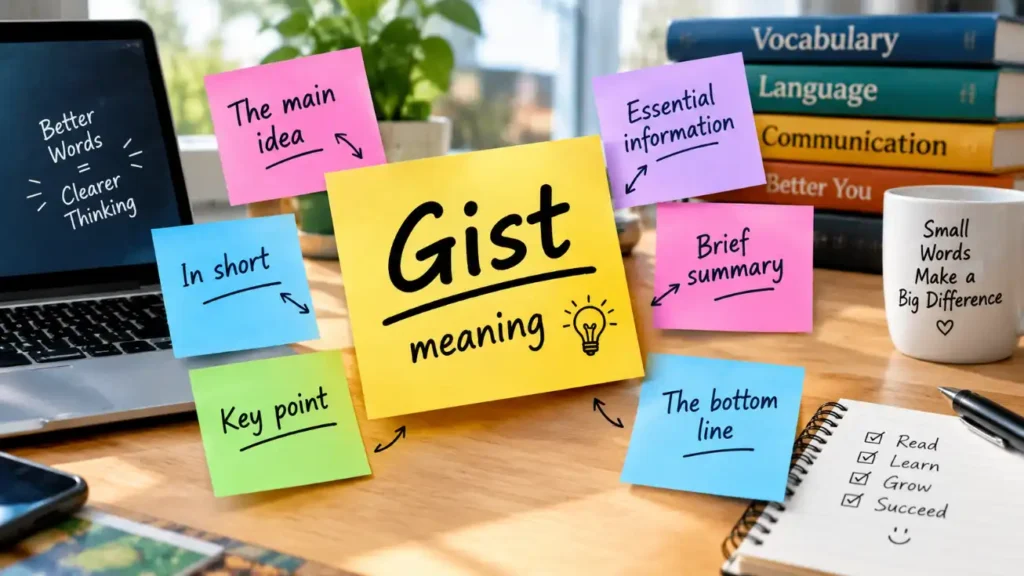
Gist refers to the essential meaning or main point of something, stripped of extra detail. When someone asks for “the gist” of a story, article, or conversation, they want the core idea summarized quickly, not every specific detail included.
You’ll hear the word constantly in everyday conversation, work meetings, and casual summaries of books, movies, or news. Understanding the gist meaning helps you use the word precisely when you want to communicate or request a quick, boiled-down summary.
This guide covers what gist means, where the word comes from, how people use it in different contexts, and the mistakes people sometimes make with it.
What It Means

In simple terms, gist names the central or essential point of something: a conversation, document, story, or argument without all the surrounding detail. Getting “the gist” of something means understanding its core meaning even if you missed or skipped over the finer points.
In a fuller sense, gist implies a kind of efficient compression: taking something potentially long or complex and reducing it to its most important, useful core. The word works well specifically because it acknowledges that some information matters more than the rest, and getting the gist means correctly identifying which parts those are.
People typically use “gist” when speed or simplicity matters more than complete accuracy on every detail catching someone up quickly, skimming a long email, or summarizing a meeting for someone who missed it.
Origin & History
Gist comes from the Anglo-French legal term “gist,” which itself derives from the French word “gésir,“ meaning “to lie” (as in physically resting or lying down). In legal English, the phrase “the gist of the action” originally referred to the essential grounds or basis on which a legal case rested literally, where the case “lay” or was founded.
This legal usage entered English in the 18th century, specifically referring to the core legal basis of a lawsuit, the essential fact or claim that made the case valid. Over time, English speakers broadened the term beyond strictly legal contexts, applying it more generally to the essential point or main idea of anything, not just legal arguments.
By the 19th century, the modern, everyday meaning of “gist” had become well established, describing the core meaning of any statement, story, or document, far removed from its narrow legal origins.
Different Contexts and Meanings

In everyday conversation. This is the word’s most common modern use asking for or providing the main point of a story, explanation, or event without going through every detail: “Just give me the gist.”
In summarizing documents or articles. People often use “gist” when skimming or condensing longer written material, extracting the key takeaway without reading or repeating every section in full.
In legal contexts (rare today). The word’s original legal meaning, the essential basis of a lawsuit, still occasionally appears in formal legal writing, though it’s far less common than the everyday, general usage.
In workplace communication. Colleagues often ask for “the gist” of a meeting, email thread, or report when they need the key information quickly, without reading through lengthy documentation.
In storytelling and reviews. People frequently give “the gist” of a movie, book, or show when recommending it to someone else, sharing the core plot or theme without spoiling every detail.
Examples
- “I didn’t read the whole report, but I got the gist of it.”
- “Can you give me the gist of what happened at the meeting?”
- “The gist of her argument was that the plan needed more funding.”
- “He explained the gist of the movie without giving away the ending.”
- “I missed the first half of the call, but I caught the gist.”
- “The gist of the email was that the deadline got pushed back.”
- “She skimmed the article just to get the gist before the discussion.”
- “The lawyer explained the gist of the original legal claim.”
- “Even in translation, the gist of the poem came through clearly.”
- “I’ll spare you the details and just give you the gist.”
How to Use It (Grammar and Context)
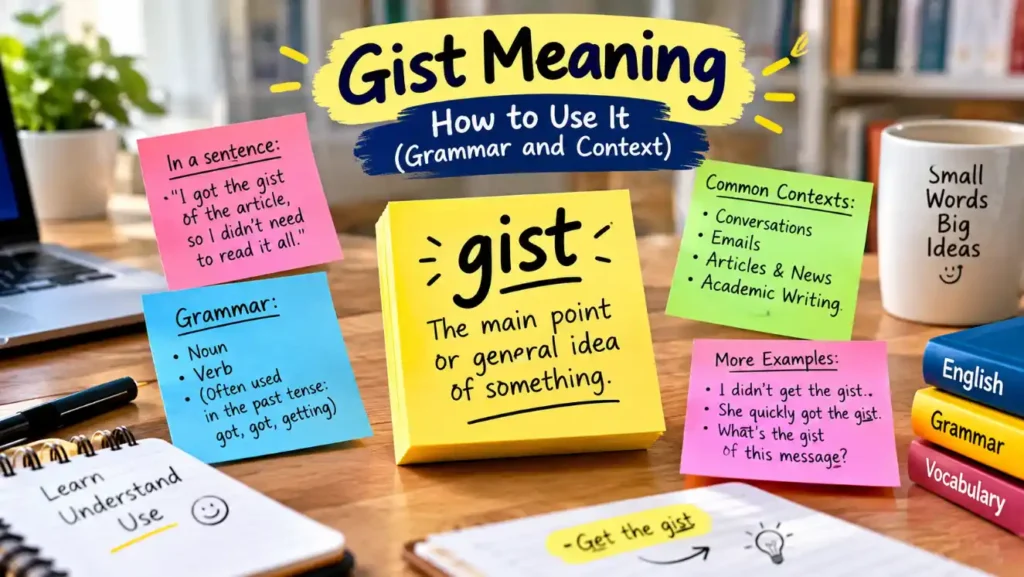
Gist functions as a noun, almost always paired with the definite article “the”: “the gist of it,” “get the gist,” “give me the gist.” It rarely appears without “the” directly before it in standard usage.
The word pairs naturally with verbs like “get,” “give,” “grasp,” or “catch,” each implying a quick, efficient extraction of the main point rather than a detailed, thorough reading or listening process.
Common Mistakes
Assuming gist means a completely accurate summary. Getting the gist implies understanding the main point, not necessarily every nuance or exact detail; it’s an efficient approximation, not a precise, comprehensive account.
Using gist for something with no clear main point. The word works best when something does have an identifiable central idea; using it for a rambling or unfocused piece of writing can feel like a stretch.
Confusing gist with summary. The words overlap closely, but “summary” often implies a more structured, complete overview, while “gist” specifically emphasizes the single most essential point.
Forgetting the definite article. Native speakers virtually always say “the gist,” rarely “a gist” or “gist” alone, since the word functions almost exclusively within that fixed phrase.
Similar Words
| Word | Meaning | Difference from Gist |
| Summary | A condensed overview covering the main points of something | A summary can be more detailed and structured; gist specifically emphasizes just the core, essential idea |
| Essence | The most fundamental or intrinsic quality of something | Essence often applies more abstractly to character or nature; gist applies more specifically to information or explanation |
| Crux | The most important or decisive point of an issue or argument | Crux often implies the central problem or turning point specifically, while gist refers more broadly to the general main idea |
| Overview | A general summary or broad view of a topic | An overview can include more structure and breadth; gist focuses tightly on the single core takeaway |
Opposite Words
| Word | Meaning | Why It’s an Opposite |
| Detail | A specific, individual piece of information | Directly contrasts with gist’s focus on the broad, essential point rather than specifics |
| Minutiae | Small, precise details, often considered unimportant | The opposite of gist’s focus on the big-picture core idea |
| Verbatim | Word-for-word, exact repetition of something | Contrasts with gist’s approximate, condensed nature |
Pronunciation
Gist is pronounced JIST, rhyming with “list” and “fist.”
Quick Facts
| Fact | Detail |
| Word origin | Anglo-French legal term, from French “gésir” (to lie) |
| Original meaning | The essential legal basis of a lawsuit |
| Modern meaning | The main point or essential idea of anything |
| Common phrase | “The gist of it,” “get the gist” |
| Typical use | Quickly summarizing without full detail |
| Grammatical pattern | Almost always paired with “the” |
Key Takeaways
- Gist refers to the essential meaning or main point of something, without full detail.
- The word comes from an Anglo-French legal term originally describing the basis of a lawsuit.
- It almost always appears paired with “the,” as in “the gist of it.”
- Gist differs slightly from “summary,” emphasizing the single core idea rather than a fuller overview.
- People use it constantly in conversation, work communication, and casual storytelling.
FAQs
What is the full meaning of “gist”?
“Gist” means the main idea, essential point, or general meaning of something.
What does “gist” mean in slang?
In informal use, “gist” usually means the basic idea or important information about something.
What is a GIST in medical terms?
GIST stands for gastrointestinal stromal tumor, a type of tumor that develops in the digestive system.
What is the synonym of GIST?
Common synonyms include essence, main idea, point, substance, meaning, and crux.
What is a gist example?
“The gist of the story is that the man moved to a new city to start a better life.”
When someone says “gist me” what does it mean?
“Gist me” informally means “tell me the main point” or “give me a quick summary.”
What does it mean to GIST with someone?
“Gist with someone” is not standard English; people may use it informally to mean sharing or discussing the main idea with someone.
What is another way to say “get the GIST of”?
You can say “understand the main idea,” “grasp the point,” or “get the basic idea.”
How do you use GIST in a sentence?
Example: “I didn’t read the entire report, but I understood the gist of it.”
What not to eat if you have GIST?
There is no universal GIST-specific food ban. Follow your doctor’s advice and limit foods that worsen your symptoms or treatment side effects.
Can GIST be cancerous?
Yes. GISTs can be cancerous (malignant), although their risk varies based on factors such as tumor size, location, and growth rate.
Conclusion
The gist meaning captures something useful about how people actually process information: not everything deserves equal attention, and getting to the heart of a story, document, or conversation quickly often matters more than absorbing every detail. That’s exactly the job this small, efficient word does.
Its legal origin adds an interesting layer once you know it: the modern, casual “give me the gist” traces directly back to lawyers arguing about the essential grounds of a case, a use so specific and formal that it’s almost unrecognizable in how casually the word gets used today. Few everyday phrases carry that much distance between their original and current meanings.
Next time someone’s about to explain something long-winded, asking for “the gist” remains one of the most efficient requests in English, a single word doing the work of “just tell me the part that actually matters.”

I am Stephen King an American author known for compelling storytelling. At writemora.com, we value clear, accurate, and reader-focused content inspired by excellence in writing.