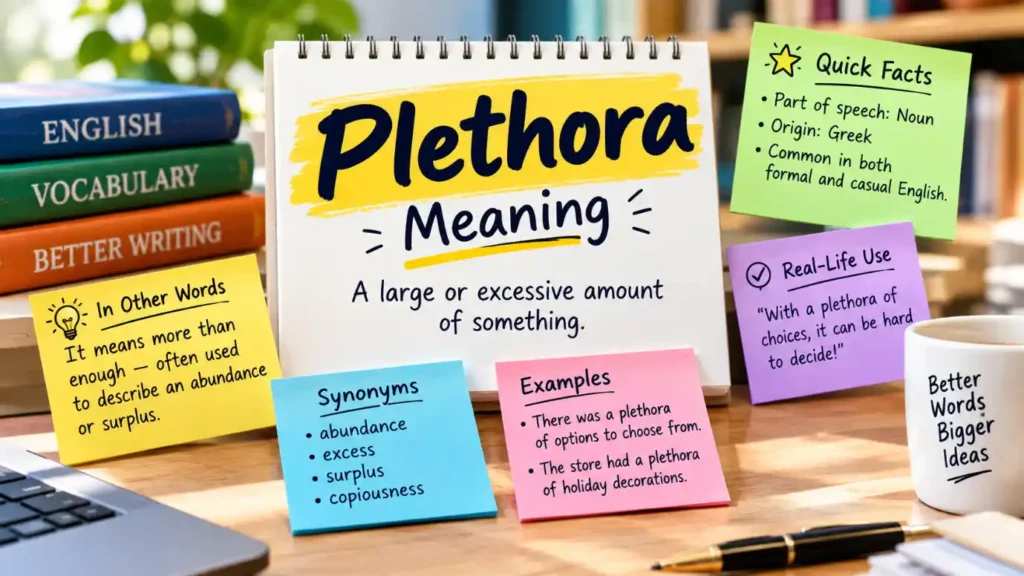
Plethora means a very large amount or number of something, often more than is needed, wanted, or easy to handle. It is a formal noun commonly used in the phrase “a plethora of,” as in “a plethora of choices.” Depending on context, it can suggest abundance, excess, or simply a large quantity.
Key Takeaways
- Plethora means a very large amount or number of something.
- It often suggests more than necessary, although it can be neutral or positive.
- The most common structure is “a plethora of + noun.”
- It is a relatively formal word, so “a lot of” or “plenty of” may sound more natural in casual conversation.
- Its English history goes back to a Greek word associated with fullness and an older medical sense of excess bodily fluid.
What Does Plethora Mean?
The word plethora is a noun used to describe a very large amount or number of something. In many contexts, it carries the idea that there is more than necessary or more than someone can easily deal with.
For example:
The website offers a plethora of useful resources.
This means the website offers a very large number of resources. The sentence does not necessarily say the resources are bad. It simply emphasizes how plentiful they are.
However, plethora can also suggest excess:
The company faces a plethora of complicated regulations.
Here, the large number of regulations is presented as a problem.
Major English dictionaries describe plethora as a formal noun meaning a very large amount, particularly an amount greater than what is needed, wanted, or manageable.
Simple Meaning of Plethora
In simple English, you can usually understand plethora as:
a very large amount, abundance, or excess of something.
The exact feeling depends on the sentence.
How to Use “Plethora” in a Sentence
The most common construction is:
a plethora of + noun
For example:
- There is a plethora of information online.
- The store has a plethora of options.
- She received a plethora of advice from her friends.
- The city offers a plethora of restaurants.
- The report contains a plethora of statistics.
The word can describe both countable and uncountable things.
For countable nouns:
a plethora of choices
For uncountable nouns:
a plethora of information
The phrase is especially common in formal writing, journalism, academic discussion, and professional communication.
“A Plethora of” Examples
Here are some natural examples in American English:
- The library has a plethora of books on American history.
- Students have a plethora of online resources available to them.
- The restaurant offers a plethora of vegetarian dishes.
- There were a plethora of questions after the presentation.
- The report contains a plethora of useful details.
- Consumers now have a plethora of streaming options.
- The job applicant had a plethora of skills but limited experience.
- The website provides a plethora of examples for English learners.
These examples show why context matters. A plethora can be helpful, overwhelming, excessive, or simply abundant.
Does Plethora Mean “A Lot” or “Too Much”?
The answer is both, depending on context.
Traditionally and in many dictionary definitions, plethora has a strong connection with excess. Cambridge describes it as a very large amount, especially one greater than what is needed, wanted, or manageable.
But modern English also uses the word more broadly for a large or abundant quantity. Dictionary.com, for example, gives both the sense of overabundance or excess and the broader meaning of a large quantity or wide array.
Compare these sentences:
The website has a plethora of learning resources.
This can sound positive or neutral.
The website has a plethora of unnecessary pop-ups.
This clearly suggests an excessive amount.
So, plethora does not always mean “too much” in a strongly negative sense. Context determines the tone.
Plethora Pronunciation
In American English, plethora is pronounced approximately:
PLETH-uh-ruh
The U.S. pronunciation is commonly represented as:
/ˈplɛθ.ɚ.ə/
The first syllable sounds like “pleth,” with the th pronounced as the unvoiced sound in think.
You can break it into three parts:
PLETH – uh – ruh
The stress falls on the first syllable.
Plethora vs. Similar Words
Several English words are close in meaning to plethora, but they are not always interchangeable.
| Word | Basic meaning | Typical feeling |
| Plethora | Very large amount, often excessive | Formal; can be negative or neutral |
| Abundance | Large or plentiful supply | Usually positive |
| Multitude | Large number of people or things | Mostly neutral/formal |
| Profusion | Large or abundant supply | Often suggests richness or excess |
| Excess | More than necessary | Clearly suggests too much |
Plethora vs. Abundance
Abundance usually has a more positive meaning.
The garden has an abundance of flowers.
This sounds pleasant and desirable.
The garden has a plethora of flowers.
This emphasizes the unusually large number and can sound more formal or excessive.
Plethora vs. Multitude
Multitude focuses on a large number or crowd.
A multitude of people attended the event.
Plethora emphasizes abundance or excess:
The event generated a plethora of questions.
Plethora vs. Profusion
Profusion means a large or abundant supply and is also relatively formal.
The garden was filled with a profusion of colorful flowers.
Both profusion and plethora can describe abundance, but plethora more readily carries the idea of more than needed or manageable.
Is Plethora Formal or Casual?
Plethora is generally formal.
You are more likely to see it in:
- Academic writing
- Business reports
- News articles
- Professional presentations
- Essays
- Formal discussions
In casual American conversation, people often choose simpler expressions such as:
- a lot of
- lots of
- plenty of
- many
- tons of
For example:
Formal:
The company offers a plethora of services.
More conversational:
The company offers a lot of services.
Both sentences communicate a similar basic idea, but the first sounds more formal.
Using plethora is not wrong in conversation. It simply has a more sophisticated or formal tone, so it may sound unnatural if used where a simple phrase would be clearer.
Origin and History of Plethora
The history of plethora is especially interesting because the word originally had a medical meaning.
English adopted plethora in the 16th century, through Late Latin from the Greek plēthōrē, meaning fullness. The Greek word is related to plēthein, meaning “to be full.”
Historically, the word was used in medicine for a condition associated with an excess of blood or bodily fluid. Over time, its meaning expanded beyond medicine.
Eventually, plethora came to describe an excessive or overflowing amount of almost anything.
That explains why the modern meaning still has a strong connection to the idea of fullness or excess.
Common Grammar Questions
Is “A Plethora of” Correct?
Yes. “A plethora of” is one of the standard and most common ways to use the word.
Examples:
a plethora of choices
a plethora of problems
The noun after of can be plural when referring to separate countable items, or uncountable when referring to a mass or quantity.
Should You Use “Is” or “Are” After Plethora?
This is a little more complicated than it first appears.
In formal writing, “plethora” is a singular noun, so a singular verb is often used:
A plethora of options is available.
However, English usage also allows notional agreement in some contexts, where writers focus on the plural items represented by the phrase:
A plethora of options are available.
Usage guides have documented both patterns. The choice can depend on if the writer treats plethora as one collective quantity or emphasizes the individual things within it.
For learners who want the safest straightforward construction, “a plethora of options is available” clearly treats plethora as the singular subject.
What Is the Plural of Plethora?
The plural form plethoras exists, although it is uncommon.
In ordinary English, you will rarely need the plural. Most writers simply use plethora as a singular noun:
The report contains a plethora of examples.
The word itself is enough to express the idea of abundance, so plethoras is usually unnecessary.
Frequently Asked Questions
The simplest meaning of plethora is “a very large amount or number of something.” It can also suggest that the amount is excessive or greater than necessary.
It can be either. Plethora often suggests excess, but context can make it neutral or positive. A “plethora of problems” is negative, while a “plethora of opportunities” can sound positive.
Depending on context, useful synonyms include abundance, excess, profusion, surplus, overabundance, multitude, and large quantity. The best choice depends on if you want to emphasize plenty, excess, or simply a large number.
Yes. Plethora is generally considered formal English. It works well in academic, professional, and written contexts, while phrases such as “a lot of” or “plenty of” are usually more natural in casual conversation.
Yes. You can use it to describe a large number of people: The conference attracted a plethora of visitors. However, multitude, crowd, or large number may sometimes sound more natural when specifically talking about people.
“A plethora of” means a very large amount or number of something. It often implies an abundance that may be greater than necessary or manageable.
The conference attracted a plethora of visitors.
However, multitude, crowd, or large number may sometimes sound more natural when specifically talking about people.
Conclusion
The plethora meaning is essentially a very large amount or number of something, often with the added idea of excess. It is a formal English noun most commonly found in the phrase “a plethora of.”
For example, saying “a plethora of choices” means there are many choices, possibly so many that they feel excessive or difficult to handle.
Remember that plethora is more formal than everyday expressions such as “a lot of” or “plenty of.” Use it when you want to emphasize abundance, especially in professional, academic, or polished writing. Its long history from an old medical term for fullness or excess to its modern general meaning also explains why the word is so closely associated with the idea of having more than enough.

I am Olivia Brooks an American editor and content researcher dedicated to creating clear, accurate content. At writemora.com, I help readers to understand words, phrases, and modern language with confidence.

