
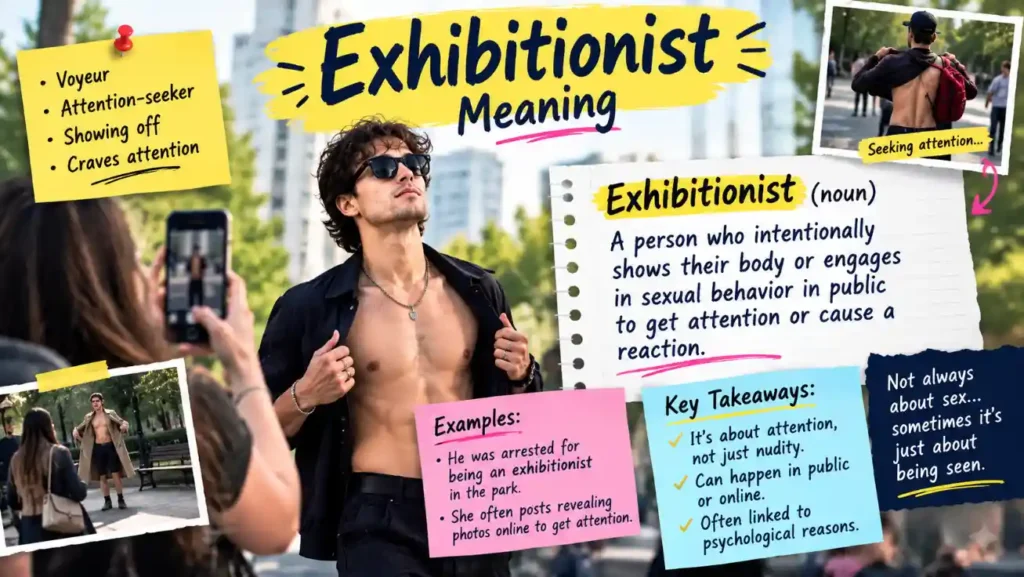
Exhibitionist has two main meanings, and they are very different in weight. In psychology, it describes a clinical pattern involving exposing oneself to unsuspecting people, which psychologists can diagnose as exhibitionistic disorder. In everyday speech, it usually just means someone who loves attention and showing off.
Mixing up these senses can cause real harm: calling a dramatic coworker an “exhibitionist” as a joke borrows language from a serious clinical issue. This guide covers both meanings and how to use the word carefully.
What It Means
In simple terms, an exhibitionist is someone who exposes themselves to be seen. What that exposure involves, and why, depends entirely on which sense you mean.
The clinical sense refers to a pattern of exposing oneself to strangers who did not agree to see it. When this pattern persists for at least six months and causes significant distress or involves non-consenting people, professionals may diagnose exhibitionistic disorder, a paraphilic disorder in the DSM-5.
The everyday sense is far lighter. An “exhibitionist” at a party tells stories at full volume, dances without embarrassment, and soaks up the spotlight: attention-seeking and uninhibited, with no clinical implication.
Context is everything. In a psychology textbook, the word is clinical. At a dinner table, it is almost always casual.
Origin & History
Exhibitionist comes from “exhibition” plus “-ist,” meaning “one who exhibits.” The word entered English in the late 19th century, when early psychologists and psychiatrists began classifying patterns of sexual behavior with scientific-sounding labels.
In the 20th century, psychiatric manuals formalized the clinical meaning. The DSM-5, published in 2013, defines “exhibitionistic disorder” with specific criteria: recurrent intense arousal from exposing oneself to an unsuspecting person, lasting at least six months, causing real distress or involving someone who did not consent.
Meanwhile, the everyday sense drifted in a lighter direction. By the mid-20th century, calling someone an exhibitionist could simply mean they were a shameless show-off. The clinical weight faded in casual use, which is exactly why the word now needs careful handling.
Different Contexts and Meanings
Clinical psychology. This is the precise, diagnostic sense. Exhibitionistic disorder is a recognized mental health condition involving a persistent pattern of exposing oneself to non-consenting strangers. Professionals treat it as a serious matter, and therapists address it through therapy and sometimes medication. Never use this sense casually.
Everyday “attention-seeking.” The casual sense describes people who crave the spotlight: the friend who performs at every gathering, the colleague who turns meetings into monologues. It is usually said with amusement rather than judgment, and it carries no clinical meaning.
Performance and art. In entertainment, “exhibitionist” can even be a compliment. A performer with an exhibitionist streak commands the stage and loves an audience. Here the word celebrates boldness, not pathology.
Legal context. Acting on the clinical behavior is a crime in most places under indecent exposure laws. News reports sometimes use “exhibitionist” for offenders, which is why the casual use can land badly.
Examples
“His friends teased him for being an exhibitionist on the dance floor.”
“The therapist explained the clinical meaning of exhibitionist to the class.”
“She has an exhibitionist streak and loves performing for a crowd.”
“The article warned against using clinical terms as casual insults.”
“He is a bit of an exhibitionist in meetings, always first to present.”
“The documentary discussed exhibitionism in the history of psychology.”
“Calling a shy person an exhibitionist would make no sense at all.”
“Performers often need a touch of the exhibitionist to hold a stage.”
How to Use It (Grammar and Context)
Exhibitionist is a noun: “He is an exhibitionist.” The adjective form is “exhibitionistic.” Do not confuse it with the verb “exhibit,” which simply means to show or display.
In casual writing and speech, the everyday sense dominates: someone flamboyant, dramatic, or hungry for attention. It works as light criticism or playful teasing among people who understand the joke.
In professional writing, use the clinical sense precisely: say “exhibitionistic disorder” rather than the looser “exhibitionist.” Never apply the clinical label to real people unless you are a qualified professional. Armchair diagnosis helps no one.
Common Mistakes
Using the clinical word as a casual insult. Calling an attention-seeking person an “exhibitionist” in the clinical sense is inaccurate and can be hurtful. Keep the two senses separate.
Confusing exhibitionist with voyeur. An exhibitionist wants to be seen; a voyeur wants to watch others unseen. They are opposite directions of the same spotlight.
Assuming all bold behavior is clinical. Loving attention, dressing flamboyantly, or performing confidently is not a disorder. The clinical term requires a specific persistent pattern involving non-consenting people.
Treating nudity as automatically exhibitionistic. Context and consent matter. Artistic, cultural, and consensual nudity are not what the clinical term describes.
Similar Words
| Word | Meaning | Difference from Exhibitionist |
| Attention-seeker | Someone who constantly tries to get noticed | Informal and general; no clinical meaning at all |
| Show-off | A person who displays their abilities boastfully | Playful and mild; about bragging, not exposure |
| Grandstander | Someone who acts to impress onlookers | Implies performing for applause, usually in public life |
| Flasher | Slang for someone who exposes themselves | Crude slang tied to the criminal act, not the casual sense |
| Extrovert | An outgoing, socially energized person | A neutral personality trait; not attention-seeking by itself |
Opposite Words
| Word | Meaning | Why It’s an Opposite |
| Introvert | Someone energized by solitude, not crowds | Avoids the spotlight the exhibitionist seeks |
| Wallflower | A shy person who blends into the background | The social opposite of a show-off |
| Reserved | Self-controlled and unwilling to show off | Directly contrasts with uninhibited display |
| Modest | Humble and not boastful | Opposes both the showing off and the immodesty |
Pronunciation
Exhibitionist is pronounced ek-suh-BISH-uh-nist, with the stress on the third syllable.
Quick Facts
| Fact | Detail |
| Word origin | “Exhibition” + “-ist” (one who exhibits), late 19th century |
| Part of speech | Noun (adjective form: exhibitionistic) |
| Two main senses | Clinical disorder vs. everyday attention-seeker |
| Clinical term | Exhibitionistic disorder (DSM-5, 2013) |
| Key criterion | Pattern lasting at least six months |
| Common confusion | Exhibitionist (wants to be seen) vs. voyeur (wants to watch) |
Key Takeaways
- Exhibitionist has a serious clinical meaning and a light everyday meaning; context decides which applies.
- Clinically, exhibitionistic disorder is a DSM-5 diagnosis involving exposing oneself to non-consenting people.
- Casually, it usually means someone who loves attention and showing off.
- Do not use the clinical label loosely or to diagnose real people.
- An exhibitionist wants to be seen; a voyeur wants to watch.
FAQs
What does exhibitionist mean?
It depends on context. Clinically, it describes a pattern of exposing oneself to unsuspecting people. Casually, it means someone who loves attention and showing off.
What is exhibitionistic disorder?
It is a DSM-5 diagnosis for a persistent pattern, lasting at least six months, of sexual arousal from exposing oneself to a non-consenting person, causing distress or impairment.
Is being an extrovert the same as being an exhibitionist?
No. Extroversion is a normal, healthy personality trait about gaining energy from social life. Exhibitionism in the clinical sense is a disorder, and in the casual sense it means dramatic attention-seeking.
What is the difference between an exhibitionist and a voyeur?
An exhibitionist wants to be seen; a voyeur wants to watch others without being seen. They are mirror images.
Is exhibitionism illegal?
The behavior behind the clinical term, exposing oneself to non-consenting people, is illegal in most places under indecent exposure laws. Merely being a dramatic show-off is not.
Can exhibitionistic disorder be treated?
Yes. Mental health professionals treat it with therapy, and sometimes medication. Anyone concerned about these urges should speak to a qualified professional.
Why do people use “exhibitionist” casually?
The everyday sense evolved separately from the clinical one, and most casual users mean only “show-off.” Still, the clinical echo is why careful speakers qualify which sense they mean.
Conclusion
Exhibitionist is a word with a split personality: a clinical term for a real disorder, and a casual label for the life of the party. Mixing the two causes confusion at best and harm at worst.
The careful approach is simple. Use the casual sense lightly, among people who will take it lightly. Reserve the clinical sense for clinical discussions. And never pin a diagnosis on a real person from the sidelines. Precision with words like this is not just good writing; it is basic respect.

I am Olivia Brooks an American editor and content researcher dedicated to creating clear, accurate content. At writemora.com, I help readers to understand words, phrases, and modern language with confidence.