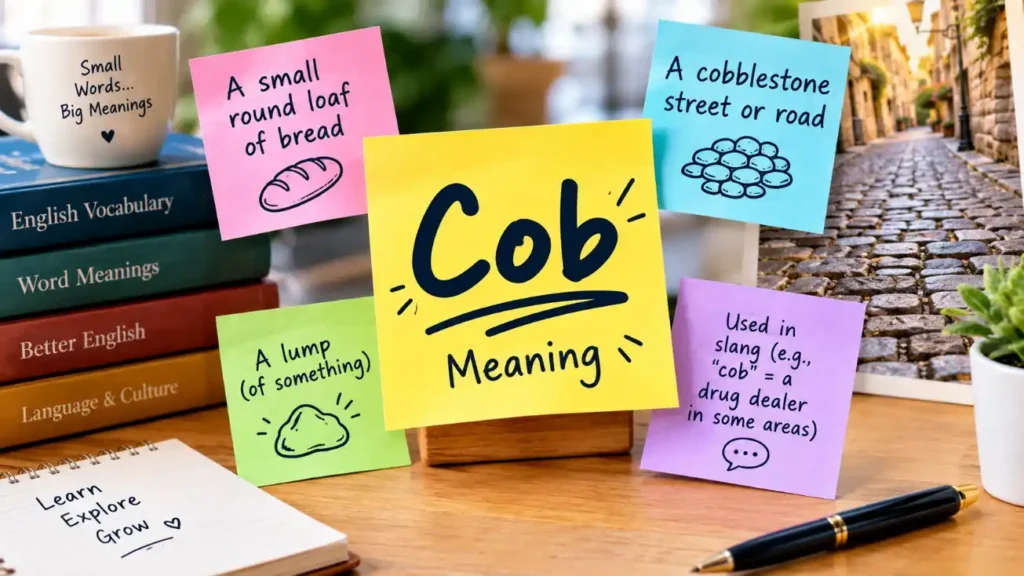
Cob refers to several genuinely different things depending on context: the central core of an ear of corn, a round loaf of bread, a male swan, a sturdy type of riding horse, and an ancient natural building material made from clay, sand, and straw. Despite sounding like one simple word, “cob” covers a surprisingly wide range of unrelated meanings.
Most people know at least one of these meanings well, usually the corn sense, without realizing how many other distinct things the same word describes. Understanding the cob meaning means sorting through several genuinely separate definitions rather than one flexible concept.
This guide covers each meaning of cob individually, where the word likely comes from, and how context tells you which one applies.
What It Means
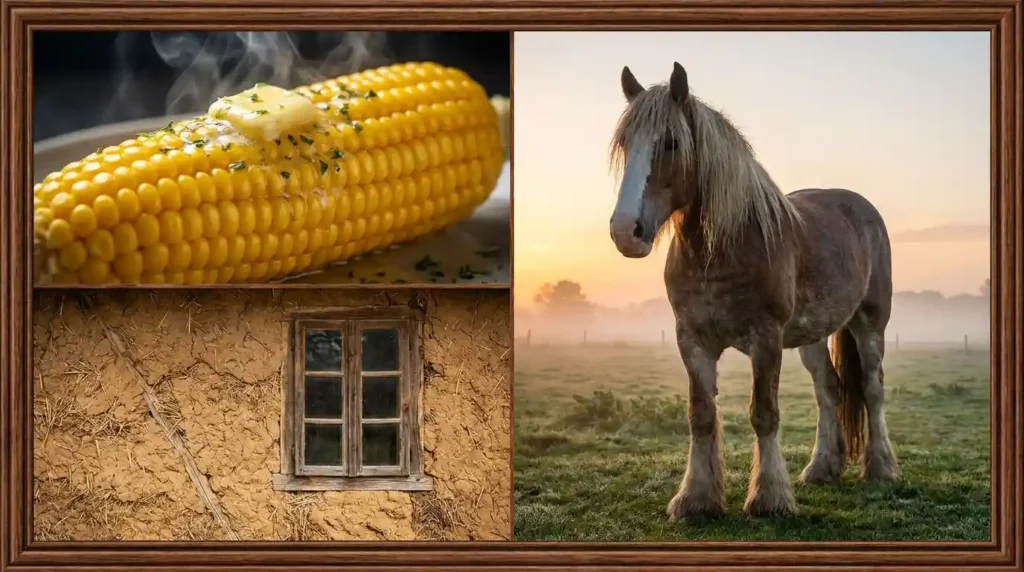
In its most common modern sense, a cob refers to the central, cylindrical core of an ear of corn, the part left over once the kernels get removed, or the whole ear itself when people say “corn on the cob.”
Baking, a cob (or “cob loaf”) describes a round loaf of bread with a firm, often rustic crust, popular particularly in British baking.
In birds, a cob specifically refers to a male swan, distinct from the female, which is called a “pen.”
Horses, a cob is a specific type of sturdy, compact riding horse, valued for its calm temperament and versatility, often used for both leisure riding and light draft work.
In construction, cob (sometimes called “cob building”) refers to an ancient natural building material made from a mixture of subsoil, water, straw, and sometimes lime, formed into thick walls by hand.
Origin & History
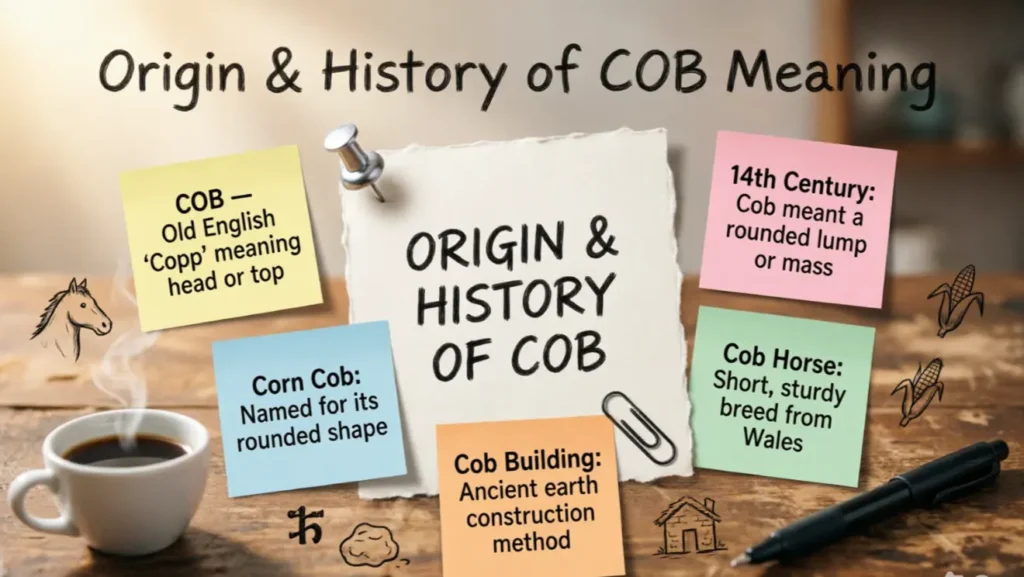
The word “cob” has a genuinely murky, tangled history in English, with different meanings likely developing from separate or only loosely related roots rather than one single, unified origin. Etymologists generally treat several of these meanings as historically distinct rather than variations of one core concept.
The corn-related meaning likely developed from an older English sense of “cob” referring to something rounded or lump-like, a meaning that also connects loosely to the bread sense, since a cob loaf is similarly round and compact in shape.
The swan meaning traces back to Middle English, used specifically to distinguish male swans from females, a distinction still maintained in formal ornithological and falconry-adjacent vocabulary today.
The building-material sense of “cob” has its own separate history, tied to a traditional construction method used in England and other parts of Europe for centuries, particularly common in regions like Devon, where cob buildings still stand after hundreds of years.
Different Contexts and Meanings
Corn on the cob. This remains the most universally recognized modern meaning the cylindrical core of corn, either with kernels still attached (as commonly eaten) or stripped bare after the kernels get removed.
Cob loaf (bread). A round, often crusty loaf of bread, popular in British and Commonwealth baking traditions, sometimes used as a bread bowl for dips or soups.
Cob (male swan). In bird terminology, particularly regarding mute swans, “cob” specifically identifies the male, while “pen” identifies the female and “cygnet” refers to a baby swan.
Cob (horse breed/type). A cob describes a specific build and temperament of horse sturdy, compact, and calm commonly used in riding, driving, and equestrian sport, particularly in the UK and Ireland.
Cob (building material). This ancient construction method uses a mixture of subsoil, straw, and water, hand-formed into thick, durable walls, valued today for its sustainability and natural insulating properties.
Examples
- “We grilled corn on the cob for the barbecue.”
- “The bakery sold fresh cob loaves every morning.”
- “The cob glided across the pond while the pen stayed near the nest.”
- “She rides a sturdy cob at her local stable.”
- “The old farmhouse walls were built using traditional cob construction.”
- “He tossed the leftover corn cobs into the compost bin.”
- “The recipe called for hollowing out a cob loaf to serve the soup inside.”
- “The male swan, or cob, aggressively defended the nesting area.”
- “Cob horses are known for their calm temperament and strength.”
- “Builders in Devon still use cob for certain traditional restoration projects.”
How to Use It (Grammar and Context)
Cob functions as a noun across all its meanings, though the specific context almost always clarifies which sense applies. Writers often pair it with a clarifying word when ambiguity might otherwise arise: “corn cob,” “cob loaf,” “cob building,” or simply relying on surrounding context, such as a sentence clearly about baking, birds, horses, or construction.
Because these meanings are so unrelated, “cob” rarely causes genuine confusion in practice; readers almost always pick up on the correct meaning quickly based on subject matter alone.
Common Mistakes
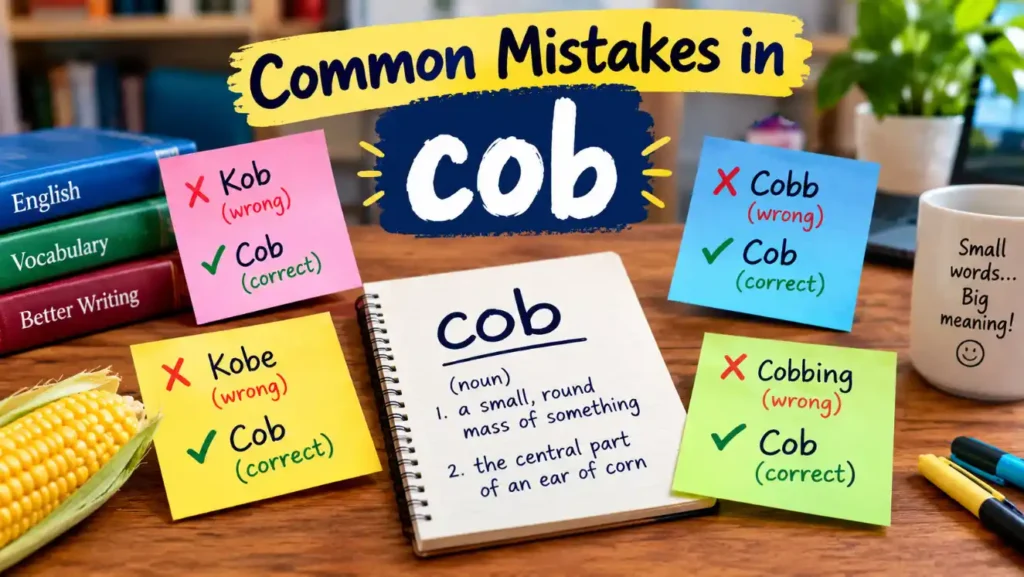
Assuming cob only refers to corn. While the corn meaning dominates casual, everyday use, at least four other genuinely distinct meanings exist, each common within its specific field.
Confusing cob (the male swan) with “cygnet” or “pen.” These three swan-related terms each mean something different: cob (male), pen (female), and cygnet (baby swan) mixing them up is a common error even among casual bird enthusiasts.
Assuming cob building is a modern or invented technique. Cob construction is genuinely ancient, with surviving buildings hundreds of years old, particularly in regions of England like Devon.
Overlooking the connection between the word’s rounded shapes. Several of cob’s meanings (the loaf, the corn core) share a loose connection to “something round or lump-shaped,” even though the word’s different senses developed largely independently.
Similar Words
| Word | Meaning | Difference from Cob |
| Husk | The outer covering removed from corn before eating | The husk surrounds the cob; the cob is the core structure the kernels attach to |
| Pen | A female swan | The direct counterpart to “cob” (male swan) within swan terminology |
| Loaf | A shaped, baked portion of bread | A cob loaf is one specific style of loaf, round and often rustic in texture |
| Adobe | A different natural building material made from mud, sand, and straw | Adobe uses sun-dried bricks; cob construction uses hand-formed walls without bricks |
Opposite Words
There’s no single grammatical opposite of “cob,” but relevant contrasts include:
| Word | Meaning | Why It Contrasts |
| Pen | A female swan | The direct another gender term within swan vocabulary |
| Kernel | An individual piece of corn | Represents a small individual part, contrasting with the cob’s role as the central core |
| Modern material | Contemporary construction materials like concrete or steel | Contrasts with cob’s ancient, natural building tradition |
Pronunciation
Cob is pronounced KOB, rhyming with “job” and “rob.”
Quick Facts
| Fact | Detail |
| Main meanings | Corn core, round bread loaf, male swan, horse type, natural building material |
| Corn context | “Corn on the cob” the cylindrical core kernels attach to |
| Swan context | Cob = male, pen = female, cygnet = baby |
| Horse context | A sturdy, compact riding horse breed/type |
| Building context | Ancient natural material made from subsoil, straw, and water |
| Word history | Multiple, largely unrelated historical origins across its different meanings |
FAQs
What does cob mean in a business?
COB means “Close of Business,” referring to the end of a company’s normal working day.
Is it cob or eod?
Both are used, but COB usually refers to the end of business hours, while EOD can mean the end of the calendar day.
What does cob stand for in banking?
In banking, COB generally stands for “Close of Business,” marking the end of the bank’s business day.
What does cob mean in mail?
In email or mail, COB means “Close of Business,” usually indicating a deadline before the workday ends.
What is cob in HR?
In HR, COB typically means “Close of Business” and is commonly used for deadlines, submissions, or employee-related tasks.
Does EOD mean midnight?
Not always. EOD usually means the end of the working or calendar day, depending on the context.
What is cob and EOB?
COB means “Close of Business,” while EOB means “End of Business.” Both generally refer to the end of working hours.
What does “cob” mean in slang?
In slang, “cob” can have different meanings depending on the region and context, but in workplaces it usually means “Close of Business.”
Is cob today correct?
Yes, “COB today” is commonly used to mean the deadline is by the end of today’s business day.
What does COB stand for in accounting?
In accounting, COB stands for “Close of Business” and often indicates when financial tasks or reports must be completed.
What does cob mean for payment?
For payments, COB usually means the payment must be submitted or processed by the end of the business day.
What is the opposite of a cob?
If you mean COB as “Close of Business,” it has no true opposite; the closest contrasting idea is the “opening of business” (BOB).
Key Takeaways
- Cob has multiple distinct meanings: corn core, bread loaf, male swan, horse type, and natural building material.
- The corn meaning dominates everyday, casual use, but the other meanings remain common within their specific fields.
- In swan terminology, cob (male), pen (female), and cygnet (baby) are all separate, specific terms.
- Cob building is a genuinely ancient construction technique, still used and preserved today.
- Context almost always makes clear which meaning of “cob” applies in a given sentence.
Conclusion
The cob meaning splits into several genuinely separate definitions that happen to share nothing but spelling and pronunciation. From the core of an ear of corn to a male swan to an ancient wall-building technique, each sense developed within its own world, largely independent of the others.
That kind of linguistic coincidence happens more often in English than people expect, especially with short, simple-sounding words that turn out to carry surprisingly tangled histories once you actually dig into them. Few four-letter words manage to span a dinner plate, a pond, a stable, and a centuries-old farmhouse wall all at once.
Next time you come across the word cob, the surrounding context will almost always tell you immediately which version you’re dealing with and now you know there are at least five genuinely different answers to choose from.

I am Olivia Brooks an American editor and content researcher dedicated to creating clear, accurate content. At writemora.com, I help readers to understand words, phrases, and modern language with confidence.