
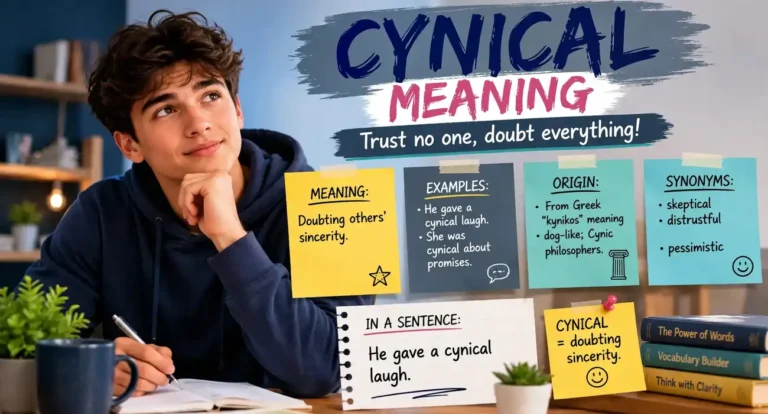
Cynical describes someone who distrusts the sincerity of other people’s motives and believes people generally act out of self-interest. A cynical person expects the worst of others: when a company announces a charity program, the cynic assumes it is really about publicity.
This guide covers what cynical means today, where the word comes from, how its two senses differ, and the mistakes people commonly make with it. In short, this guide explains the cynical meaning clearly, from its Greek roots to its modern use.
What It Means
In simple terms, the cynical meaning is a deep distrust of people’s motives. A cynical person doubts that anyone acts from genuine kindness. For example, compliments sound like flattery, and promises sound like manipulation.
However, keep the modern sense separate from the ancient one. Today, “cynical” is a criticism that suggests bitterness and a refusal to believe in anything good. In contrast, the ancient Greek Cynics were philosophers with a serious moral program.
In addition, cynicism often grows out of disappointment. After people feel let down by leaders or employers, that disappointment can harden into a general rule of trusting no one’s stated reasons.
Origin & History
The word comes from the Greek “kynikos,” meaning “dog-like,” from “kyon” (dog). The name was first given, partly as an insult, to the followers of Antisthenes, a student of Socrates, and Diogenes of Sinope in the 4th century BC. Critics called them “dogs” because they rejected polite convention, lived with almost nothing, and spoke bluntly in public.
The ancient Cynics taught that virtue was the only true good, and that wealth and luxury distracted people from an honest, natural life. In addition, the movement later influenced Stoicism. By the 19th century, however, the emphasis had fallen on the Cynics’ scorn for convention, and the cynical meaning had taken its modern shape: disbelief in the sincerity of human motives.

Different Contexts and Meanings
Modern everyday sense. A cynical employee assumes a new policy is a trick, and a cynical voter assumes every candidate is lying. In both cases, the attitude is distrustful and often weary.
Philosophical sense. A capital-C Cynic is a follower of the ancient Greek school. This use is historical and neutral, not an insult.
Cynical in politics. Reporters describe voters as cynical when scandals pile up and turnout falls. In other words, it is a collective loss of faith in institutions.
Cynical in the workplace. Managers call morale “cynical” when staff stop believing leadership announcements. As a result, it signals a breakdown of trust after broken promises, and it shows the cynical meaning in action.
Examples
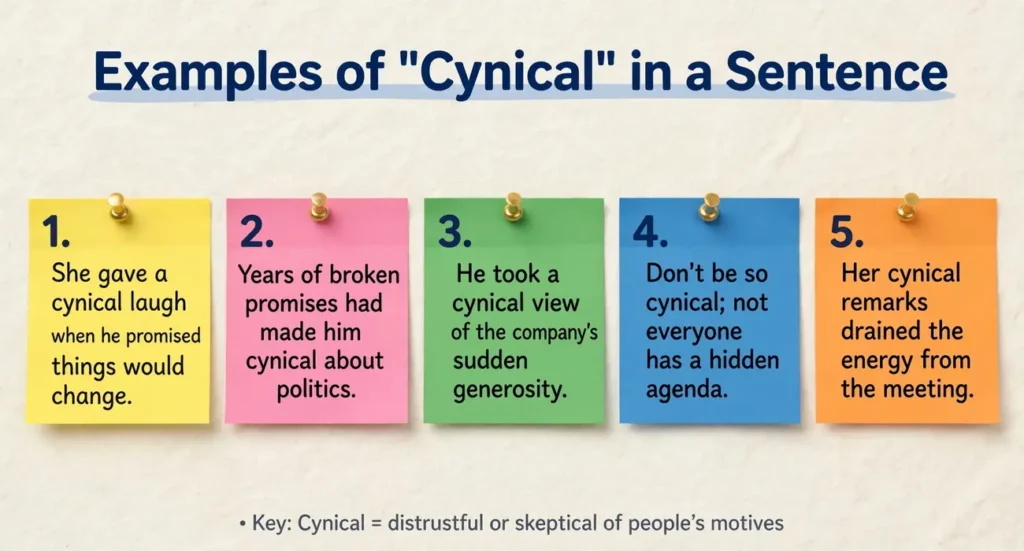
- “She gave a cynical laugh when he promised things would change.”
- “Years of broken promises had made him cynical about politics.”
- “He took a cynical view of the company’s sudden generosity.”
- “Don’t be so cynical; not everyone has a hidden agenda.”
- “Her cynical remarks drained the energy from the meeting.”
- “The reporter asked a cynical question about the charity’s real motives.”
- “He smiled in a cynical way that suggested he believed none of it.”
- “Growing up during the scandal left a generation cynical about leaders.”
- “She tried to stay hopeful, but the news made her feel cynical.”
- “His cynical tone told me he had stopped trusting the process.”
How to Use It (Grammar and Context)
Use cynical as an adjective that describes a person, an attitude, a remark, or a view: “a cynical person,” “cynical about the plan.” The adverb is “cynically,” and the noun is “cynicism.” In addition, a distrustful person is “a cynic” (lowercase), while “a Cynic” (capital C) is an ancient philosopher. When you use the word, the cynical meaning therefore depends on that capital letter.
Common Mistakes
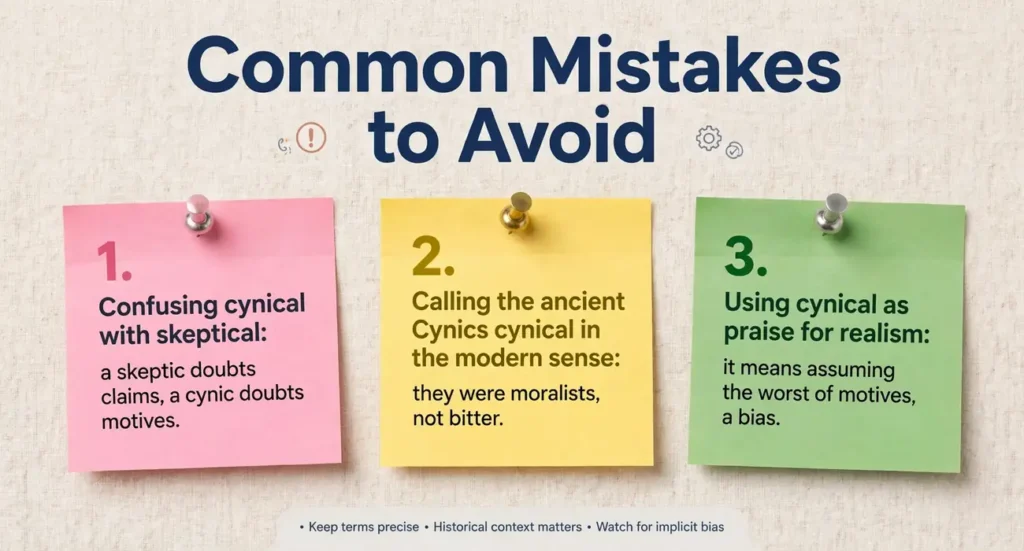
Confusing cynical with skeptical. A skeptic doubts claims until evidence appears, and will change their mind when the evidence arrives. A cynic doubts motives and usually will not. In short, the cynical meaning is about motives, not claims.
Calling the ancient Cynics “cynical” in the modern sense. Diogenes was a moralist who rejected luxury, not a bitter, distrustful person in the modern way.
Using cynical as praise for realism. Saying “I’m just being cynical” does not mean you are being realistic. It means you assume the worst of people’s motives, which is a bias, not clear-eyed realism.
Confusing “cynic” with “Cynic.” A lowercase cynic is a distrustful person, while a capital-C Cynic is an ancient philosopher. Keep the capital letter in mind, because it changes the meaning completely.
Similar Words
| Word | Meaning | Difference from Cynical |
|---|---|---|
| Skeptical | Doubting claims until evidence appears | Skepticism is open-minded doubt; cynicism assumes bad motives from the start |
| Distrustful | Not willing to trust | Broader and milder; cynical specifically doubts sincerity behind actions |
| Pessimistic | Expecting bad outcomes | Pessimism is about outcomes; cynicism is about hidden motives |
| Jaded | Worn out and unimpressed by experience | Jaded comes from overexposure; cynical comes from distrust |
| Misanthropic | Disliking humankind in general | Stronger and broader; a misanthrope dislikes people, a cynic distrusts motives |
| Sardonic | Mocking or scornful in humor | Sardonic describes the tone of jokes; cynical describes the underlying attitude |
Opposite Words
| Word | Meaning | Why It’s an Opposite |
|---|---|---|
| Trusting | Willing to believe in others | Directly opposes the distrust at the heart of cynical |
| Optimistic | Expecting good outcomes | A hopeful outlook against cynicism’s weary doubt |
| Idealistic | Believing in noble principles | Holds faith in goodness that cynicism rejects |
| Hopeful | Feeling things can improve | A forward-looking attitude that cynicism has abandoned |
Pronunciation
Cynical is commonly pronounced SIN-ih-kul, with the stress on the first syllable. The “y” sounds like a short “i,” and the final syllable is unstressed.
Quick Facts
| Fact | Detail |
|---|---|
| Word origin | Greek “kynikos” (dog-like), from “kyon” (dog) |
| Modern meaning | Distrustful of the sincerity of human motives |
| Ancient meaning | Follower of Cynic philosophy (Antisthenes, Diogenes of Sinope, 4th century BC) |
| Key distinction | Lowercase “cynic” (distrustful person) vs. capital-C “Cynic” (Greek philosopher) |
| Related forms | Cynically (adverb), cynicism (noun), cynic (noun) |
| Common confusion | “Cynical” vs. “skeptical” (doubt of motives vs. doubt of claims) |
Key Takeaways
- Cynical meaning: distrusting the sincerity of people’s motives and expecting self-interest.
- The word comes from the Greek “kynikos,” meaning “dog-like,” first applied to the ancient philosophers.
- Ancient Cynicism was a serious moral philosophy, not the negativity the modern word suggests.
- Keep the two senses apart: a lowercase “cynic” is a distrustful person, and a capital-C “Cynic” is a philosopher.
- Cynical is not the same as skeptical; skepticism stays open to evidence.
FAQs
What does it mean to be cynical?
It means distrusting people’s stated motives, assuming self-interest, doubting sincerity, and expecting the worst of their intentions. In short, the cynical meaning is doubt about motives, not just doubt about facts.
What is the difference between cynical and skeptical?
A skeptic doubts claims until evidence appears and can be convinced. A cynic doubts motives and usually stays unconvinced. Therefore, skepticism is open-minded, while cynicism is not.
Where did the word come from?
It comes from the Greek “kynikos,” meaning “dog-like,” given to the followers of Antisthenes and Diogenes of Sinope, who were called “dogs” for rejecting convention.
Who were the ancient Cynics?
They were Greek philosophers of the 4th century BC, led by Antisthenes and Diogenes, who taught that virtue was the only good and that wealth and status blocked an honest life.
Is being cynical the same as being realistic?
No. Realism sees things as they are, good and bad. Cynicism assumes bad motives in advance, which is a bias.
What is the opposite of cynical?
Trusting and optimistic are the closest opposites. A trusting person believes in the sincerity that cynicism refuses.
Why is Diogenes called “the Dog”?
Critics used “dog” as an insult for his shameless public behavior. Diogenes embraced it, saying he lived simply and honestly like a dog rather than pretending.
Conclusion
The cynical meaning carries a double history that makes it richer than it first appears. In modern speech it names a weary distrust of human motives, the attitude of someone who has heard one promise too many. In its older sense it names a bold Greek philosophy that called comfort and status worthless and praised the honest, simple life.
Keeping those two senses apart is the key to using the word well. Call a bitter attitude “cynical” with a lowercase c, and reserve the capital-C Cynic for Diogenes and his fellow philosophers.

I am Stephen King an American author known for compelling storytelling. At writemora.com, we value clear, accurate, and reader-focused content inspired by excellence in writing.