
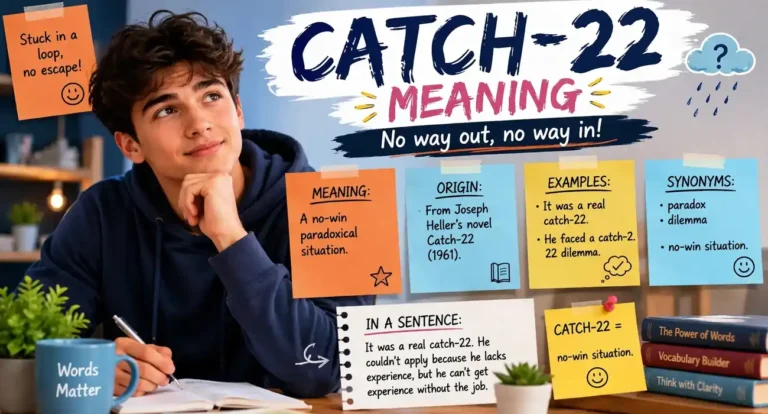
Catch-22 describes a paradoxical situation with no escape because the rules contradict each other: the only way out stays blocked by the very conditions that create it.
This guide covers what a catch-22 is, where the term comes from, how it shows up in real life, and the mistakes people commonly make with it. In short, this guide explains the catch-22 meaning clearly, from its novel to its everyday use.
What It Means
In simple terms, the catch-22 meaning is a no-win situation built from self-contradictory rules: you need one thing to get another, but the first requires already having the second. For example, the classic job-market case is that you cannot get hired without experience, yet you cannot gain experience without being hired.
However, a catch-22 is stricter than a dilemma. A dilemma offers bad options, while a catch-22 makes every option impossible.
Origin & History
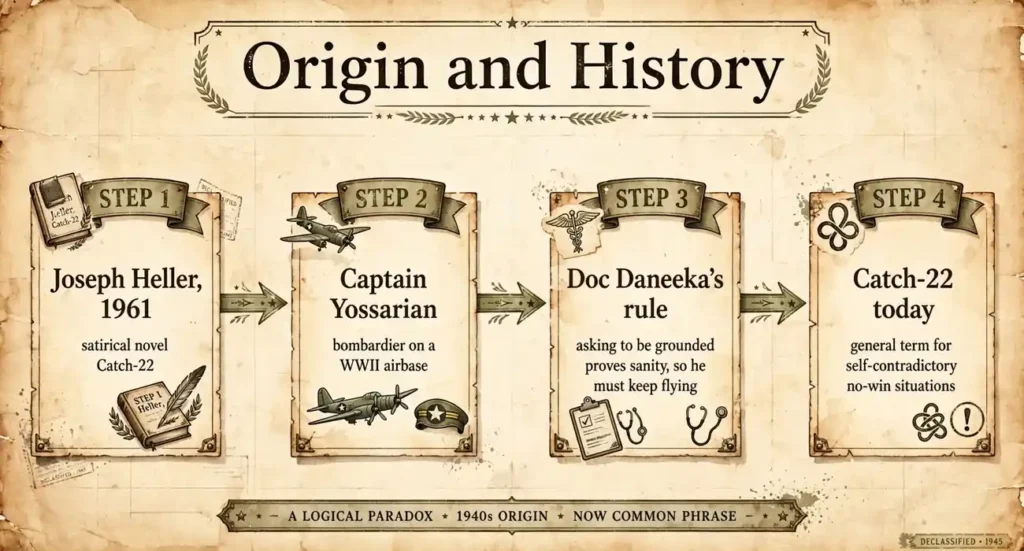
American author Joseph Heller coined the term in his 1961 satirical novel Catch-22, set on a U.S. Army airbase in the Mediterranean during World War II. The novel follows bombardier Captain John Yossarian, and Doc Daneeka explains the regulation: an airman who willingly flies dangerous missions is insane and can be grounded, but asking to be grounded proves sanity, so he must keep flying.
The book became a bestseller and spawned a 1970 film directed by Mike Nichols. In addition, the phrase entered dictionaries as a general term for self-contradictory, inescapable situations, and the catch-22 meaning has stayed in everyday language ever since.
Different Contexts and Meanings
Original military rule. The regulation always works against the airman: asking for help proves you do not need it, and every version of the rule favors the authority.
Everyday bureaucracy. You need an ID to get a document, but you need the document to get the ID. Each requirement blocks the other.
Work and careers. Employers demand experience for entry-level jobs, yet those jobs are the only place to gain it. As a result, new graduates face the same locked door.
Money and credit. Banks want proof you can repay before they lend, which is hardest when you need a loan most. Similarly, you need a credit history to get a card, but the card is how you build that history.
Examples
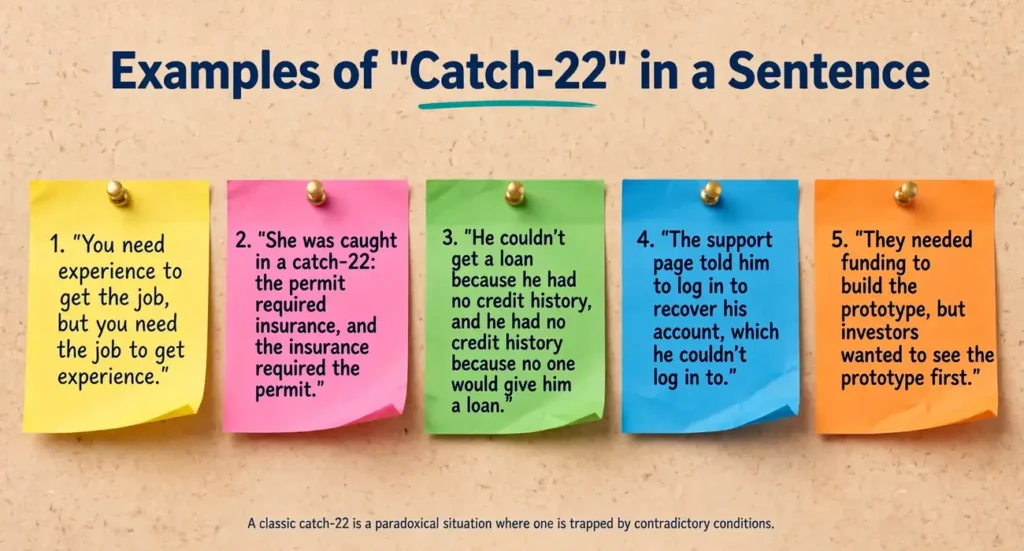
- “You need experience to get the job, but you need the job to get experience.”
- “She was caught in a catch-22: the permit required insurance, and the insurance required the permit.”
- “He couldn’t get a loan because he had no credit history, and he had no credit history because no one would give him a loan.”
- “The support page told him to log in to recover his account, which he couldn’t log in to.”
- “They needed funding to build the prototype, but investors wanted to see the prototype first.”
- “It was a classic catch-22: asking for help proved she didn’t need it.”
- “The visa required a job offer, and the job offer required a visa.”
- “He couldn’t cancel the subscription without calling, and the phone line kept disconnecting.”
- “The grant required published research, but she needed the grant to do the research.”
- “She was stuck in a bureaucratic catch-22 between two offices, each blaming the other.”
How to Use It (Grammar and Context)
Use catch-22 as a noun phrase with “a”: “a catch-22,” “a catch-22 situation.” The plural is “catch-22s.” The standard styling is Catch-22, with a hyphen and a capital C, matching the novel title. In addition, casual writing often uses lowercase “catch-22,” which is widely accepted. The keyword spelling “catch 22” without a hyphen appears in searches, but edited writing keeps the hyphen. When you write about it, the catch-22 meaning stays clearest when you keep the hyphen and the capital C in formal text.
Common Mistakes
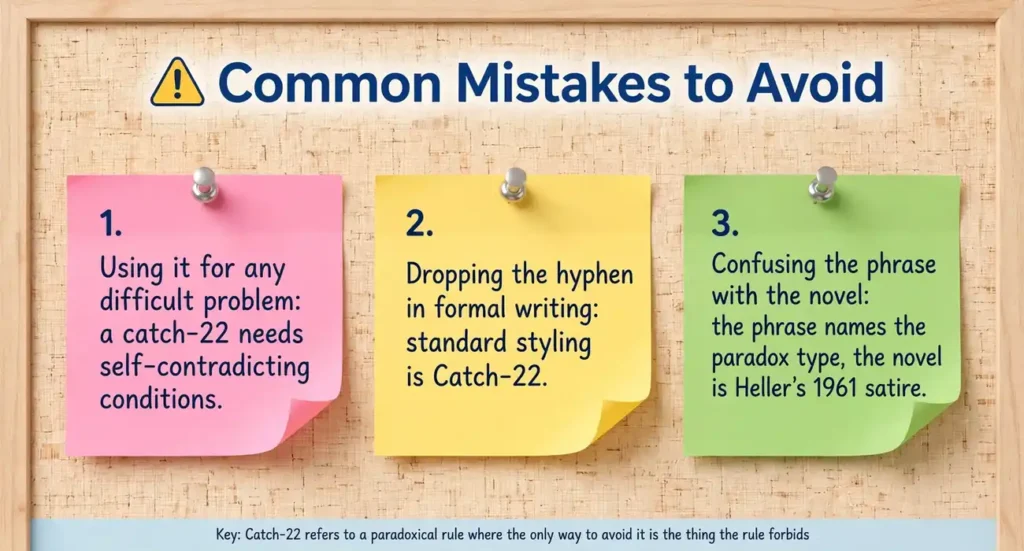
Using it for any difficult problem. A catch-22 needs self-contradicting conditions where each requirement blocks the other. A hard choice alone is not one.
Dropping the hyphen in formal writing. Searches accept “catch 22,” but edited English writes “Catch-22.”
Confusing the phrase with the novel. “Catch-22” is Heller’s 1961 satire, while “a catch-22” is the type of paradox it named.
Thinking it is an old idiom. It is only a few decades old: Heller coined it in 1961, though it sounds like ancient folk wisdom.
Similar Words
| Word | Meaning | Difference from Catch-22 |
|---|---|---|
| Paradox | Statement or situation that contradicts itself | Broader; a catch-22 is a specific kind involving rules |
| Dilemma | Choice between equally bad options | A dilemma offers bad choices; a catch-22 offers no working choice |
| No-win situation | Position where success is impossible | Informal and general; catch-22 names the self-contradictory mechanism |
| Double bind | Conflicting demands where every response is punished | Similar, but a double bind stresses punishment while a catch-22 stresses blocked escape |
| Vicious circle | Chain of events that reinforces itself | Describes a repeating loop; a catch-22 is one locked moment of contradiction |
| Deadlock | Standstill where neither side can move | Usually between two parties; a catch-22 can trap a single person in rules |
Opposite Words
| Word | Meaning | Why It’s an Opposite |
|---|---|---|
| Win-win | Outcome where everyone benefits | Every path succeeds, the reverse of a blocked trap |
| Solution | Way to resolve a problem | An escape route a catch-22 denies |
| Way out | Available path forward | Exactly what a catch-22 removes |
| Straightforward choice | Clear decision with a workable option | No contradiction between options |
Pronunciation
Catch-22 is commonly pronounced KACH twen-tee-TOO, with the stress on “catch” and on “two.” In other words, it has three beats: catch, twenty, two.
Quick Facts
| Fact | Detail |
|---|---|
| Meaning | Paradoxical no-win situation caused by contradictory rules |
| Coined by | Joseph Heller in his 1961 novel Catch-22 |
| Original catch | An airman seeking exemption proves sanity by asking, so he must keep flying |
| Standard styling | Catch-22 (hyphenated, capital C); “catch 22” is a common search spelling |
| Part of speech | Noun phrase (“a catch-22”); plural “catch-22s” |
| Key distinction | Needs self-contradicting rules, not just a hard problem |
Key Takeaways
- Catch-22 meaning: a no-win situation where contradictory rules block every escape.
- Joseph Heller coined the term in his 1961 novel Catch-22.
- In the novel, requesting an exemption proves sanity, which disqualifies the airman from the exemption.
- Real-life examples include the job-experience paradox and the loan-credit paradox.
- Do not use it for ordinary hard problems; the rules themselves must contradict each other.
FAQs
What does catch-22 mean in simple words?
It means being trapped by rules that contradict each other, where the only way out is blocked by the problem itself. In short, the catch-22 meaning is a locked trap, not just a hard choice.
Where did the term come from?
Joseph Heller coined it in his 1961 satirical novel Catch-22, set on a World War II airbase. Readers then adopted the phrase for similar paradoxes.
What was the original Catch-22 in the novel?
An airman could be grounded if he was insane, but asking to be grounded proved sanity, so he had to keep flying. Needing the exemption made it impossible to get.
Is it spelled catch 22 or catch-22?
The standard form is “Catch-22” with a hyphen, matching the novel title. “Catch 22” is common in searches but less correct in edited writing.
What is an example of a catch-22 in real life?
Needing job experience to get hired but needing a job to gain experience is the classic case. Similarly, needing a credit history to get a loan while the loan is how you build that history is another.
What is the difference between a catch-22 and a dilemma?
A dilemma is a hard choice between bad options. A catch-22 is stricter: the rules contradict each other so no option can work.
Why do people still talk about Catch-22 today?
Bureaucracies, software systems, and job markets keep producing the same self-defeating rules Heller satirized. Therefore, the phrase names a familiar frustration.
Conclusion
The catch-22 meaning is a rare case of one novel giving the language a permanent word. Heller’s name for the regulation that trapped Yossarian now names something people meet everywhere: rules that defeat themselves.
The phrase survived because the trap survived: anyone who has needed experience to get experience has lived inside Heller’s paradox.
Use it precisely, though. A catch-22 is not bad luck and not a tough decision. It is the special frustration of a system whose own rules make escape impossible, and naming it correctly is the first step toward changing the rules.

I am Olivia Brooks an American editor and content researcher dedicated to creating clear, accurate content. At writemora.com, I help readers to understand words, phrases, and modern language with confidence.