
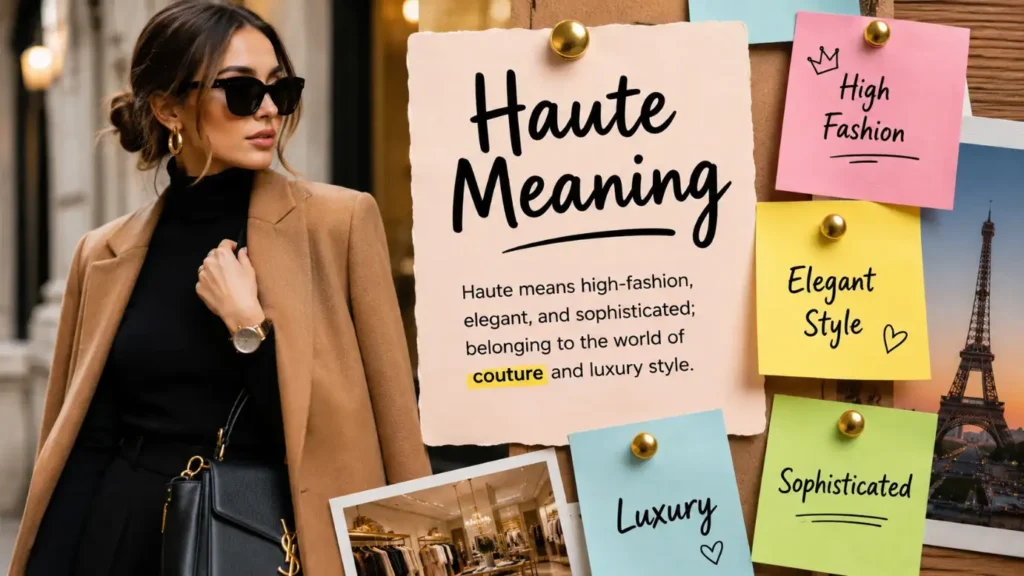
Haute comes from French and translates literally to “high.” English speakers rarely use it alone, though instead, they borrow it as part of set phrases like haute couture and haute cuisine, where it signals the highest tier of quality, craft, or exclusivity in a given field.
You’ll spot haute constantly in fashion writing, restaurant reviews, and lifestyle content, almost always paired with another word. Understanding the haute meaning helps you use these borrowed phrases correctly instead of guessing at them.
This guide covers what haute means, where the word comes from, the specific phrases people build with it, and the mistakes writers commonly make when using it.
What It Means
In simple terms, haute means “high” in French, functioning as an adjective that modifies a noun to signal elevated status, quality, or exclusivity. English speakers essentially never use the word on its own; they always pair it with another term, most commonly in fixed phrases borrowed directly from French.
In a fuller sense, haute carries connotations beyond just “high” in a literal sense. It implies the top tier of a field: the most exclusive, most skillfully made, or most prestigious version of something. When people call something “haute,” they’re signaling that it sits above ordinary or mass-market versions of the same category.
English writers most often encounter the word inside two major phrases: haute couture (high fashion, custom-made by elite designers) and haute cuisine (elaborate, high-end cooking associated with fine dining).
Origin & History

Haute comes directly from French, where it functions as the feminine form of the adjective “haut,” meaning “high” or “tall.” French uses gendered adjectives, so “haute” appears specifically before feminine nouns like “couture” (dressmaking) and “cuisine” (cooking).
The phrase “haute couture” originated in 19th-century Paris, tied to the rise of formal, custom-fitted fashion houses that catered to wealthy clients. English speakers began borrowing the phrase wholesale rather than translating it, in part because no single English word captured the same specific meaning of elite, made-to-measure fashion.
“Haute cuisine” followed a similar path, becoming the standard term in English for elaborate, technically demanding French-style cooking associated with fine dining. Over the 20th century, English speakers extended the “haute” pattern to other fields, coining phrases like “haute cuisine,” and later, more playfully, terms like “haute mess” or “haute dog” as puns.
Different Contexts and Meanings
Haute couture. This describes high fashion created by exclusive design houses, typically custom-fitted, made with expensive materials, and produced in extremely limited quantities. French law actually regulates who can officially call their work “haute couture.“
Haute cuisine. This describes elaborate, technically skilled cooking associated with fine dining, often featuring multiple courses, refined presentation, and classical French cooking techniques.
Haute as a general modifier. Writers sometimes attach “haute” to other nouns to signal a high-end or elevated version of something, even outside fashion and food “haute jewelry,” for instance, describes exceptionally exclusive, custom-made jewelry.
In playful or ironic use. Because “haute” sounds like “hot,” writers occasionally use it for puns, coining phrases like “haute dog” for an upscale hot dog stand, deliberately blending the word’s elevated meaning with everyday humor.
As shorthand for luxury generally. In casual usage, people sometimes drop “haute” into conversation loosely to suggest something feels upscale or sophisticated, even without referencing fashion or food specifically.
Examples
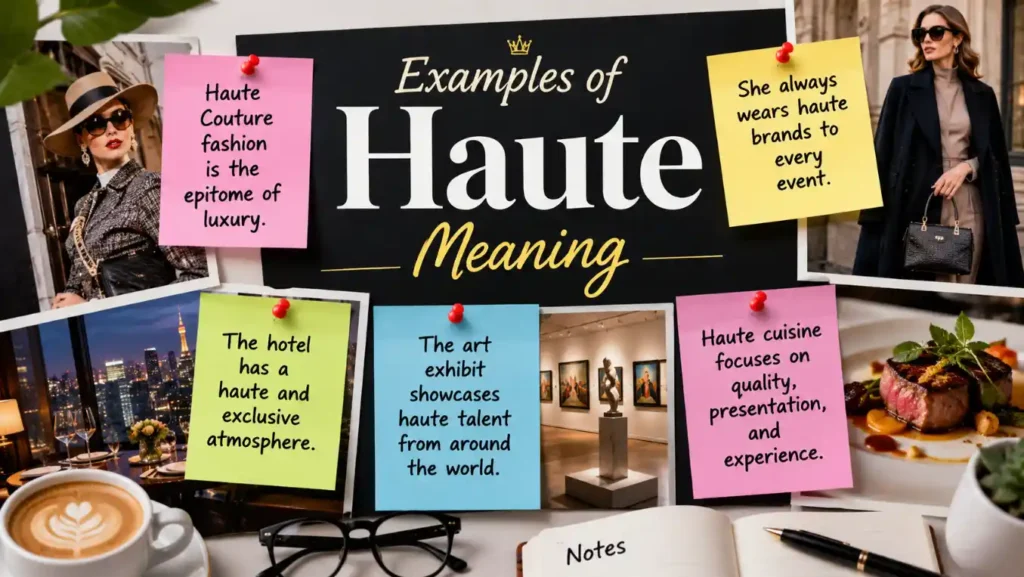
- “The gown came straight from a haute couture runway show.”
- “The restaurant specializes in haute cuisine, with a tasting menu that takes hours.”
- “She works as a designer in the haute couture industry in Paris.”
- “The jewelry brand released a new haute jewelry collection.”
- “It’s less haute cuisine, more comfort food with a fancy plate.”
- “The magazine covered the latest haute couture trends from Paris Fashion Week.”
- “That food truck calls itself ‘haute dog,‘ serving gourmet hot dogs.”
- “Only a handful of houses hold official haute couture status.”
- “The chef trained in classical haute cuisine before opening his own restaurant.”
- “The event felt very haute, from the venue to the guest list.”
How to Use It (Grammar and Context)
English speakers almost always use “haute” as part of a fixed, borrowed French phrase rather than as a standalone adjective. Writing “that dress is so haute” without the following noun sounds unusual in English, even though the grammar technically works in French.
Because haute functions as a French adjective, it doesn’t change form in English the way it would in French (where it shifts to “haut” before masculine nouns). English treats the whole phrase “haute couture,” “haute cuisine” as a fixed unit borrowed directly from French, spelling and all.
Common Mistakes
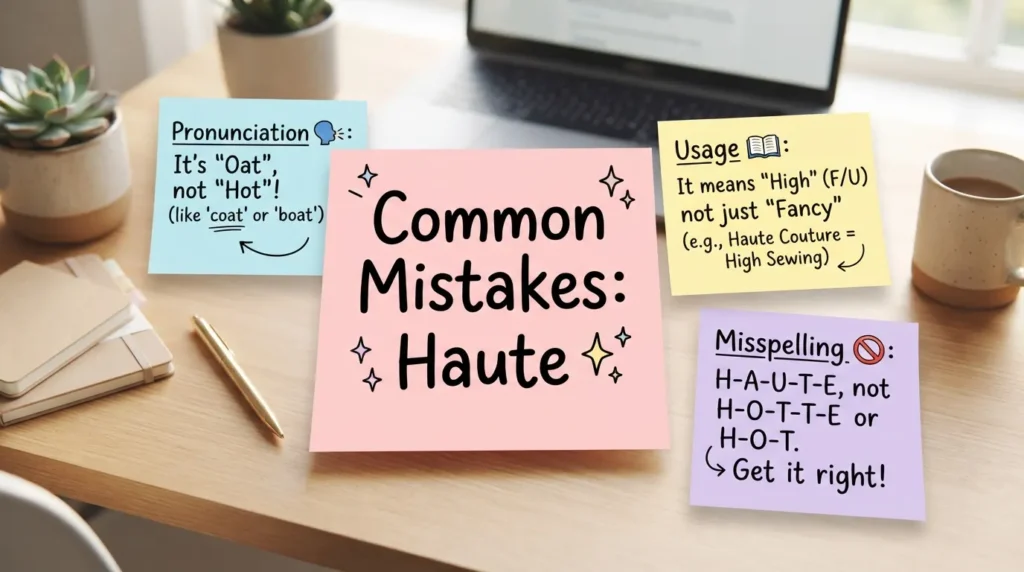
Using haute as a standalone English word. Native English speakers rarely say something is simply “haute” without pairing it with a noun; doing so can sound like a misused borrowing rather than natural English.
Confusing haute with “hot.” Because the words sound alike, some writers mistakenly treat “haute” as a stylish spelling of “hot,” when the words carry entirely different meanings and origins.
Misspelling it as “hote” or “hault.” Since the word comes from French, it doesn’t follow English spelling patterns, and writers sometimes guess at the spelling incorrectly.
Overusing it outside fashion and food. While playful uses exist, attaching “haute” to unrelated nouns too often can feel forced rather than clever.
Similar Words
| Word | Meaning | Difference from Haute |
| Luxury | High-end, expensive, associated with comfort or status | Luxury works as a standalone English word; haute almost always needs a paired noun |
| Chic | Stylish and fashionable in a sophisticated way | Chic describes style broadly; haute specifically signals top-tier exclusivity in fashion or cuisine |
| Elite | Belonging to the most select, privileged group | Elite applies broadly to people or groups; haute applies specifically to fashion, cuisine, and similar crafted goods |
| Gourmet | Food prepared and presented to a high culinary standard | Gourmet focuses specifically on food; haute (via “haute cuisine”) covers the same idea plus fashion and other fields |
Opposite Words
| Word | Meaning | Why It’s an Opposite |
| Mass-market | Produced in bulk for a wide, general audience | Directly opposes the exclusivity and limited production associated with haute couture |
| Casual | Relaxed, informal, everyday in style | Contrasts with the elevated, formal connotations of haute |
| Basic | Plain, simple, without special craft or distinction | Opposes the elite craftsmanship implied by “haute” |
Pronunciation
Haute is pronounced hot, rhyming with “coat.” The “h” stays silent, following standard French pronunciation.
Quick Facts
| Fact | Detail |
| Language of origin | French |
| Literal meaning | “High” (feminine form of “haut”) |
| Most common phrases | Haute couture, haute cuisine |
| Pronunciation | Rhymes with “coat”; silent H |
| Regulated term | “Haute couture” carries legal protection in France, limiting who can use it |
| Typical use in English | Always paired with a noun, rarely used alone |
FAQs
What does haute mean in English?
Haute means “high” in French and, in English, signals the top tier of quality or exclusivity, almost always used within a set phrase like haute couture or haute cuisine.
Is haute pronounced like “hot”?
No. Haute is pronounced “oht,” rhyming with “coat,” with a silent H. It just happens to look similar to “hot” in spelling.
What’s the difference between haute couture and regular fashion?
Haute couture refers to exclusive, custom-fitted fashion made by officially recognized design houses, following strict French legal standards, unlike mass-produced or ready-to-wear fashion.
Can you use haute by itself in a sentence?
Technically yes, but it’s uncommon in natural English. Speakers almost always pair it with a noun, as in “haute cuisine” or “haute fashion.”
Why is haute cuisine associated with French cooking?
The term originated to describe elaborate, technically demanding cooking rooted in classical French culinary tradition, and it remains closely tied to that heritage even as chefs worldwide practice it.
Is haute couture a protected term?
Yes, in France, only design houses that meet specific official criteria can legally call their work haute couture.
What does “haute” mean outside fashion and food?
Writers sometimes extend it to other high-end fields, such as “haute jewelry,” or use it playfully in puns, though its core meaning always signals elevated quality or exclusivity.
Where does the word haute come from?
It comes from French, as the feminine form of “haut,” meaning “high” or “tall.”
Key Takeaways
- Haute means “high” in French and signals top-tier quality or exclusivity in English.
- It almost always appears paired with a noun, as in haute couture or haute cuisine.
- Haute couture refers to legally protected, exclusive, custom fashion in France.
- Haute cuisine describes elaborate, technically skilled cooking tied to classical French tradition.
- People pronounce it “oht,” rhyming with “coat,” with a silent H, despite its resemblance to the English word “hot.”
Conclusion
The haute meaning boils down to a simple French word for “high” that English speakers borrowed to signal the very top of a field, the most exclusive fashion, the most skillfully prepared food, the most elevated version of nearly anything. Because English never fully absorbed the word on its own, it survives almost entirely inside a handful of set phrases, which is exactly why it can feel unfamiliar the first time you encounter it outside “haute couture” or “haute cuisine.”
That borrowed, phrase-bound quality is part of what gives haute its punch. Reaching for a French term instead of an English equivalent adds a layer of prestige that a plain word like “high-end” doesn’t quite deliver, which is why fashion magazines, restaurant critics, and marketers keep returning to it decade after decade. Even the playful spinoffs of a gourmet hot dog stand calling itself “haute dog,” for instance, work precisely because everyone already recognizes what the real phrase signals.
Once you know the word means “high” and belongs almost exclusively inside phrases like these, you’ll spot it everywhere and you’ll know exactly why writers reach for it instead of a plainer English word.

I am Olivia Brooks an American editor and content researcher dedicated to creating clear, accurate content. At writemora.com, I help readers to understand words, phrases, and modern language with confidence.