
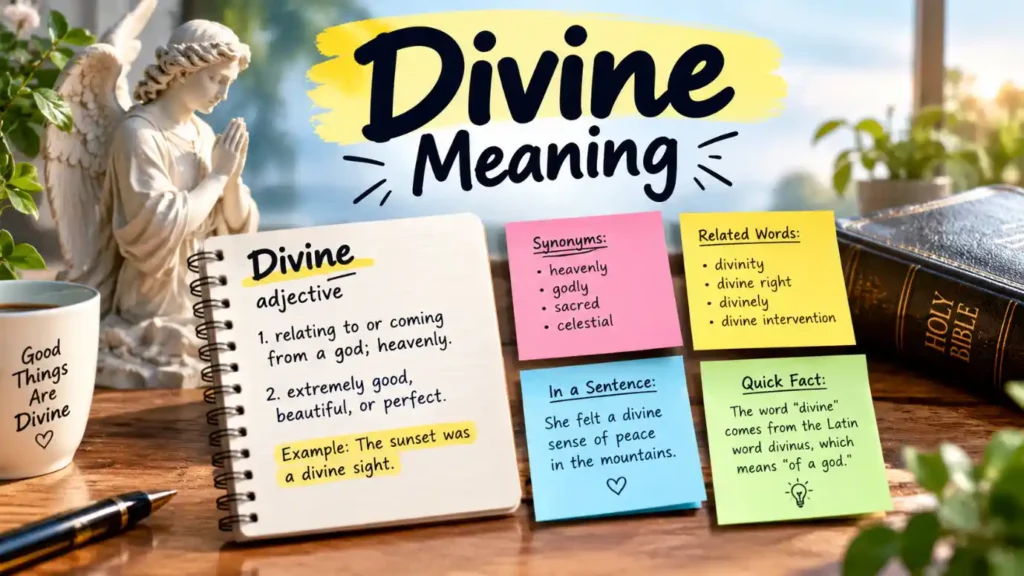
Divine meaning generally refers to something connected with, coming from, or resembling God or a god. It can describe something sacred, heavenly, or godlike. In everyday English, divine can also mean extremely wonderful or beautiful. As a verb, divine can mean to discover something through intuition, guessing, or divination.
Key Takeaways
- Divine primarily means related to God, a god, or something sacred.
- It can describe qualities considered holy, heavenly, or godlike.
- In informal or older usage, divine can mean extremely good, beautiful, or enjoyable.
- As a verb, to divine means to figure something out through intuition or guessing.
- Divinity refers to divine nature or the state of being divine, while divinely is the adverbial form.
What Does Divine Mean?
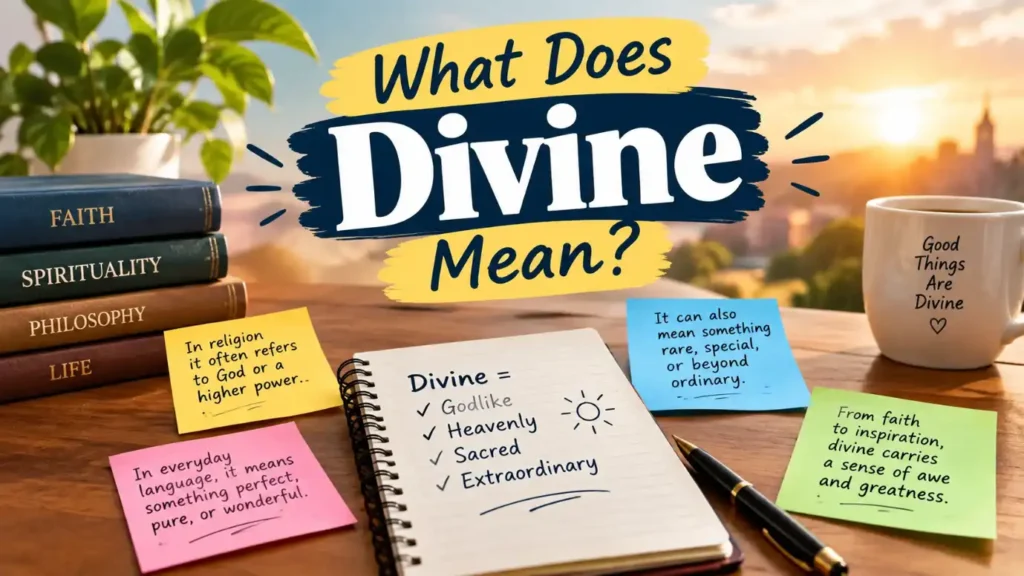
The word divine has several meanings, but its central idea is a connection with a god, God, or something considered sacred or godlike.
For example, phrases such as divine love, divine guidance, and divine intervention use divine in a religious or spiritual sense. The word can describe something believed to come from God or to possess qualities associated with a deity. Oxford and Cambridge both identify this as the primary modern meaning.
However, the divine is not limited to religion. In everyday English, especially in older or informal usage, it can mean wonderful, beautiful, or exceptionally pleasing.
For example:
The chocolate cake was absolutely divine.
Here, the speaker is not saying that the cake is literally sacred. They are emphasizing how enjoyable or excellent it was.
The meaning therefore depends strongly on context.
Divine Meaning in Different Contexts
Religious and Spiritual Meaning
In religious writing, divine commonly refers to God, a god, or something associated with a deity.
Examples include:
- Divine will: God’s will or purpose.
- Divine guidance: guidance believed to come from God.
- Divine intervention: help or action believed to come from God.
- Divine law: a law regarded as originating from God.
- Divine love: love associated with God or a deity.
Different religions and traditions understand divine qualities in different ways, so the exact theological meaning can vary according to the context.
For example, when someone says, “She believes the event was part of a divine plan,” they are expressing a belief that the event has a purpose connected to God. That is a statement about the speaker’s belief rather than a definition that applies to every person.
Everyday or Figurative Meaning
In everyday English, divine can be used figuratively to describe something exceptionally good.
Cambridge and Oxford both list this sense, with Oxford labeling it old-fashioned.
Examples include:
- “The dessert was divine.”
- “She looked divine in that dress.”
- “We had a divine afternoon by the lake.”
- “The restaurant served a divine chocolate mousse.”
In these sentences, divine works as a strong compliment. It is similar to words such as wonderful, excellent, beautiful, or amazing.
Divine as a Verb
Divine can also function as a verb, although this use is more formal or literary.
To divine something can mean to figure it out by intuition, insight, or guessing.
For example:
From his expression, I divined that something was wrong.
This means the speaker understood or inferred that something was wrong without being directly told.
The verb can also refer to the traditional practice of searching for underground water with a divining rod. Oxford lists both the guessing/inference sense and this water-finding sense.
How to Use Divine in a Sentence
The easiest way to understand the divine is to look at how it works in different sentences.
| Context | Example | Meaning |
| Religious | They prayed for divine guidance. | Guidance from God |
| Spiritual | She felt a divine presence. | A presence associated with God or the sacred |
| Figurative | The meal was divine. | Extremely enjoyable |
| Descriptive | The painting had a divine quality. | Beautiful or godlike |
| Verb | He divined the answer from the clues. | Figured out or inferred |
Notice that the surrounding words usually make the intended meaning clear.
When the divine appears beside words such as God, prayer, worship, guidance, intervention, or will, the religious meaning is likely.
When it describes food, clothing, music, or an experience, it may simply mean wonderful or excellent.
Divine Synonyms and Related Words
The best synonym depends on the sense of divine being used.
For the religious meaning, suitable alternatives include:
- holy
- sacred
- godly
- heavenly
- spiritual
- godlike
For the figurative meaning of “extremely good,” alternatives include:
- wonderful
- excellent
- amazing
- beautiful
- splendid
- superb
These words are not interchangeable in every sentence. For example, sacred usually carries a religious meaning, while wonderful does not.
Divine vs. Divinity vs. Divinely
These words are closely related but serve different grammatical purposes.
| Word | Part of Speech | Meaning |
| Divine | Adjective/verb | Related to God or godlike; or to infer/guess |
| Divinity | Noun | Divine nature, godhood, or a divine being |
| Divinely | Adverb | In a divine or exceptionally pleasing manner |
For example:
- “They believe the message is divine.”
- “The story explores the nature of divinity.”
- “The singer performed divinely.”
Dictionary.com defines divinity as the quality or nature of being divine and also uses it for a divine being or the study of divine things.
Origin and Pronunciation of Divine
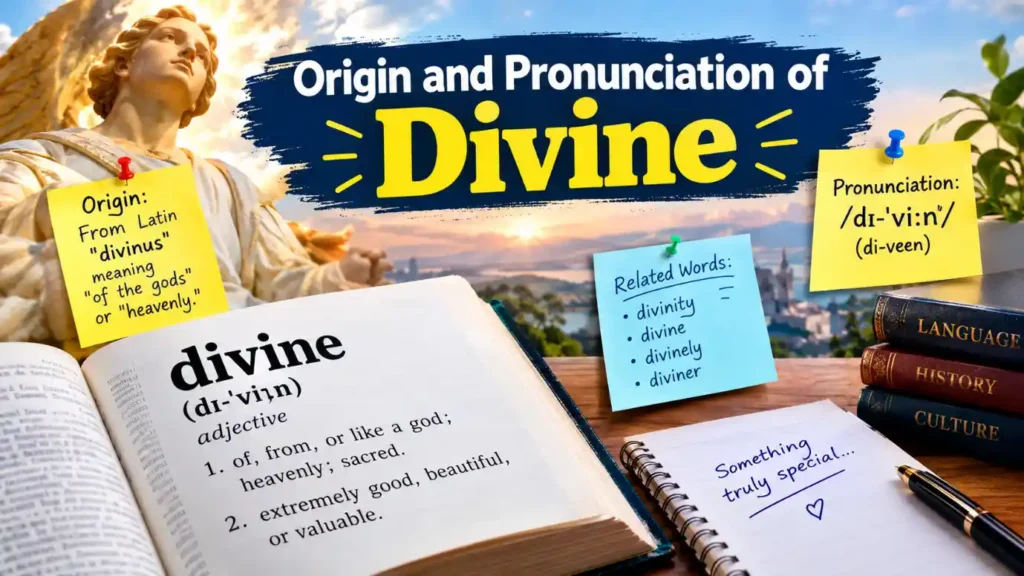
Divine is pronounced /dɪˈvaɪn/, approximately “dih-VINE” in American English.
The adjective comes from Middle English through Old French from Latin dīvīnus, meaning “divine” or associated with a god. It is related to Latin dīvus, meaning “godlike.” The word has been used in English since the Middle English period.
The verb has a related history, developing through Old French from Latin dīvināre, associated with predicting or discovering through divination.
Common Phrases With Divine
You may encounter divine in several established expressions:
Divine intervention refers to help or action believed to come from God.
It will refers to what someone believes God wants or intends.
Divine right historically refers to the belief that a monarch’s authority to rule comes directly from God. In modern general English, it can also be used figuratively for an assumed right to do something without permission.
Divine nature refers to qualities or characteristics associated with a deity or God.
Understanding the phrase around divine is important because the word can move from a specifically religious meaning to a figurative one.
Frequently Asked Questions About Divine
Spiritually, divine generally describes something connected with God, a deity, the sacred, or a higher spiritual reality. The exact interpretation depends on the religious or spiritual tradition in which the word is being used.
In Biblical contexts, divine generally describes something associated with God, God’s nature, God’s authority, or something understood as coming from God. The precise meaning depends on the particular passage and its theological context.
Usually, yes. When the divine describes something as godlike, sacred, wonderful, or exceptionally good, it generally expresses admiration or reverence. However, its meaning and tone depend on the context.
Depending on the context, synonyms include holy, sacred, heavenly, godly, spiritual, godlike, wonderful, excellent, and superb. No single synonym works perfectly in every sentence.
Divinely is the adverb form of divine. It can mean “in a divine manner” or, in informal usage, “extremely well” or “wonderfully.” For example, “She sings divinely” can mean that she sings exceptionally well.
Conclusion
The divine meaning is centered on the idea of something connected with, coming from, or resembling God or a god. In religious contexts, it can describe sacred qualities, divine guidance, or God’s will. In everyday English, divine can also be a strong compliment meaning exceptionally wonderful or beautiful.
The word can even function as a verb, meaning to infer something through intuition or guessing. Recognizing the context is therefore the key to understanding exactly what divine means in a particular sentence.

I am Olivia Brooks an American editor and content researcher dedicated to creating clear, accurate content. At writemora.com, I help readers to understand words, phrases, and modern language with confidence.