
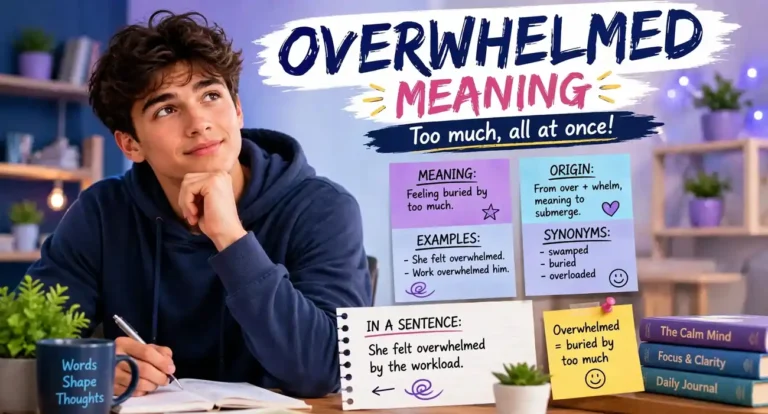
Overwhelmed describes the feeling you get when demands pile up faster than you can handle them. For example, your inbox fills, your deadlines stack, your emotions run high, and suddenly everything feels like too much at once. People use the word for work stress, grief, joy, and even good news that arrives all at once. For instance, a new parent can feel overwhelmed by love and exhaustion in the same hour; a student, by exams and money worries. Overall, the word captures a specific state: you still care, but your capacity feels full. Therefore, this article explains the meaning, the origin, and healthy ways to handle it.
What “Overwhelmed” Means
To feel overwhelmed means to feel buried under more than you can manage. First, the word works as an adjective for emotions and situations: work, sadness, kindness, or information. Meanwhile, the core image is water rising: just as a flood overwhelms a riverbank, stress can overwhelm a person. In addition, the feeling often brings physical signs: a racing heart, shallow breathing, trouble sleeping, and difficulty focusing. For example, people also use it for positive overload, like a bride overwhelmed by love or a fan meeting a hero. Finally, in both cases, the emotion is bigger than the person feels ready to hold. However, the word does not mean weak. Instead, it means the load exceeds current capacity, which changes with rest and support.
Origin & History
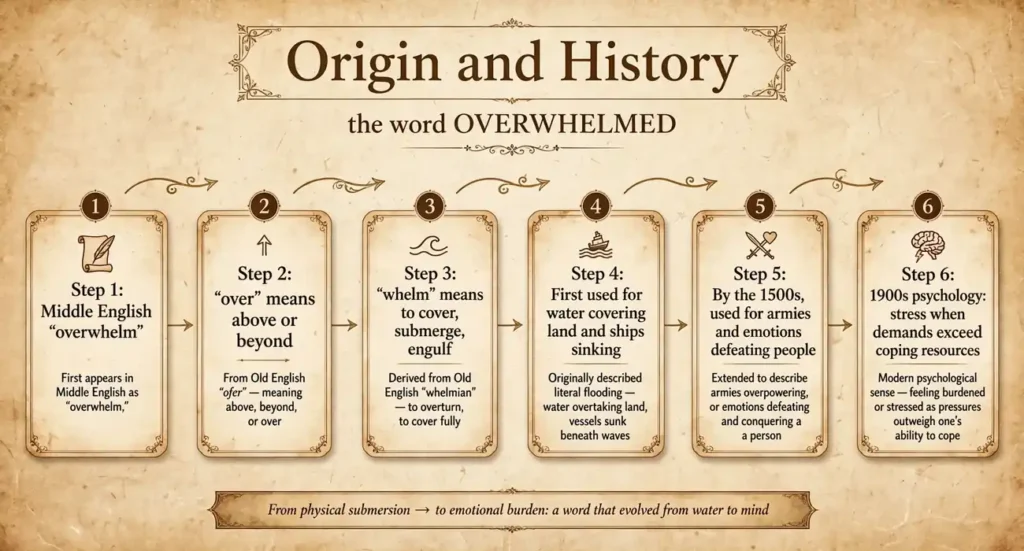
The word overwhelmed comes from the verb “overwhelm,” which dates back to Middle English. First, the “over” part means above or beyond, and “whelm” is an old word meaning to cover, submerge, or engulf. Meanwhile, people first used overwhelm for water covering land or ships sinking under waves. Later, by the 1500s, writers used it for armies and emotions defeating people. However, the image stayed the same: something larger covers something smaller. In addition, over time, the adjective “overwhelmed” became the common form for describing feelings. Similarly, psychology adopted it in the 1900s for stress responses, when demands exceed coping resources. Finally, today, the word appears in mental health discussions, workplace wellness programs, and everyday conversation. As a result, its history explains why it feels so physical: people still describe stress as drowning or flooding.
Different Contexts and Meanings
First, in mental health, it describes a stress response when demands exceed coping ability, and therapists help clients name it to break tasks into smaller steps. Next, at work, employees feel overwhelmed by workload and unclear priorities, and managers use the word to spot burnout risk. Meanwhile, in grief, people feel overwhelmed by loss, paperwork, and the pressure to “move on.” In addition, in parenting, new parents feel overwhelmed by sleepless nights and constant needs. Similarly, in positive contexts, gratitude, surprise parties, or good news can overwhelm. Finally, social media also creates overwhelm through endless feeds and comparison. Overall, each context shares the same pattern: too much input, not enough capacity, and a need to pause or ask for help.
Examples of “Overwhelmed” in a Sentence
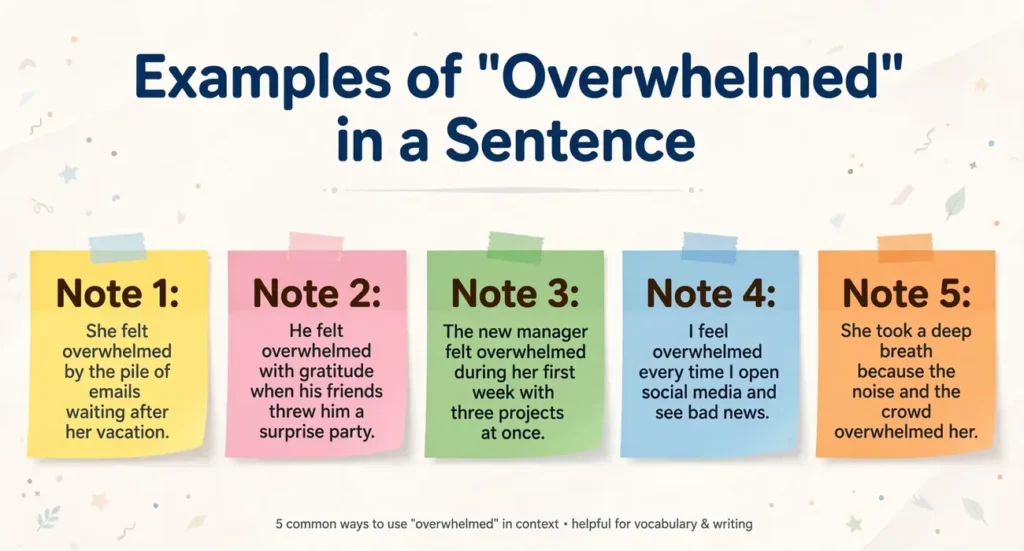
- “She felt overwhelmed by the pile of emails waiting after her vacation.”
- “He felt overwhelmed with gratitude when his friends threw him a surprise party.”
- “The new manager felt overwhelmed during her first week with three projects at once.”
- “I feel overwhelmed every time I open social media and see bad news.”
- “She took a deep breath because the noise and the crowd overwhelmed her.”
- “He felt overwhelmed by grief in the weeks after his father passed away.”
- “The students felt overwhelmed before finals, so the teacher extended the deadline.”
- “She felt overwhelmed by the kindness of strangers who donated to her fundraiser.”
- “He breaks big tasks into small steps when work starts to overwhelm him.”
- “They felt overwhelmed by the move, but friends helped them unpack in one day.”
How to Use “Overwhelmed” Correctly
Overwhelmed is an adjective, and you usually pair it with “by” or “with.” For example, you say “overwhelmed by work” or “overwhelmed with joy.” In addition, you can also use “feel overwhelmed” or “get overwhelmed.” Meanwhile, the verb form is “overwhelm,” as in “the news overwhelmed her.” Similarly, in formal writing, it fits reports on stress and mental health. In contrast, in casual talk, it fits any situation where life feels like too much. However, avoid it for small annoyances: a late bus frustrates you; it does not overwhelm you. Therefore, save it for real overload. Finally, with others, be gentle: “you seem overwhelmed, how can I help?” shows care, while “stop being overwhelmed” dismisses the feeling.
Common Mistakes to Avoid
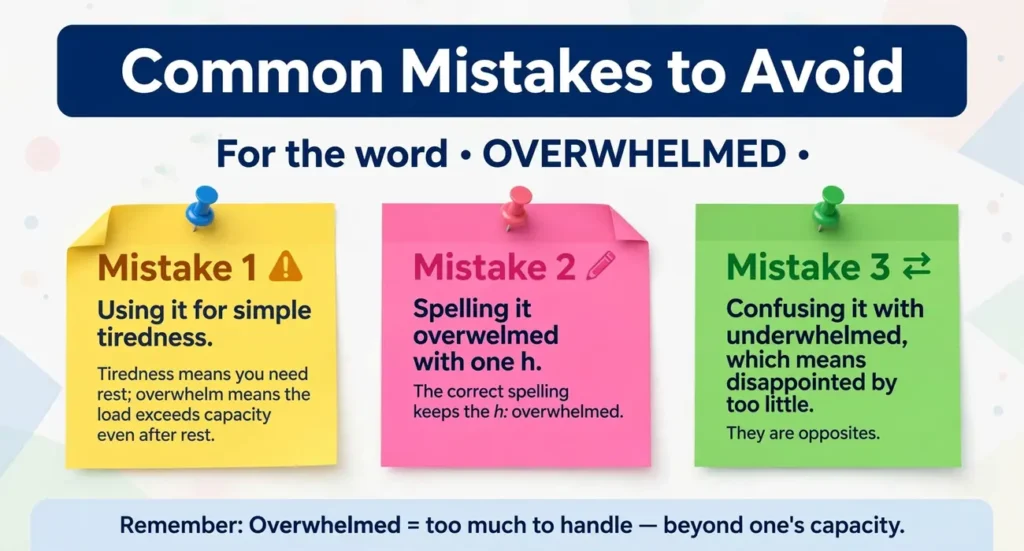
First, one mistake is using it for simple tiredness. However, tiredness means you need rest; overwhelm means the load exceeds capacity even after rest. In addition, another mistake is spelling it “overwelmed” with one h. Instead, the correct spelling keeps the h. Similarly, some confuse it with “underwhelmed,” which means disappointed by too little. In fact, they are opposites. Meanwhile, another error is using it only for negative feelings. For example, positive overwhelm is real, felt at weddings, births, and reunions. Also, some say “overwhelmed” when they mean “stressed.” However, stress is broader; overwhelm is the peak where coping feels impossible. Finally, some use it to excuse avoiding all responsibility. Instead, it is a signal to get support and prioritize, not to quit everything.
Similar Words and Phrases
| Word | Meaning | Difference |
|---|---|---|
| Stressed | Under mental or emotional pressure | Broader; overwhelmed means pressure exceeds capacity |
| Swamped | Buried under too much work | Casual; overwhelmed covers emotions too |
| Burned out | Exhausted from long-term stress | Long-term result; overwhelmed can be a single moment |
| Flooded | Hit by too much at once | Metaphor; overwhelmed is the standard term |
| Snowed under | Buried in tasks | Idiom for work; overwhelmed fits any area of life |
| Drained | Low on energy | Describes energy; overwhelmed describes load |
Opposite Words and Phrases
| Word | Meaning | Why It’s an Opposite |
|---|---|---|
| Calm | Peaceful and steady | Calm means no overload at all |
| In control | Managing everything well | Control means capacity exceeds demands |
| Relaxed | Free from tension | Relaxed is the rest state after overwhelm passes |
| Underwhelmed | Disappointed by too little | The direct opposite: too little instead of too much |
Pronunciation
You pronounce the word as oh-ver-WELMD. First, stress the third syllable, WELM, and let the final d blend softly. Meanwhile, the first part sounds like “oh-ver,” and the whole word flows as three syllables. For example, some speakers stress it as oh-ver-HWELMD with a breathy h, but the simpler version is standard in American English.
Quick Facts
| Fact | Detail |
|---|---|
| Part of speech | Adjective (also verb form: overwhelm) |
| Root image | Water covering land or a ship |
| Language origin | Middle English, “over” plus “whelm” (to submerge) |
| Common triggers | Workload, grief, parenting, information overload |
| Positive use | Overwhelmed by love, gratitude, or good news |
| Related term | Burnout, the long-term result of chronic overwhelm |
| Healthy response | Pause, prioritize, break tasks down, ask for help |
Key Takeaways
- Overwhelmed means demands exceed your current capacity to cope.
- The word comes from an old image of water covering land.
- It applies to negative stress and positive overload, like joy and gratitude.
- It differs from tiredness, stress, and burnout, though they connect.
- Naming the feeling is the first step to handling it.
Frequently Asked Questions
What does it mean to feel overwhelmed?
It means you face more demands, emotions, or information than you feel able to handle right now. The load feels bigger than your capacity.
Is feeling overwhelmed a mental health problem?
Not by itself. It is a normal stress response, but if it lasts weeks and affects sleep or work, talk to a doctor or counselor.
What is the difference between stressed and overwhelmed?
Stress means pressure. Overwhelmed means pressure passed the point where you feel able to cope.
Can you feel overwhelmed by good things?
Yes. Weddings, births, and big wins can overwhelm people with joy and gratitude.
How can I help someone who feels overwhelmed?
Listen without judgment, help them break tasks into small steps, and offer specific help like a meal.
What should I do when I feel overwhelmed?
Pause, breathe, write down everything on your mind, pick one small task, and ask for support.
Conclusion
Overwhelmed means too much, all at once, more than you can hold. The word carries water in its history, and the feeling still resembles a flood. But floods pass, and capacity returns with rest, support, and small steps. Name it, break it down, and ask for help. One small step, then the next, gets you through deep water. For a standard definition, see the dictionary entry for flood.

I am Olivia Brooks an American editor and content researcher dedicated to creating clear, accurate content. At writemora.com, I help readers to understand words, phrases, and modern language with confidence.