
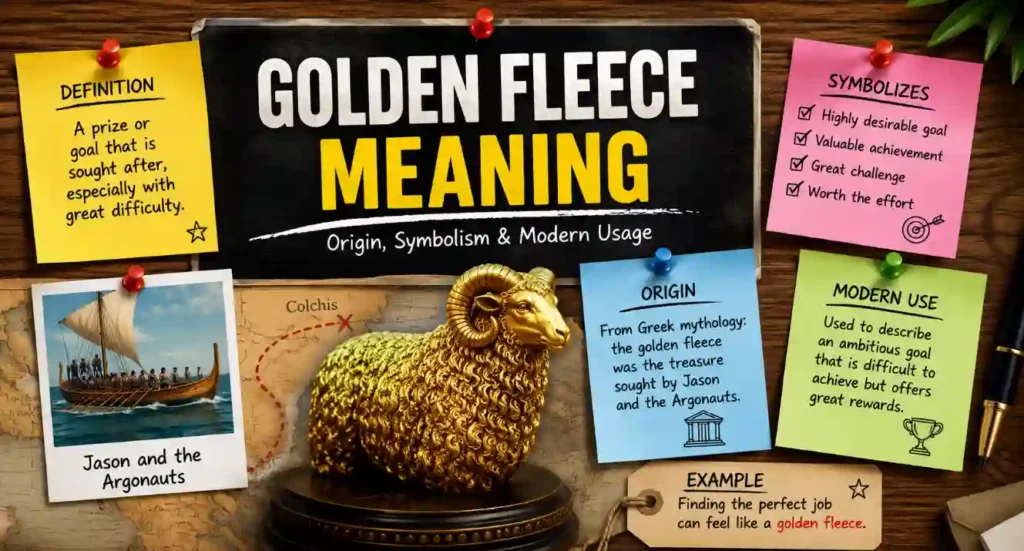
If you’ve heard someone call a project or prize a “golden fleece,” you’re hearing an echo of one of the oldest adventure stories in Western literature. The golden fleece meaning works on two levels: it’s a literal object from Greek mythology the wool of a magical ram and it’s a modern idiom for something incredibly valuable that’s also incredibly hard to get. Sometimes people also use it sarcastically, to describe a prize that turns out to be a scam or a waste of effort.
This guide covers both sides of the phrase. You’ll get the short version, the full myth behind it, the different ways people use it today, real example sentences, and answers to the questions people ask most often. By the end, you’ll know exactly when and when not to use “golden fleece” in your own writing or conversation.
What “Golden Fleece” Means

The simple version: A golden fleece is a symbol of something extremely valuable and extremely difficult to obtain. When someone says they’re “chasing the golden fleece,” they mean they’re pursuing a prize that requires real effort, risk, or struggle to reach.
The fuller picture: The phrase comes from Greek mythology, where the Golden Fleece was the wool of a ram with golden hair, literally a fleece made of gold. It hung in a sacred grove in the land of Colchis, where a dragon that never slept stood guard over it. The hero Jason gathered a crew of warriors called the Argonauts and sailed to retrieve it, facing a series of trials along the way.
Over time, the phrase moved out of mythology and into everyday language. Today, people mostly use it as a metaphor. It can describe:
- A genuinely worthy goal that takes courage and sacrifice to reach
- A prize that looks amazing on the surface but turns out to be fraudulent or empty (used ironically)
- Any object, opportunity, or achievement people treat as the ultimate prize in a story, business deal, or competition
Context does most of the work here. The tone of the sentence usually tells you if “golden fleece” is being used sincerely (a noble quest) or sarcastically (a con or a letdown).
Origin and History
The story of the Golden Fleece belongs to Greek mythology, and it ties closely to the tale of Jason and the Argonauts. According to the myth, a ram with a fleece of gold rescued two children, Phrixus and Helle, from danger, carrying them through the sky. Helle fell partway through the journey, but Phrixus completed it, arriving safely in Colchis, a kingdom on the eastern edge of the Black Sea. In gratitude, he sacrificed the ram and gave its fleece to the local king, who hung it in a sacred grove and set a dragon to guard it.
Years later, the king sent a prince named Jason on what everyone believed was an impossible mission: retrieve the Golden Fleece and bring it home to reclaim his rightful throne. He built a ship called the Argo, assembled a crew of legendary heroes (the Argonauts), and sailed through a series of dangerous trials before reaching Colchis. There, with help from the sorceress Medea, Jason completed a set of nearly impossible tasks the Colchian king had set for him and finally claimed the fleece.
Scholars still debate the exact age of the story and its earliest written form, since much of Greek mythology traveled by word of mouth for generations before poets and playwrights ever wrote it down. What’s clear is that the tale held a firm place in ancient Greek culture, and writers, artists, and filmmakers have retold, referenced, and reinterpreted it for thousands of years since from ancient epic poetry to modern films and novels.
Different Meanings and Contexts

The phrase shows up in a few distinct ways depending on where you encounter it.
Mythological meaning. In its original context, “the Golden Fleece” refers to the specific magical object from the Jason myth, a literal fleece with the power to symbolize authority, legitimacy, and divine favor.
Idiomatic meaning (sincere use). In everyday English, “golden fleece” or “chasing the golden fleece” describes a difficult but worthwhile pursuit, a big goal that demands real sacrifice, if that’s a career ambition, a scientific breakthrough, or a long-shot business venture.
Idiomatic meaning (ironic or critical use). Writers also use the phrase to describe something that looks like a prize but isn’t a scam, a wasteful government program, or an opportunity that promises riches and delivers disappointment. This usage leans on the idea of chasing something shiny that turns out to be worthless or corrupt.
Cultural and artistic references. “Golden Fleece” appears as a title or theme in books, films, video games, and even award names, usually invoking either the adventure-and-glory angle or the too-good-to-be-true angle, depending on the creator’s intent.
Business and political usage. In journalism and commentary, “golden fleece” sometimes appears as a play on words combining “fleece” (the wool) with the verb “to fleece,” meaning to cheat someone out of money. This double meaning makes it a popular choice for headlines about wasteful spending or financial schemes.
Examples of “Golden Fleece” in a Sentence
- “Landing that publishing deal felt like finally grabbing the golden fleece after years of rejection.”
- “The company promised investors a golden fleece, but the technology never actually worked.”
- “Winning the championship was their golden fleece, the one prize that had eluded the team for a decade.”
- “Critics called the tax break a golden fleece for large corporations, dressed up as help for small businesses.”
- “She spent her twenties chasing the golden fleece of a tenured professorship.”
- “The startup’s founder described the elusive government contract as their golden fleece.”
- “Every generation of explorers has its own golden fleece, some prize just out of reach.”
- “The ‘miracle diet’ turned out to be a golden fleece: expensive, exhausting, and ultimately empty.”
- “Getting funding for the expedition was itself a golden fleece, before the journey even began.”
- “He treated the promotion like the golden fleece, worth any personal sacrifice to obtain.”
How to Use “Golden Fleece” Correctly

Grammatically, “golden fleece” functions as a noun phrase. Writers most often pair it with a definite article (“the golden fleece”) when referring to the mythological object, and drop the article when using it more loosely as a metaphor (“a golden fleece,” “their golden fleece”).
A few usage notes:
- Capitalization: When referring directly to the myth, many writers capitalize it as “the Golden Fleece,” treating it like a proper noun (similar to “the Holy Grail”). In general metaphorical use, lowercase is common and acceptable.
- Pairing verbs: The idiom pairs naturally with verbs like chase, seek, pursue, find, and claim echoing the idea of a quest.
- Tone matters: Because the phrase can be sincere or sarcastic, make sure the surrounding sentence makes your intent clear. “He finally found his golden fleece” reads as admiring; “they sold it as a golden fleece” reads as skeptical.
- Avoid overuse: Like most vivid idioms, it loses its punch if you use it more than once or twice in the same piece of writing.
Common Mistakes to Avoid
- Confusing it with “the Holy Grail.” Both idioms describe a highly sought-after prize, but the Golden Fleece comes from Greek mythology and the Holy Grail from medieval Christian legend. Casual speakers often swap them, though purists will note the difference.
- Missing the ironic use. Some readers only know the sincere “worthy quest” meaning and get confused when a headline uses “golden fleece” to mean a scam. Context clues (words like scheme, waste, promised) usually signal the ironic version.
- Overcapitalizing in casual metaphor. Writing “the Golden Fleece” when you mean “a hard-won personal goal” (not the myth itself) can look like you’re referencing the specific legend rather than using the phrase generically.
- Using it for something easy to get. The idiom implies difficulty and rarity. Calling an everyday purchase or minor achievement a “golden fleece” undercuts the phrase’s meaning.
Similar Words and Phrases
| Phrase | Meaning | How It Differs |
| Holy Grail | The ultimate, almost unattainable goal | Rooted in medieval Christian legend rather than Greek myth |
| Wild goose chase | A pointless, frustrating pursuit | Implies the pursuit is futile from the start; golden fleece implies a real (if difficult) prize |
| Pot of gold | A rich reward, often linked to luck | Tied to folklore (rainbows/leprechauns), lighter and more whimsical in tone |
| Fool’s gold | Something that looks valuable but isn’t | Focuses entirely on the deception, without the “worthy quest” undertone |
| Silver lining | A small benefit found within a hard situation | Not about a prize at all about finding comfort in difficulty |
Opposite Words and Phrases
| Phrase | Meaning | Why It’s an Opposite |
| Booby prize | A joke reward given for last place or failure | Represents a worthless “win,” the reverse of a hard-earned treasure |
| Low-hanging fruit | An easy goal requiring little effort | Opposite of the difficulty and rarity implied by a golden fleece |
| White elephant | A burdensome possession with no real value | A “prize” that costs more than it’s worth, rather than something genuinely desirable |
| Consolation prize | A minor reward given after failing to win the main goal | Explicitly not the main prize being pursued |
Pronunciation
“Golden fleece” is pronounced GOHL-dun FLEES. Both words carry roughly equal stress, and “fleece” rhymes with words like peace and release.
Quick Facts
| Fact | Detail |
| Origin | Greek mythology, the story of Jason and the Argonauts |
| Literal meaning | The wool of a mythical ram with golden hair |
| Modern meaning | A highly prized but hard-to-obtain goal (sincere use) or a deceptive “prize” (ironic use) |
| Part of speech | Noun phrase |
| Common pairing | “Chase,” “seek,” “find,” or “claim” the golden fleece |
| Related idiom | The Holy Grail |
Frequently Asked Questions
What does “golden fleece” mean in simple terms?
It means something extremely valuable and hard to get a prize worth chasing, or sometimes, sarcastically, a prize that turns out to be fake or worthless.
Where does the phrase “golden fleece” come from?
It comes from Greek mythology, specifically the story of Jason and the Argonauts, who sailed to retrieve a fleece made of gold from a grove that a dragon guarded.
Is the Golden Fleece the same as the Holy Grail?
They’re similar in function and both represent an ultimate, hard-to-reach goal but they come from different traditions. The Golden Fleece comes from Greek myth; the Holy Grail comes from medieval Christian legend.
Why do people call it a “fleece” if it’s made of gold?
In the myth, the fleece belonged to a real ram, an animal with golden hair, so the fleece itself counted as gold, unlike an ordinary wool fleece.
What does “to fleece someone” mean, and is it related?
“To fleece someone” means to cheat or overcharge them, and it comes from the older meaning of shearing wool. It’s a coincidental wordplay with “golden fleece” that writers often use intentionally in headlines about scams or waste.
Who were the Argonauts?
The Argonauts were the crew of heroes who sailed with Jason on his ship, the Argo, to help him retrieve the Golden Fleece.
Can people use “golden fleece” in a negative or sarcastic way?
Yes. Writers often use it ironically to describe something marketed as a great prize that turns out to be a scam, a waste of money, or a disappointment.
Do people still commonly use “golden fleece” today?
It’s not an everyday phrase, but it appears regularly in journalism, literature, and commentary as a vivid way to describe an elusive prize, genuine or fake.
Key Takeaways
- The golden fleece meaning has two layers: the literal mythological object and the modern idiom.
- In Greek mythology, Jason and the Argonauts retrieved the Golden Fleece, the wool of a magical ram after a dangerous quest.
- As an idiom, it describes something highly valuable and difficult to obtain. People use it sincerely for worthy goals and ironically for scams or false promises.
- Context and tone tell you if the phrase carries admiration or criticism.
- It’s closely related to but distinct from “the Holy Grail.“
Conclusion
The phrase “golden fleece” has survived thousands of years because it captures something universal: the pull of a prize that’s genuinely hard to earn. If you’re reading about Jason’s mythical voyage or a modern headline calling out a shady investment scheme, the core idea stays the same, something gleaming, valuable, and just out of reach.
That staying power comes from how flexible the phrase is. A myth gave it shape, but writers keep finding new places to put it: a scientist’s decades-long search for a cure, a company’s pitch to investors, a sports team’s chase for a title it’s never won. The image works because almost everyone understands what it feels like to want something enough to risk a hard journey for it and almost everyone has also been burned by a prize that promised more than it delivered.
Next time you hear the phrase, listen for the tone. It’ll tell you if the writer is celebrating a hard-won victory or warning you about a trap wrapped in gold. And next time you reach for a vivid way to describe your own long-shot goal, you’ll know exactly where the phrase comes from and how to use it with precision instead of guesswork.

I am Olivia Brooks an American editor and content researcher dedicated to creating clear, accurate content. At writemora.com, I help readers to understand words, phrases, and modern language with confidence.