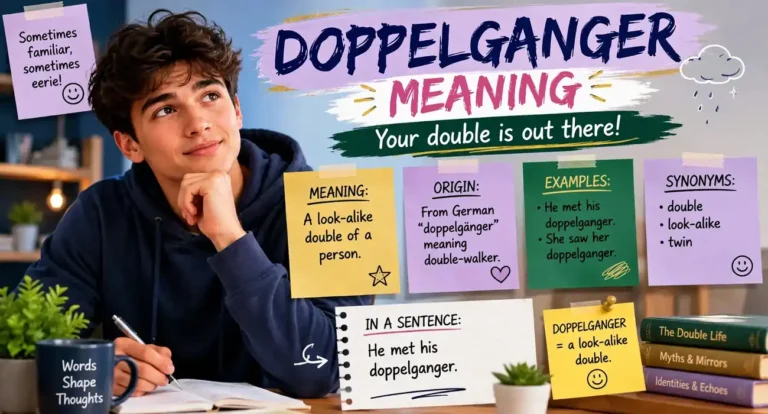
Doppelganger describes a mysterious double of a living person, someone who looks exactly like you but is not you. The word comes from German folklore, where seeing your own double brought bad luck or death. Today, most people use it lightly: a stranger who shares your face, hairstyle, or whole look earns the title.
Celebrities get doppelganger comparisons all the time. The word still carries a hint of the eerie, though. A true doppelganger feels uncanny, like a glitch in real life. This article explains the meaning, the history, and the modern use. In short, this guide explains the doppelganger meaning clearly, from its folklore roots to its modern use.
What It Means
The doppelganger meaning centers on a person who looks almost identical to another, even though the two share no family connection. In addition, the word can mean a ghostly double, an apparition that mirrors a living person. Folklore treats the double as a warning. Everyday speech, though, usually means just a striking lookalike. For example, someone might say, “I saw my doppelganger at the mall today.” The word works as a noun for yourself or someone else. Writers love doppelgangers because a character meeting a double creates instant tension. Similarly, psychologists use the concept to discuss identity and the unsettling feeling of seeing yourself from outside. Whether literal or joking, the word always points to an uncanny resemblance.
Origin & History
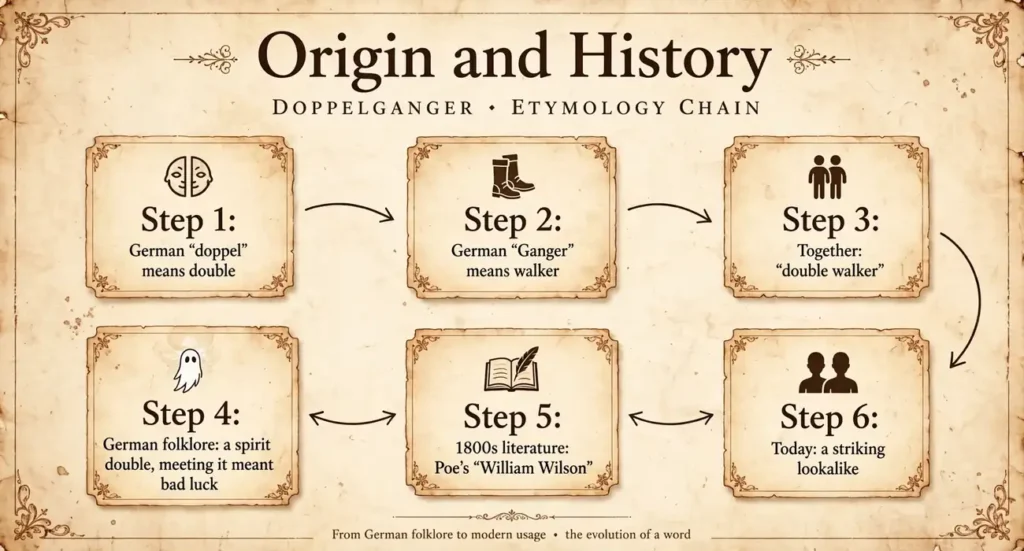
The word comes from German: “Doppel” means double, and “Ganger” means walker or goer, so it literally means “double walker.” In German folklore, every person was said to have a spirit double, and meeting your double spelled trouble. In some stories, the double appeared before a death or caused mischief while the real person slept. As a result, the concept spread through 1800s European literature, where writers like Hoffmann and Poe used doubles to explore madness and guilt. For example, Poe’s “William Wilson” features a narrator tormented by a man with his name, face, and voice. In the 1900s, movies and television picked up the theme, using evil twins and mirror selves to scare audiences. Today, casual use has lost much of its dark edge, but horror stories keep the old meaning alive.
Different Contexts and Meanings
Folklore and horror portray the doppelganger as a supernatural double, often evil or dangerous, that mimics a person, wears their clothes, and sometimes tries to replace them. Psychology calls this the “doppelganger effect,” or autoscopic phenomena: a person feels they see their own body from outside. This can happen during illness, exhaustion, or certain neurological conditions, and doctors take it seriously. Pop culture usually means just a lookalike, as fans post side-by-side photos of celebrities and strangers who share a face. Comedy uses the double for confusion when a character gets blamed for things the lookalike did. Everyday talk gives the title of office doppelganger to a coworker with the same haircut and glasses. Therefore, each context shares the same core: two people, one face, and a reaction ranging from laughter to fear.
Examples
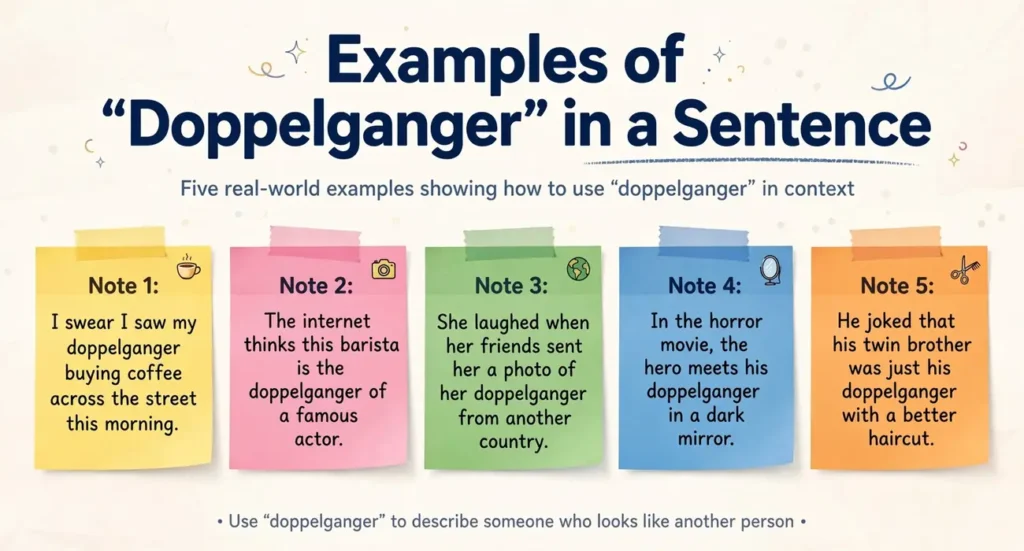
- “I swear I saw my doppelganger buying coffee across the street this morning.”
- “The internet thinks this barista is the doppelganger of a famous actor.”
- “She laughed when her friends sent her a photo of her doppelganger from another country.”
- “In the horror movie, the hero meets his doppelganger in a dark mirror.”
- “He joked that his twin brother was just his doppelganger with a better haircut.”
- “The museum guide looked so much like my teacher that I called him her doppelganger.”
- “She posted a side-by-side photo and asked followers about the resemblance.”
- “Old legends warned that meeting your doppelganger meant trouble was coming.”
- “The novel uses a doppelganger to show the hero’s hidden dark side.”
- “He found his doppelganger on a travel vlog and could not believe the similarity.”
How to Use It (Grammar and Context)
Doppelganger is a noun, and its plural is “doppelgangers.” Use it with a possessive or an article, as in “my doppelganger,” “her doppelganger,” or “a doppelganger.” In addition, it works as a modifier, for example in “doppelganger photo” or “doppelganger effect.” It fits casual conversation, creative writing, and discussions about movies and folklore. In formal writing about German literature or psychology, explain it on first use. The pronunciation trips people up, so say it slowly at first. Reserve the word for a strong facial resemblance, not ordinary similarities like the same shirt. As a joke, keep the tone light; in a horror story, lean into the eerie history.
Common Mistakes
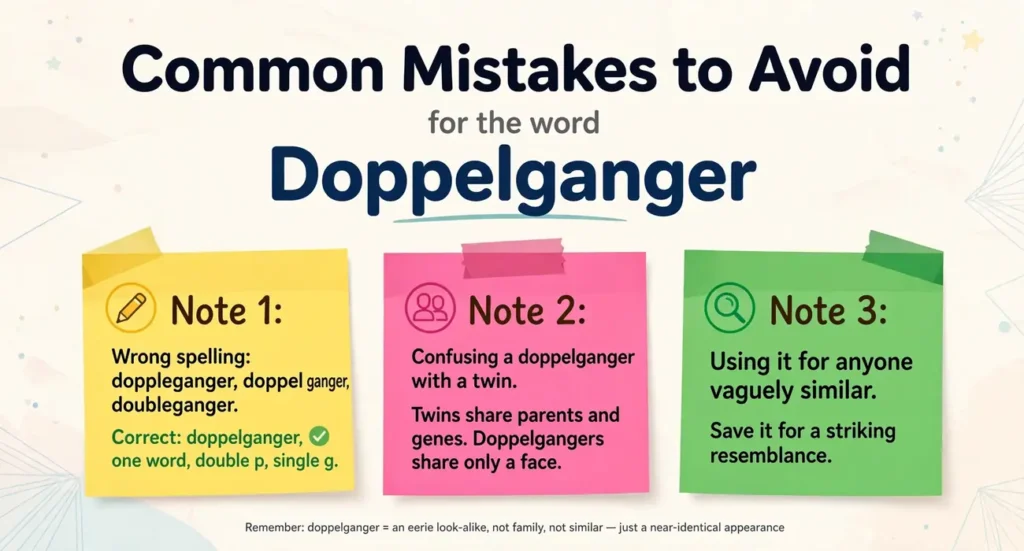
Spelling it wrong is the most common mistake: “doppleganger,” “doppel ganger,” and “doubleganger” are all incorrect. The correct spelling is doppelganger, one word, with a double p and a single g in the middle. Another mistake is confusing a doppelganger with a twin: twins share parents and genes, while doppelgangers share only a face. Similarly, using the word for anyone vaguely similar weakens it, so save it for a striking resemblance. Do not pronounce it as “double-ganger,” since its German roots give it a different sound. Finally, do not mix it up with an “alter ego,” which is a second personality, not a second body. Explain the word on first use so readers who have never seen it can follow.
Similar Words
| Word | Meaning | Difference from Doppelganger |
|---|---|---|
| Lookalike | Someone who resembles another person | Casual and broad; doppelganger sounds stronger and stranger |
| Twin | Sibling born at the same time | Twins share family; doppelgangers share only a face |
| Double | Someone who stands in for another | Often a job role; doppelganger implies mystery |
| Alter ego | Second self or personality | Mental or social; doppelganger is physical |
| Clone | Genetic copy of a person | Scientific; doppelganger is folkloric |
Opposite Words
| Word | Meaning | Why It’s an Opposite |
|---|---|---|
| Original | First or real person | A doppelganger copies the original |
| Unique face | Face like no other | A doppelganger means the face repeats |
| Stranger | Someone with no connection | A doppelganger feels connected through looks |
| Individual | Distinct person | A doppelganger blurs individuality |
Pronunciation
Doppelganger is pronounced DOP-uhl-gang-er, with the stress on the first syllable, DOP, and the rest flowing quickly. The “gang” sounds like the English word “gang,” and the final “er” is soft. In addition, some speakers say DOP-uhl-geng-er, with a softer middle sound.
Quick Facts
| Fact | Detail |
|---|---|
| Language origin | German, from “doppel” (double) and “Ganger” (walker) |
| Literal meaning | Double walker |
| Folklore belief | Seeing your double warned of bad luck or death |
| Famous story | Edgar Allan Poe’s “William Wilson” |
| Modern use | Lookalike photos and celebrity comparisons |
| Psychology term | Autoscopic phenomena for seeing one’s own double |
| Plural form | Doppelgangers |
Key Takeaways
- A doppelganger is a double or lookalike of a living person.
- The word comes from German folklore, where meeting your double meant danger.
- Today, people use it mostly for striking lookalikes and celebrity comparisons.
- Twins share family; doppelgangers share only a face.
- Spell it as one word: doppelganger.
FAQs
What does doppelganger mean in simple terms?
A person who looks exactly like another person but has no family connection; in folklore, it can also mean a ghostly double.
Is seeing your doppelganger bad luck?
Folklore says yes, but modern culture treats it as a fun coincidence.
What is the difference between a doppelganger and a twin?
Twins share parents and genes; doppelgangers share only a strong facial resemblance, with no family link.
Where does the word come from?
German: “Doppel” means double and “Ganger” means walker, so it literally means “double walker.”
Can a doppelganger be a real scientific thing?
People can look strikingly similar by chance; the supernatural part belongs to folklore, not science.
Why do people love doppelganger photos online?
The uncanny resemblance feels surprising and fun, and side-by-side photos let people share the shock.
Conclusion
Doppelganger meaning spans folklore, psychology, and pop culture, but the core idea stays the same: one face, two people, and a reaction. Old stories treated the double as a warning; modern culture treats it as a joke or a horror trope.
Whether you spot your lookalike in a coffee shop or watch a movie about an evil twin, the word captures something strange and human. We all want to feel unique, so meeting someone with our face shakes that feeling.

I am Olivia Brooks an American editor and content researcher dedicated to creating clear, accurate content. At writemora.com, I help readers to understand words, phrases, and modern language with confidence.